Jeg
In "Jeg er nødt til at undskylde", Jeg means “I” and is the speaker’s subject. The same form is used when saying what you yourself need, can, or feel. In this dialogue it appears at the start of the sentence.
er
In "Jeg er nødt til", er is the form of være used with Jeg and means “am”. Here it links the speaker to the expression of necessity; the need-to meaning comes from "nødt til". A useful pattern is er followed by a description or state.
nødt til
In "Jeg er nødt til at undskylde", nødt til together means “need to” or “have to”. nødt expresses necessity, while til connects that necessity to the action that follows; at then introduces the action. Reuse the pattern er nødt til at + verb when explaining that something is necessary.
at
In "at undskylde", at marks the verb undskylde as an infinitive, meaning “to apologize”. It follows expressions such as "er nødt til" before the action. A common reuse pattern is at + verb.
undskylde
In "at undskylde", undskylde means “to apologize” for what happened. The infinitive form follows at here. A useful pattern is undskylde for + what the apology concerns.
for
In "undskylde for det, der skete", for introduces what the apology is about. It means “for” in this context and connects the apology to the event. Reuse undskylde for + an event, action, or problem when apologizing.
det
In "det, der skete", det points to the thing or situation that happened. In "det værktøj" it is part of the phrase meaning “the tool”, and in "med det" it refers back to the tool. The form det can therefore point to a thing or introduce a noun phrase, depending on its position.
der
In "det, der skete", der links det to the event that happened. In "Hvad skete der med det?", it is part of the natural Danish question pattern for asking what happened. A useful pattern is det, der + verb when referring to something that happened.
skete
In "det, der skete" and "Hvad skete der med det?", skete means “happened”. It is the past form of ske. Reuse the question pattern "Hvad skete der med" when asking what happened to something.
med
In "skete med det" and "med det værktøj", med means “with” and shows the thing involved. With ske, the pattern skete med noget asks what happened to something. It can also introduce an accompanying object, as in "med det værktøj".
værktøj
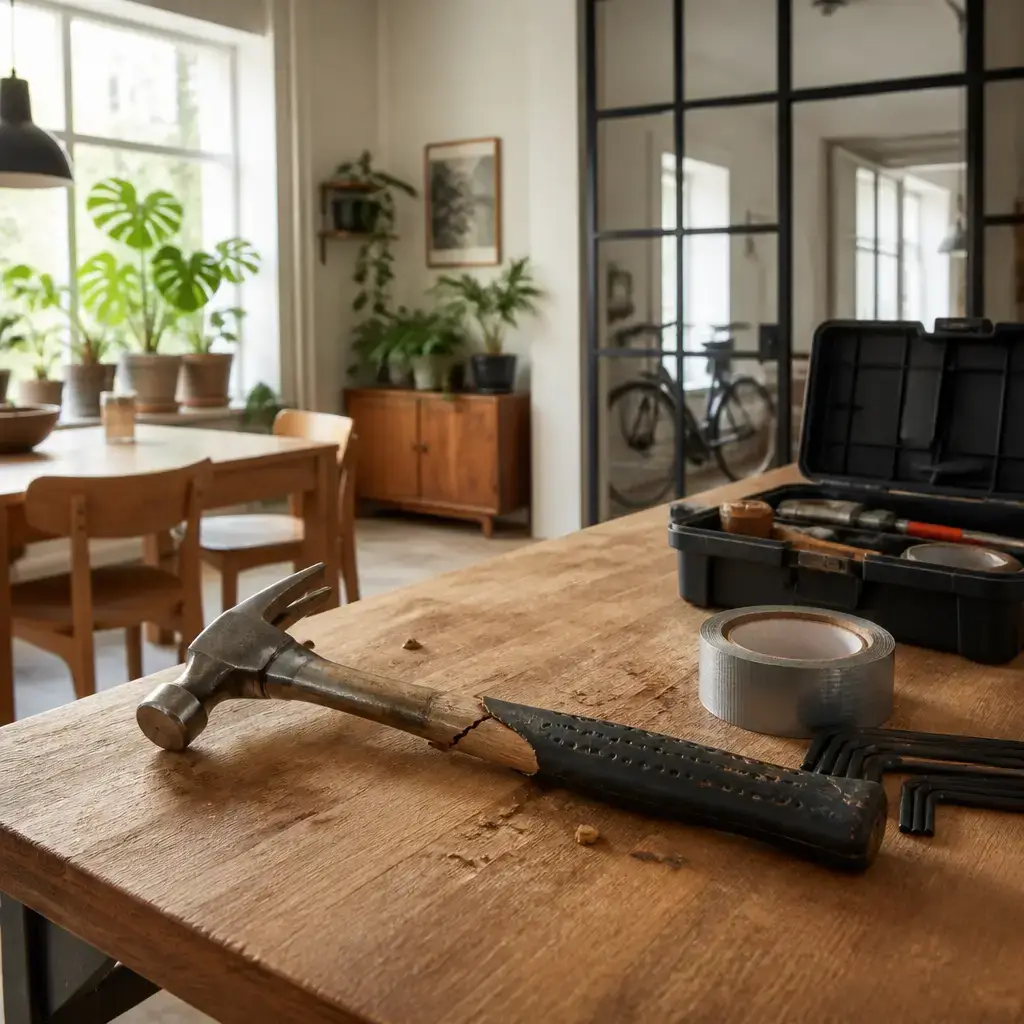
In "det værktøj", værktøj means “tool”, a physical object used for a task. The word is used here to identify the borrowed object involved in the problem. A practical pattern is to use værktøj when talking about equipment used to do work.
lånte
In "det værktøj, jeg lånte", lånte means “borrowed” and refers to the tool the speaker had borrowed. It is the past form of låne. The pattern "jeg lånte" can be reused to say that you borrowed a particular object.
Hvad
In "Hvad skete der med det?", Hvad means “what” and asks for information about the event. It appears at the beginning of this question. A useful pattern is Hvad + verb when asking what happened or what someone did.
Håndtaget
In "Håndtaget revnede", Håndtaget means “the handle”, specifically the part of the tool that cracked. It is the definite form of håndtag. Use it when identifying the handle of an object or tool.
revnede
In "Håndtaget revnede", revnede means “cracked”, describing what happened to the handle. It is the past form of revne. This form is useful when reporting that an object developed a crack.
mens
In "mens jeg brugte det", mens means “while” and connects two actions happening during the same period. It introduces the action that was in progress when the handle cracked. Reuse the pattern mens + subject + verb to describe simultaneous actions.
brugte
In "jeg brugte det", brugte means “used” or “was using” the tool. It is the past form of bruge. The reusable pattern is bruge or its needed form + an object, as in "brugte det".
Lad
In "Lad mig se", Lad means “let” and starts a request for permission to do something. It is the imperative form of lade. The pattern Lad mig + verb is useful when asking to do something yourself.
mig
In "Lad mig se", mig means “me” and identifies the person who will see the damage. It is the object form used after Lad. Reuse the pattern Lad mig + verb when asking to perform an action yourself.
se
In "Lad mig se", se means “see” and names the action the speaker asks to perform. It follows mig in the request pattern. A useful pattern is se + an object or situation, such as seeing how serious something is.
hvor
In "hvor stor skaden er", hvor means “how” and introduces a question about degree, not location. It works with stor to ask about the extent of the damage. Reuse the pattern hvor + adjective when asking how large or serious something is.
stor
In "hvor stor skaden er", stor describes the extent or severity of the damage. Together with hvor, it asks how serious the damage is. The pattern hvor stor + noun is useful when assessing the size or extent of something.
skaden
In "hvor stor skaden er", skaden means “the damage” being assessed. It is the definite form of skade. Use it when referring to a particular injury, defect, or other damage already relevant in the situation.
kan
In "Jeg kan erstatte det", kan means “can” and expresses what the speaker is able or willing to do. It is followed by the infinitive erstatte without at. A useful pattern is kan + verb when offering or describing an available action.
erstatte
In "kan erstatte det", erstatte means “replace” the damaged tool. It is the infinitive after kan and takes det as the thing being replaced. Reuse erstatte + an object when offering a new item instead of a damaged one.
eller
In "erstatte det eller hjælpe med at reparere det", eller means “or” and joins two possible solutions. It presents replacement and repair as alternatives. A useful pattern is option A eller option B when offering a choice.
hjælpe
In "kan ... hjælpe med at reparere det", hjælpe means “help” with the repair. It is the infinitive after kan and is followed here by med at + action. Reuse hjælpe med at + verb when offering assistance with an activity.
reparere
In "at reparere det", reparere means “repair” the damaged tool. It is the infinitive introduced by at after hjælpe med. The pattern hjælpe med at reparere + an object is useful when offering help fixing something.
Vi
In "Vi bør undersøge", Vi means “we” and includes the speaker and the other person involved. It is the subject of a suggestion about what they should do together. The pattern Vi kan or Vi bør + verb is useful for joint plans and decisions.
bør
In "Vi bør undersøge", bør means “should” and presents checking the repair as the appropriate next step. It is followed directly by the infinitive undersøge. Reuse bør + verb when recommending an action.
undersøge
In "bør undersøge, om en reparation holder", undersøge means “check” or “investigate” whether the repair will work. It is the infinitive after bør and introduces the question with om. The pattern undersøge, om + clause is useful when checking a possibility or result.
om
In "om en reparation holder", om means “whether” and introduces the point being checked. It connects undersøge to the clause about the repair. Reuse undersøge, om + a complete clause when verifying whether something is true or will work.
en
In "en reparation", en means “a” and introduces one unspecified repair. It appears directly before the noun reparation. The pattern en + noun is used when mentioning an unspecified item or instance.
reparation
In "en reparation holder", reparation means “repair”, referring to the work done to fix the tool. It is the noun after en and the subject of holder. Use it when discussing a repair as a solution or completed piece of work.
holder
In "om en reparation holder", holder means “holds” or “stays intact”, asking whether the repair will remain effective. It is the present form of holde. A useful pattern is noget holder when judging whether a fix or object will last.
ked af
In "Jeg er ked af, at jeg har givet dig ekstra arbejde", ked af together expresses being sorry or regretful. ked describes the speaker’s unhappy feeling, and af connects that feeling to what follows. Reuse the complete pattern Jeg er ked af, at + clause when apologizing or expressing regret.
har
In "jeg har givet dig ekstra arbejde", har is the form of have used to build the completed-action expression “have caused”. It does not express possession here. A useful pattern is har + a past participle when referring to an action with a present consequence.
givet
In "har givet dig ekstra arbejde", givet means “given” in the sense of “caused” extra work for someone. It is the past participle of give and follows har. The pattern give someone + a result or task is useful when describing an effect on another person.
dig
In "givet dig ekstra arbejde", dig means “you” or “to you”, the person who received the extra work. It is the person affected by the action. Reuse the pattern give dig + something when saying that you give or cause something for another person.
ekstra
In "ekstra arbejde", ekstra means “extra” or additional. It describes work beyond what was already expected. The pattern ekstra + noun is useful when explaining an added task, cost, or responsibility.
arbejde
In "ekstra arbejde", arbejde means “work”, referring to tasks caused by the damaged tool. It is the noun described by ekstra. Use it when talking about work someone has to do, including work created by a problem.
Sig
In "Sig det til mig med det samme", Sig means “tell” or “say” and gives a direct instruction to communicate something. It is the imperative form of sige. The pattern Sig det til mig is useful when asking someone to tell you information.
med det samme
In "Sig det til mig med det samme", med det samme is a fixed expression meaning “right away” or “immediately”. med, det, and samme combine to form the complete time expression, so its meaning should be learned as a whole. It can be placed with an instruction to say that the action should happen immediately.
næste
In "næste gang", næste means “next” and points to the following occasion. It modifies gang to refer to a future repetition of the situation. Reuse the exact pattern næste gang when referring to what should happen on the next occasion.
gang
In "næste gang", gang means “time” in the sense of an occasion or instance. Together with næste, it means “next time”. Use næste gang when giving advice about a future occasion.
få styr på
In "Vi kan få styr på det", få styr på together means “sort out” or “get under control”. få contributes the idea of getting, styr refers to control or order, and på links that control to the thing concerned. Reuse the pattern få styr på + an issue or object when saying that a problem can be managed or resolved.