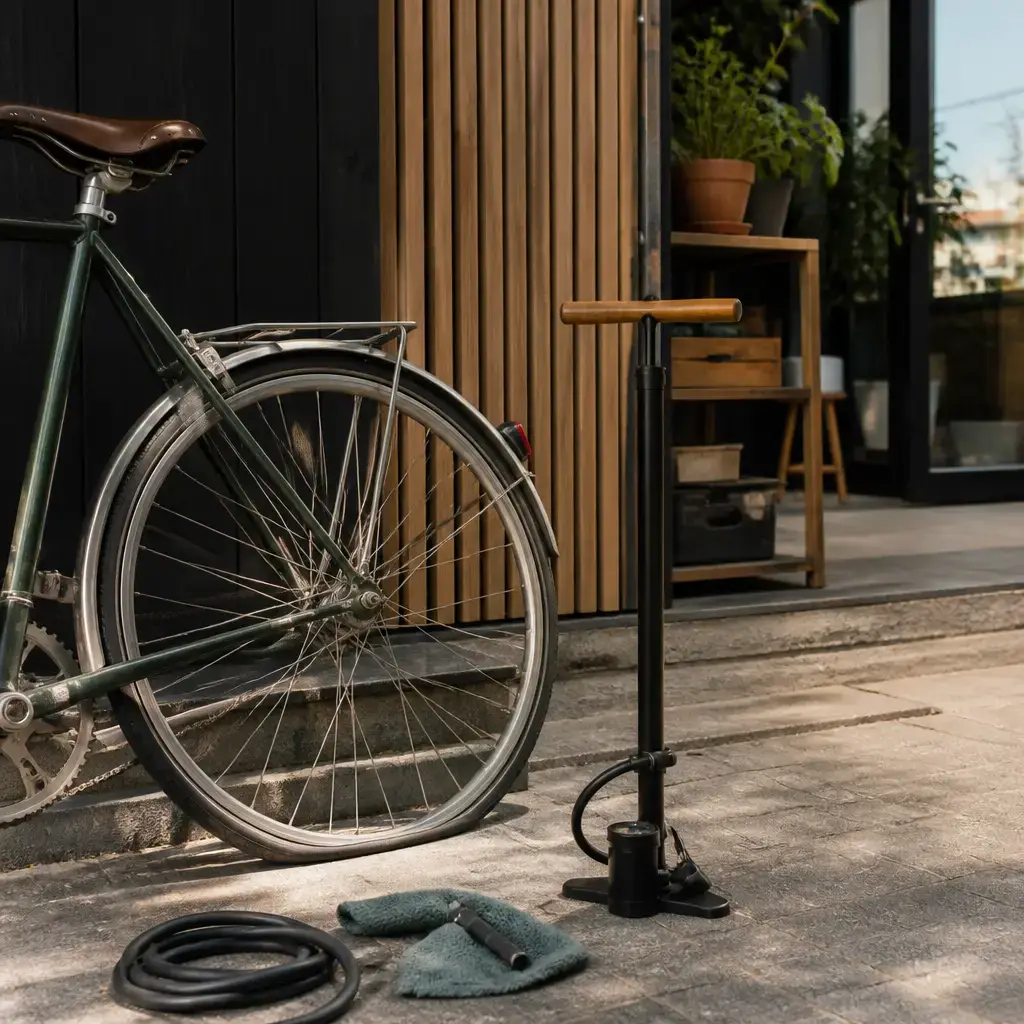
Mit
Mit means “my” in Mit bagdæk, referring to the speaker’s back tire. It is the possessive form used with the neuter noun bagdæk.
bagdæk
Bagdæk means “back tire” here, the tire at the rear of a bicycle. It is a compound noun used after Mit in Mit bagdæk.
er
Er means “is” here and links Mit bagdæk with its condition, næsten fladt. It is used to describe the tire’s current state.
næsten
Næsten means “almost” and shows that the tire is close to being flat but not necessarily completely flat. It comes before the description næsten fladt.
fladt
Fladt means “flat” in this dialogue, describing the condition of the back tire. Its form agrees with the neuter noun bagdæk in Mit bagdæk er næsten fladt.
Jeg
Jeg means “I” and is the subject of Jeg har en pumpe. It identifies the person who owns or has the pump.
har
Har means “have” in Jeg har en pumpe, stating that the speaker has a pump available. It commonly comes before the thing someone has, such as en pumpe.
en
En means “a” in en pumpe and introduces one non-specific pump. It is used before the common-gender noun pumpe.
pumpe
Pumpe means “pump,” the object that can be borrowed to add air to the tire. In en pumpe, it follows the indefinite article en.
du
Du means “you” and refers to the person who can borrow the pump. In du kan låne, it is the subject of the subordinate clause.
kan
Kan means “can” and expresses ability or permission in du kan låne. It is followed by the infinitive låne.
låne
Låne means “borrow” in du kan låne, referring to taking the pump for temporary use. After kan, the reusable pattern is kan låne plus the object being borrowed.
Skal
Skal means “should” in Skal jeg først tjekke...? and forms a question about what the speaker ought to do. It comes before the subject jeg and the infinitive tjekke.
først
Først means “first” and marks the first step in the procedure. Here it comes before tjekke in Skal jeg først tjekke...?
tjekke
Tjekke means “check” in først tjekke, referring to checking the tire for a leak. It is an infinitive after Skal jeg.
om
Om means “whether” in om der er en lækage and introduces the question being checked. The pattern tjekke, om... is used when checking whether something is true.
der
Der is the placeholder subject in der er en lækage, an expression meaning that a leak exists. It is used with er before the thing that exists.
lækage
Lækage means “leak,” specifically a possible leak in the tire or inner tube in this dialogue. It appears after en in en lækage.
Se
Se means “look” here and gives a direct instruction to inspect the tire. It is used at the beginning of the command Se langs dæksiden.
langs
Langs means “along” and indicates following the length or edge of something. In langs dæksiden, it is followed by the area being inspected.
dæksiden
Dæksiden means “the sidewall,” the side part of the tire. The definite form is used because the speaker means the relevant sidewall of the tire being checked.
før
Før means “before” and introduces the action that should happen earlier. In før du fylder luft i, it is followed by a clause with its own subject and verb.
fylder
Fylder means “fill” or “add” here, as in adding air to the tire. The expression fylder luft i uses luft as what is added and i to indicate where it goes.
luft
Luft means “air,” the substance being added to the tire. It is the object in fylder luft i.
i
I means “in” here and marks the destination in fylder luft i, meaning to fill air into it. Its meaning comes from this placement expression together with fylder luft.
vise
Vise means “show” in vise mig, hvordan jeg sætter den på. The pattern vise mig, hvordan... is used to ask someone to demonstrate how to do something.
mig
Mig means “me” and identifies the person who should receive the explanation or demonstration. It follows vise in vise mig.
hvordan
Hvordan means “how” and introduces an explanation of the method. In hvordan jeg sætter den på, it begins a clause describing the action.
sætter
Sætter means “attach” or “put on” in sætter den på, referring to attaching the pump part. The reusable pattern is sætte noget på, with the object between the verb and på.
den
Den means “it” here and refers to the pump or pump part that is being attached. It is the object in sætter den på.
på
På means “on” or “onto” in sætter den på, marking the surface or object where it is attached. Together with sætter den, it forms the instruction to put it onto something.
Tryk
Tryk means “press” here and gives a direct instruction to apply pressure to the part. It begins the command Tryk denne del ned over ventilen.
denne
Denne means “this” and points to the specific part being held or demonstrated. It comes directly before del in denne del.
del
Del means “part,” referring to the particular pump component in the instruction. In denne del, it identifies the nearby part to press.
ned
Ned means “down” and indicates downward movement in Tryk denne del ned over ventilen. It combines with the pressing action to show the direction of the movement.
over
Over means “over” or “onto” in ned over ventilen, describing the part’s movement down onto the valve. Together, ned over ventilen gives the destination and direction of the action.
ventilen
Ventilen means “the valve,” the valve on the tire where the pump is attached. The definite form is used for the specific valve in front of the speaker.
og
Og means “and” and joins the instruction to press the part with the instruction to pump slowly. It connects two coordinated actions in the same command.
pump
Pump means “pump” here and gives the instruction to operate the pump. It is followed by langsomt, which explains how the action should be performed.
langsomt
Langsomt means “slowly” and describes the speed of the pumping action. It comes after pump in pump langsomt.
Dækket
Dækket means “the tire” and is the specific tire being checked after air has been added. The definite form makes it the known tire from the earlier lines.
føles
Føles means “feels” in Dækket føles fast nok, describing the tactile impression of the tire. The pattern føles plus a description is used to report how something feels.
fast
Fast means “firm” here, describing the tire’s resistance when it is touched. It follows føles in føles fast.
nok
Nok means “enough” and shows that the tire has reached a sufficient level of firmness. In fast nok, it follows the adjective and means “firm enough.”
nu
Nu means “now” and places the observation in the present moment. It comes at the end of Dækket føles fast nok nu.
Tag
Tag means “bring” or “take” here and gives an instruction about returning the pump. In Tag pumpen med tilbage, the surrounding words specify that it should be taken back.
pumpen
Pumpen means “the pump,” referring to the specific pump that was borrowed. The definite form is used because both speakers know which pump it is.
med
Med means “with” in Tag pumpen med tilbage and contributes the meaning of taking the pump along. The complete expression indicates carrying something with you.
tilbage
Tilbage means “back” and indicates movement back to the place or person from which the pump came. In Tag pumpen med tilbage, it completes the instruction to bring the pump back.
når
Når means “when” and introduces the time condition for returning the pump. It is followed by the clause når du er færdig.
færdig
Færdig means “finished” in når du er færdig, referring to being finished using the pump. It follows er in the common pattern være færdig, meaning to be finished.