Må
In “Må jeg bruge noget rengøringsspray?” it asks for permission: “may I use some cleaning spray?” Danish commonly uses “Må jeg + verb” when asking whether something is allowed.
jeg
In “Må jeg bruge noget rengøringsspray?” jeg means “I,” the person asking to use the spray. It commonly appears before the verb in a question such as “Må jeg bruge ...?”
bruge
In “Må jeg bruge noget rengøringsspray?” bruge means “use.” It follows “Må jeg” in this permission question, and the same pattern can be used with another object after bruge.
noget
In “noget rengøringsspray,” noget means “some” and refers to an unspecified amount of cleaning spray. It is placed before the thing being requested in this phrase.
rengøringsspray
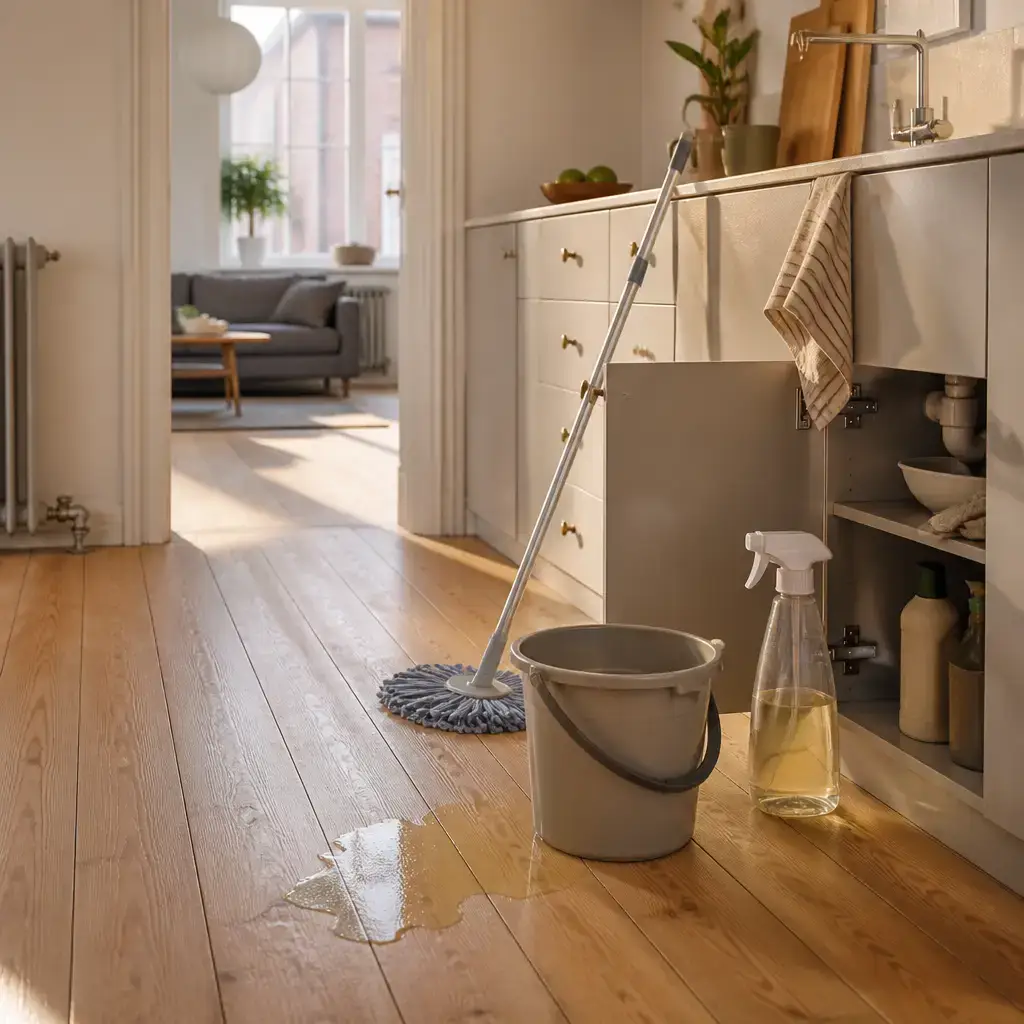
In “noget rengøringsspray,” rengøringsspray means “cleaning spray,” the product being requested. It is a compound word naming a spray used for cleaning.
Det
In “Det står under vasken” and “Det hjælper,” Det means “it” or “that,” referring to the spray in the first sentence and to the situation or help in the second. It is placed at the beginning of both statements as the subject.
står
In “Det står under vasken,” står says that the item is located under the sink. With an object as the subject, “står under ...” is a useful way to describe where something is kept.
under
In “under vasken,” under means “under,” describing the spray’s location below the sink. A reusable pattern is under + a place or object.
vasken
In “under vasken,” vasken means “the sink.” The word appears after under to identify the place beneath which the spray is located.
Er
In “Er der spildt noget?” Er asks whether something has happened, while the same form appears as “er” in “Der er spildt juice” and “gulvet ikke er glat.” It is used here to connect the subject or introductory element with the rest of the statement.
der
In “Er der spildt noget?” der is an introductory element in a question about whether something has spilled; it does not refer to the location “there” here. This pattern asks whether an event or situation exists: “Er der ...?”
spildt
In “Er der spildt noget?” and “Der er spildt juice,” spildt describes liquid that has spilled. A useful pattern from the dialogue is “Der er spildt + a substance.”
juice
In “Der er spildt juice,” juice means “juice,” the liquid that spilled. It follows spildt to identify what was spilled.
på
In “på køkkengulvet,” på means “on” and marks the surface where the juice spilled. It also appears in “sætter pris på,” where it is part of the expression meaning “appreciate.”
køkkengulvet
In “på køkkengulvet,” køkkengulvet means “the kitchen floor,” the surface affected by the spill. It follows på as the location of the spilled juice.
Tag
In “Tag også den lille spand,” Tag means “take,” and the speaker uses it to give a direct instruction. It is useful before the object someone should take.
også
In “Tag også den lille spand,” også means “also” or “too,” adding the bucket to the spray and mop already being taken. It is placed before the added object in this instruction.
den
In “den lille spand,” den means “the” and introduces the specific bucket being mentioned. It comes before the adjective and noun in this phrase.
lille
In “den lille spand,” lille means “small,” describing the bucket. It is placed between den and the noun spand.
spand
In “den lille spand,” spand means “bucket,” the container that should also be taken. It follows the description lille in the noun phrase.
så
In “så du kan skylle moppen,” så means “so” and introduces the purpose of taking the bucket. It commonly links an action with the result or purpose that follows.
du
In “så du kan skylle moppen,” du means “you,” the person who will rinse the mop. It appears before kan in this clause.
kan
In “så du kan skylle moppen,” kan means “can,” expressing that the person is able to rinse the mop. A reusable pattern is kan + verb, as in kan skylle.
skylle
In “kan skylle moppen,” skylle means “rinse.” It follows kan and takes moppen as the object being rinsed.
moppen
In “skylle moppen,” moppen means “the mop,” the item to be rinsed. It appears after skylle as the object of that action.
hjælper
In “Det hjælper,” hjælper means “helps” or “is helpful,” referring to the assistance with the cleaning problem. “Det hjælper” is a useful short response after someone has offered or provided help.
tager
In “Jeg tager dem begge med tilbage,” tager means “take” or “bring” in the context of returning the borrowed items. The reusable pattern “tager + object + med tilbage” expresses taking something back.
dem
In “Jeg tager dem begge med tilbage” and “Stil dem ved min dør,” dem means “them,” referring to the cleaning spray, bucket, and mop. It is used after the verb when these objects are being taken or placed.
begge
In “dem begge,” begge means “both,” emphasizing that both items previously mentioned will be returned. It commonly follows a pronoun or noun to specify that the two items are included.
med
In “tager dem begge med tilbage,” med contributes the meaning “along” or “with” and is part of the expression for taking something back. A reusable pattern is tage something med when bringing or taking it along.
tilbage
In “med tilbage,” tilbage means “back,” showing that the items will return to the neighbor. It is useful with movement or carrying expressions when something is returned.
når
In “når jeg er færdig” and “når alt er tørt,” når means “when” and introduces the time condition for the action. It commonly links an action to a later point or condition.
færdig
In “jeg er færdig,” færdig means “finished,” referring to the speaker completing the cleaning. “Jeg er færdig” is a common way to say that one has finished an activity.
Stil
In “Stil dem ved min dør,” Stil means “leave” or “place,” telling someone where to put the items. It is useful in a direct instruction followed by the object and its location.
ved
In “ved min dør,” ved means “by” or “at,” marking the location where the items should be left. A reusable pattern is ved + a place or object.
min
In “min dør,” min means “my” and identifies the door belonging to the speaker. It is placed directly before dør in this possessive phrase.
dør
In “ved min dør,” dør means “door,” specifically the speaker’s door. It follows the possessive min in the phrase.
alt
In “når alt er tørt,” alt means “everything,” referring to all the wet areas or items involved in the cleaning. It can be used as the subject of a statement about the whole situation.
tørt
In “alt er tørt,” tørt means “dry,” describing the condition of everything after the cleaning. The pattern er tørt states that something is dry.
sætter pris på
In “Jeg sætter pris på din hjælp,” sætter pris på means “appreciate” or “value.” The whole expression conveys appreciation: sætter contributes “sets,” pris means “price” or “value,” and på is the required following part. A reusable pattern is sætter pris på + a person, thing, or action.
din
In “din hjælp,” din means “your,” identifying the help as belonging to the person being addressed. It is placed before hjælp in this possessive phrase.
hjælp
In “din hjælp med det her rod,” hjælp means “help,” referring to the neighbor’s assistance with the mess. It commonly appears with med to specify what the help concerns.
rod
In “det her rod,” rod means “mess,” referring to the spilled juice and the cleaning situation. It follows det her in this phrase naming the problem.
Bare
In “Bare sørg for, at gulvet ikke er glat bagefter,” Bare means “just” and softens the instruction that follows. It is useful at the beginning of a brief reminder or request.
sørg
In “sørg for, at gulvet ikke er glat bagefter,” sørg means “make sure.” The reusable construction is sørg for, at + a clause when asking someone to ensure a result.
for
In “sørg for, at ...,” for is part of the expression meaning “make sure,” rather than meaning “for” by itself. The complete pattern is sørg for, at + a statement.
at
In “sørg for, at gulvet ikke er glat bagefter,” at introduces the statement describing what must be ensured. It follows sørg for in this construction.
gulvet
In “gulvet ikke er glat,” gulvet means “the floor,” the surface that must be checked after cleaning. It is the subject of the statement about being slippery.
ikke
In “gulvet ikke er glat,” ikke means “not” and makes the statement negative: the floor must not be slippery. It appears before the description er glat here.
glat
In “gulvet ikke er glat,” glat means “slippery,” describing the unsafe condition the speaker wants to avoid. It is used after er to describe the floor.
bagefter
In “ikke er glat bagefter,” bagefter means “afterward,” referring to the time after the cleaning. It can be placed at the end of a clause to show when the condition should be checked.