Min
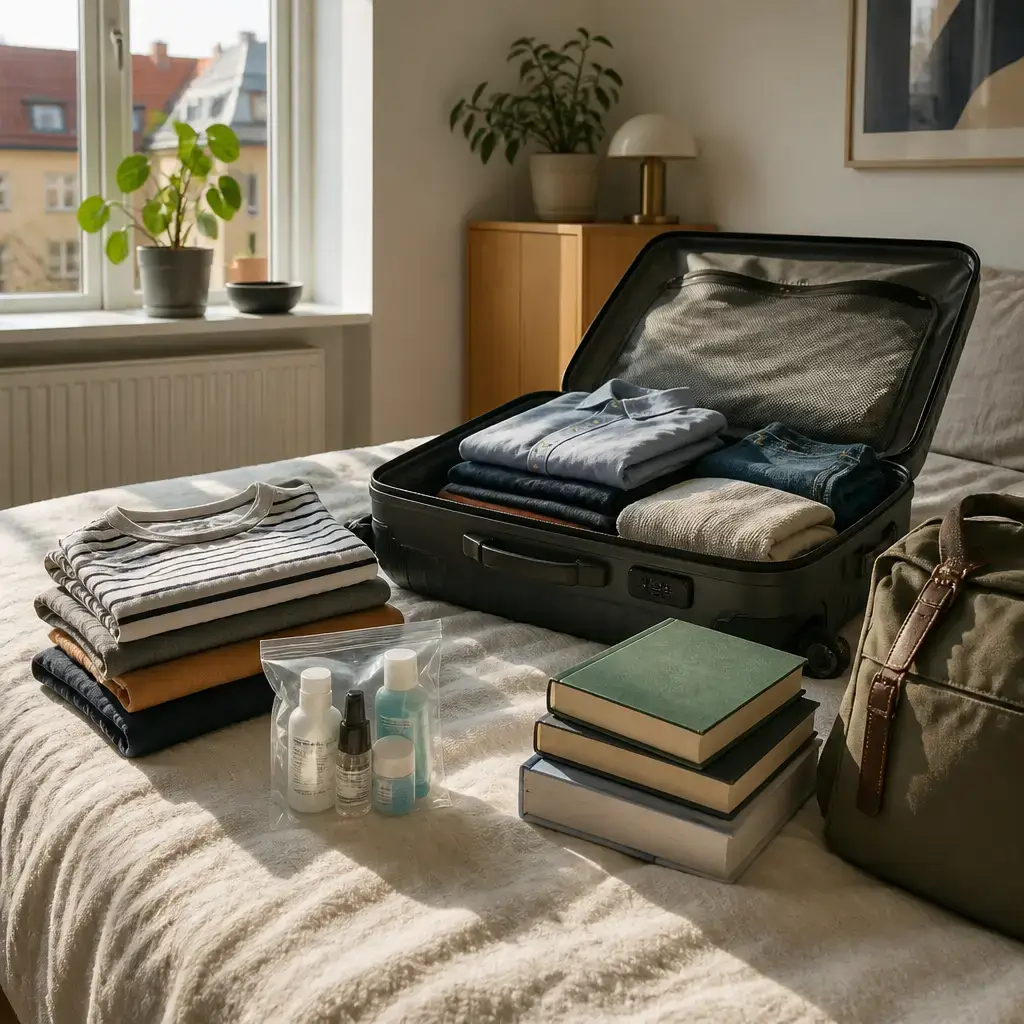
“Min” means “my” in “Min kuffert” and shows who the suitcase belongs to. A reusable pattern is “Min” followed by the thing that belongs to you, such as “Min kuffert”. Use it when talking about your own belongings.
kuffert
“kuffert” means “suitcase” in “Min kuffert”. It is the travel bag being organized in the dialogue. A useful pattern is “[possessive] kuffert”, such as “Min kuffert”, when talking about someone’s suitcase.
er
“er” means “is” in “kuffert er rodet” and describes the suitcase’s condition. It is the form of “være” used with “kuffert” here. Use “er” to state what something is like, for example “Kufferten er klar” for “The suitcase is ready”.
rodet
“rodet” means “messy” in “Min kuffert er rodet”. It describes the suitcase as untidy before it is organized. Use it after “er” to describe a messy object or place.
og
“og” means “and” in “rodet, og vi rejser”. It connects the statement about the suitcase with the statement about leaving. Use “og” to join two related words, phrases, or clauses.
vi
“vi” means “we” in “vi rejser i morgen”. It refers to the speaker and at least one other person traveling together. Use “vi” as the subject when describing something that you and others do.
rejser
“rejser” means “travel” or “leave” in “vi rejser i morgen”. It is the present form of “rejse” used for the planned trip. A useful pattern is “vi rejser” followed by a time expression, such as “vi rejser i morgen”. Use it when saying that you or a group are traveling.
i
“i” means “in” as part of the time expression “i morgen”, which means “tomorrow”. Here it does not describe a location; it helps form a time expression. Use “i” in fixed time expressions such as “i morgen” when referring to tomorrow.
morgen
“morgen” means “tomorrow” in the exact expression “i morgen”. The same word can refer to the morning in other contexts, but here the full expression refers to the next day. Use “i morgen” to say when something will happen tomorrow.
Fold
“Fold” means “fold” in the instruction “Fold skjorterne”. It is the command form used to tell someone to fold the shirts. A reusable pattern is “Fold” followed by the object, such as “Fold skjorterne”.
skjorterne
“skjorterne” means “the shirts” in “Fold skjorterne”. It names the clothing that should be folded. Use it after an action word when referring to the shirts, as in “Fold skjorterne”.
først
“først” means “first” in “Fold skjorterne først”. It tells the listener that folding should happen before the other packing steps. Use “først” to mark the first action in an ordered series.
for
“for” introduces the purpose in “for at spare plads”, meaning “in order to save space”. Together with “at” and the following verb, it explains why the shirts should be folded. Use the pattern “for at” followed by a verb to state a purpose.
at
“at” is the infinitive marker in “for at spare plads”. It combines with “spare” to form the purpose expression “for at spare plads”. Use “at” before a verb in this type of infinitive construction.
spare
“spare” means “save” in “spare plads”, specifically to use less space. It follows “at” in the purpose expression “for at spare plads”. A useful pattern is “spare plads” when arranging things so that more can fit.
plads
“plads” means “space” in “spare plads”. It is the room that folding the shirts helps preserve in the suitcase. Use “spare plads” when an action creates more room for other things.
Skal
“Skal” helps form the question “Skal jeg skille væsker fra tøjet?”, meaning “Should I separate the liquids from the clothes?” At the beginning of this question, it asks whether the suggested action is appropriate. Use “Skal” before the subject to ask whether someone should do something.
jeg
“jeg” means “I” in “Skal jeg skille væsker fra tøjet?” It identifies the person asking whether to perform the action. Use “jeg” as the subject when talking about your own action or situation.
skille
“skille” means “separate” in “skille væsker fra tøjet”. The useful construction is “skille” one thing “fra” another thing. Use it when asking or explaining that two things should be kept apart.
væsker
“væsker” means “liquids” in “skille væsker fra tøjet”. It refers to the liquid items being kept away from the clothes. Use it as the thing being separated in the pattern “skille væsker fra tøjet”.
fra
“fra” means “from” in “skille væsker fra tøjet”. It marks the thing that the liquids are separated from. A useful pattern is “skille” one thing “fra” another thing.
tøjet
“tøjet” means “the clothes” in “fra tøjet”. It is the clothing that should be kept separate from the liquids. Use it after “fra” when describing separation from the clothes.
Læg
“Læg” means “put” or “place” in the instruction “Læg væsker i en plastikpose”. It tells someone to place the liquids inside a plastic bag. A reusable pattern is “Læg” an object “i” a container or place.
en
“en” means “a” in “en plastikpose”. It introduces one unspecified plastic bag. Use “en” before a singular noun in this kind of phrase, such as “en plastikpose”.
plastikpose
“plastikpose” means “plastic bag” in “en plastikpose”. It is the container where the liquids should be placed. Use it after a word such as “en” when naming one plastic bag.
før
“før” means “before” in “før du pakker dem”. It places the action of packing after the action of putting the liquids in the bag. Use “før” before a clause to say that one action happens earlier than another.
du
“du” means “you” in “før du pakker dem”. It is the subject of the clause describing the person who packs the liquids. Use “du” when addressing the person who is expected to do an action.
pakker
“pakker” means “pack” in “du pakker dem”. It describes putting the liquids among the travel belongings. It is the present form of “pakke” used after “du”. Use “pakker” with an object when saying what someone packs.
dem
“dem” means “them” in “pakker dem” and refers back to “væsker”. It is the object of the action of packing. Use “dem” when referring to previously mentioned things that are being acted on.
Det
“Det” has two roles in the dialogue: in “Det føles, som om” it forms the impersonal expression “it feels as if”, while in “Det gør kufferten nemmere” it refers back to the preceding action. Use the exact surrounding expression to understand whether it introduces a general impression or refers to a previous situation.
føles
“føles” means “feels” in “Det føles, som om kufferten er tæt på vægtgrænsen”. It presents the speaker’s impression that the suitcase is nearly at the limit. Use “Det føles, som om” to describe how a situation seems.
som
“som” means “as” in the expression “som om”. Together, “som om” introduces an impression or appearance in “Det føles, som om kufferten er tæt på vægtgrænsen”. Use the complete pattern “som om” before the clause that describes what something seems like.
om
“om” is part of “som om”, meaning “as if” in “Det føles, som om kufferten er tæt på vægtgrænsen”. It cannot be understood as “about” in this expression. Use “som om” to introduce something that appears to be the case.
kufferten
“kufferten” means “the suitcase” in “kufferten er tæt på vægtgrænsen”. It refers to the specific suitcase already being discussed. Use this form when referring to that particular suitcase in the packing situation.
tæt
“tæt” means “close” in the expression “tæt på vægtgrænsen”. It says that the suitcase is nearly at the weight limit. Use “tæt på” followed by a limit, place, or point when something is close to it.
på
“på” is part of the expression “tæt på”, meaning “close to” in “tæt på vægtgrænsen”. It links “tæt” to the limit being approached. Use the pattern “tæt på” followed by the relevant place, time, or limit.
vægtgrænsen
“vægtgrænsen” means “the weight limit” in “tæt på vægtgrænsen”. It is the maximum weight that the suitcase is nearly reaching. Use it after “tæt på” when discussing how close something is to a weight limit.
Så
“Så” means “then” in “Så flyt de tunge bøger”. It connects the weight problem with the suggested next action. Use “Så” at the beginning of a sentence when giving a consequence or next step.
flyt
“flyt” means “move” in “flyt de tunge bøger over i din rygsæk”. It is a direct instruction to transfer the books to another bag. A useful pattern is “flyt” an object “over i” a new place or container.
de
“de” means “the” in “de tunge bøger”. It points to the specific books that are being discussed. Use it before the plural noun phrase you are identifying, as in “de tunge bøger”.
tunge
“tunge” means “heavy” in “de tunge bøger”. It describes the books that should be moved because they add weight to the suitcase. Use it before a noun when identifying heavy items.
bøger
“bøger” means “books” in “de tunge bøger”. These are the items that should be transferred to the backpack. Use it as the object of an instruction such as “flyt de tunge bøger”.
over
“over” is part of “over i din rygsæk”, which describes moving the books across into the backpack. It emphasizes the transfer from the suitcase to another container. Use the pattern “flyt” something “over i” another place or container.
din
“din” means “your” in “din rygsæk”. It shows that the backpack belongs to the person being addressed. Use “din” before the person’s singular possession, such as “din rygsæk”.
rygsæk
“rygsæk” means “backpack” in “din rygsæk”. It is the destination for the heavy books. Use it after a possessive such as “din” when naming someone’s backpack.
gør
“gør” means “makes” in “Det gør kufferten nemmere at lukke”. It describes the result of moving the books: closing the suitcase becomes easier. A useful pattern is “gør” an object “nemmere at” do something.
nemmere
“nemmere” means “easier” in “gør kufferten nemmere at lukke”. It compares the suitcase’s new condition with its earlier condition. Use the pattern “nemmere at” followed by a verb to describe an action that becomes easier.
lukke
“lukke” means “close” in “nemmere at lukke”. It is the action that becomes easier after the books are moved. Use “at lukke” after an expression such as “nemmere at” when describing the action of closing something.
Nu
“Nu” means “now” in “Nu burde den være klar”. It marks the current point after the packing changes have been made. Use “Nu” to introduce what is expected or true at this moment.
burde
“burde” means “should” or “ought to” in “burde den være klar”. It expresses an expectation that the suitcase is ready after the changes. Use “burde” before a verb, such as “burde være”, when saying what is expected.
den
“den” means “it” in “den være klar” and refers to the suitcase. It allows the speaker to refer back to the already mentioned suitcase without repeating “kufferten”. Use “den” when referring back to this specific object.
være
“være” means “be” in “burde den være klar”. It follows “burde” and links the suitcase with the description “klar”. Use “burde være” when saying what something is expected to be.
klar
“klar” means “ready” in “være klar til turen”. It describes the suitcase as prepared for the trip. A useful pattern is “klar til” followed by the event or activity for which something is ready.
til
“til” means “for” in “klar til turen”. It links “klar” to the trip that the suitcase is prepared for. Use the pattern “klar til” followed by an event, activity, or destination.
turen
“turen” means “the trip” in “klar til turen”. It refers to the specific upcoming trip mentioned in the dialogue. Use it after “til” in the phrase “klar til turen” when saying that something is ready for the trip.