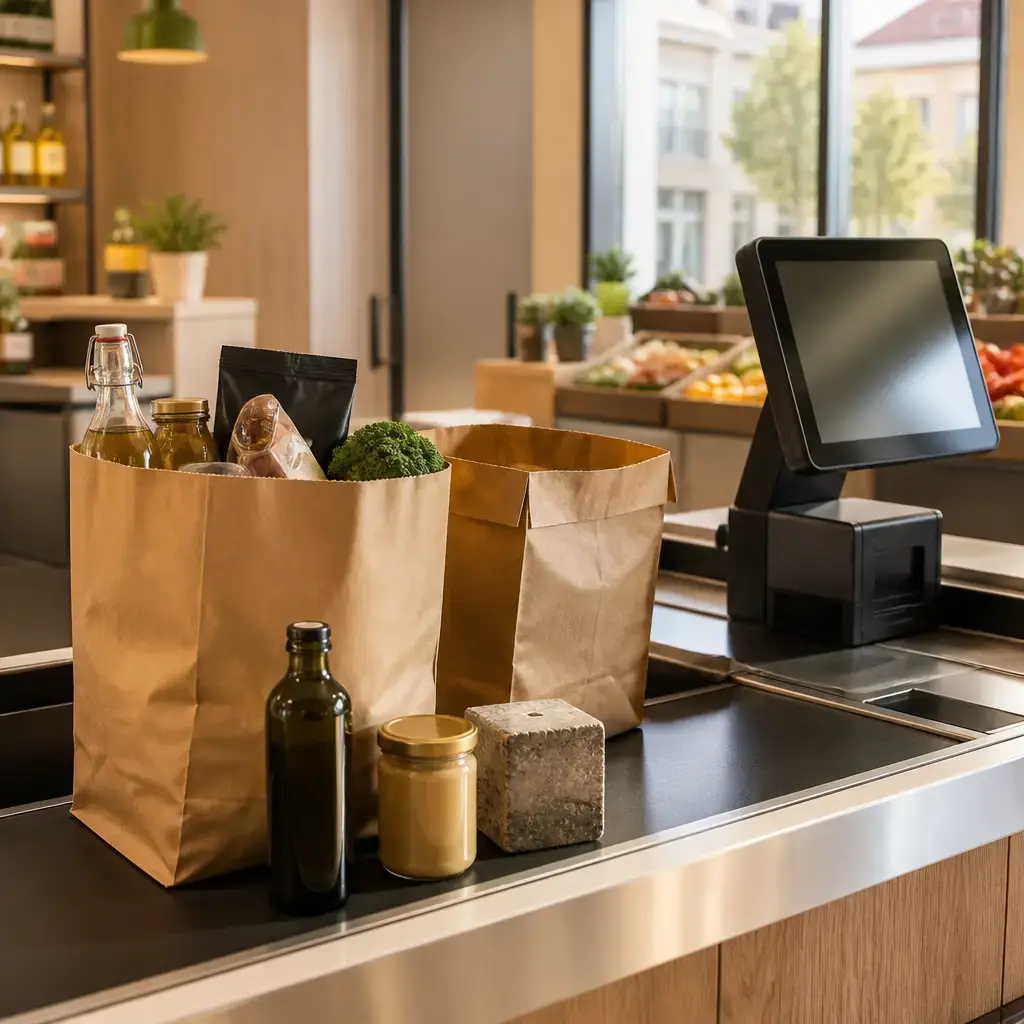
Er
'Er' means 'is' in the question 'Er denne kasse åben nu?'. It is the present form of 'være' used to ask about the checkout's current state.
denne
'Denne' means 'this' and points to the checkout being discussed in 'denne kasse'. It is placed before the noun it identifies.
kasse
'Kasse' means 'checkout' here, referring to the checkout area or station in 'denne kasse'. Use it when identifying a checkout in a shop.
åben
'Åben' means 'open' in 'Er denne kasse åben nu?', describing whether the checkout is available. It is used after the form of 'være' to describe the checkout's state.
nu
'Nu' means 'now' and asks about the checkout's status at the present moment in 'åben nu'. Use it when checking whether something is happening or available at this moment.
Du
'Du' means 'you' and is the person being addressed in 'Du kan lægge dine varer her'. It appears at the beginning as the subject of the suggestion.
kan
'Kan' means 'can' in 'Du kan lægge dine varer her' and 'Jeg kan flytte den tunge vare'. It is followed by an infinitive to express ability or that an action is possible.
lægge
'Lægge' means 'put' or 'place' in 'lægge dine varer her'. After 'kan', it names the action that the customer can perform.
dine
'Dine' means 'your' in 'dine varer', identifying the items as belonging to the person being addressed. It is placed before the noun it describes.
varer
'Varer' means 'items' or 'goods' in the shop phrase 'dine varer'. Use it for the products a customer is placing at the checkout.
her
'Her' means 'here' and indicates the place where the items should be put in 'lægge dine varer her'. Use it to direct someone to the speaker's indicated location.
Skal
'Skal' means 'should' in the question 'Skal jeg bruge skærmen til at betale?'. The same form appears as lowercase 'skal' in 'Jeg skal nok være forsigtig', where it helps express a reassuring future commitment.
jeg
'Jeg' means 'I' and identifies the speaker in 'Skal jeg bruge skærmen til at betale?' and 'Jeg skal nok være forsigtig'. It is used as the subject of the speaker's action or question.
bruge
'Bruge' means 'use' in 'bruge skærmen'. It follows 'Skal jeg' as the action the speaker is asking about.
skærmen
'Skærmen' means 'the screen' in 'bruge skærmen' and refers to the payment screen at the checkout. It can be used after an action such as using or operating the screen.
til
'Til' connects words with different relationships in this dialogue: 'til at betale' expresses the purpose of using the screen, while 'til højre for dig' describes a location. The full phrase determines which relationship it expresses.
at
'At' introduces the action 'betale' in 'til at betale'. Together, 'til at betale' gives the purpose of using the screen.
betale
'Betale' means 'pay' in 'til at betale'. It names the action that the screen is used for.
Brug
'Brug' means 'use' in the direct instruction 'Brug skærmen til højre for dig'. It tells the other person what action to take.
højre
'Højre' means 'right' in 'til højre for dig'. It helps identify the screen's position from the other person's viewpoint.
for
'For' links the direction to the person in 'højre for dig', giving the reference point for 'right'. The whole phrase 'til højre for dig' means 'on your right'.
dig
'Dig' means 'you' in 'for dig' and identifies the person whose viewpoint is used for the direction. It follows 'for' in this location phrase.
Posen
'Posen' means 'the bag' in 'Posen virker for fuld', referring to the bag being discussed. The same word appears as lowercase 'posen' in 'i posen' later in the dialogue.
virker
'Virker' means 'seems' or 'feels' in 'Posen virker for fuld'. It presents the speaker's impression about the bag rather than a direct statement about its actual condition.
fuld
'Fuld' means 'full' in 'for fuld'. With 'for', the phrase 'for fuld' means 'too full', describing the bag's condition.
flytte
'Flytte' means 'move' in 'flytte den tunge vare til en anden pose'. It follows 'kan' and names the action of transferring the item to another bag.
den
'Den' identifies the particular item in 'den tunge vare'. It appears before the description and noun to refer to the heavy item being discussed.
tunge
'Tunge' means 'heavy' in 'den tunge vare', describing the item's weight. It is placed before 'vare' to specify which item should be moved.
vare
'Vare' means 'item' or 'product' in 'den tunge vare'. In this shop context, it refers to one product being moved into another bag.
en
'En' introduces the bag in 'en anden pose'. It is part of the phrase meaning 'another bag', so the complete expression supplies the intended reference.
anden
'Anden' means 'another' in 'en anden pose', indicating a bag different from the current one. It comes before the noun it describes.
pose
'Pose' means 'bag' in 'en anden pose'. Use it for the bag receiving the moved item or other shop items.
Læg
'Læg' means 'put' in the polite request 'Læg venligst tingene af glas i en separat pose'. It gives a direct instruction about where to place the glass items.
venligst
'Venligst' means 'please' in 'Læg venligst tingene af glas i en separat pose'. It makes the direct request more polite.
tingene
'Tingene' means 'the things' or 'the items' in 'tingene af glas'. It refers to the glass items that should be put in a separate bag.
af
'Af' indicates the material in 'tingene af glas'. The full phrase 'tingene af glas' means 'the glass items' or items made of glass.
glas
'Glas' means 'glass' in 'tingene af glas', identifying the material of the items. It is used after 'af' to specify what the items are made of.
i
'I' means 'in' in 'i en separat pose'. It introduces the bag where the items should be placed.
separat
'Separat' means 'separate' in 'en separat pose'. It specifies that the bag should be kept apart from the other bag or items.
nok
'Nok' adds reassurance in 'Jeg skal nok være forsigtig'. Here it helps assure the other person that the speaker will be careful while handling the glass items.
være
'Være' means 'be' in 'skal nok være forsigtig'. It follows 'skal' and links the speaker to the quality 'forsigtig'.
forsigtig
'Forsigtig' means 'careful' in 'være forsigtig'. It describes how the speaker promises to handle the glass items while packing them.
når
'Når' means 'when' or 'while' in 'når jeg pakker dem i posen'. It introduces the action that takes place at the same time as being careful.
pakker
'Pakker' means 'pack' or 'bag' in 'når jeg pakker dem i posen'. It takes 'dem' as the items being packed and 'i posen' as the bag they go into.
dem
'Dem' means 'them' in 'pakker dem i posen'. It refers back to 'tingene af glas', the glass items being packed.