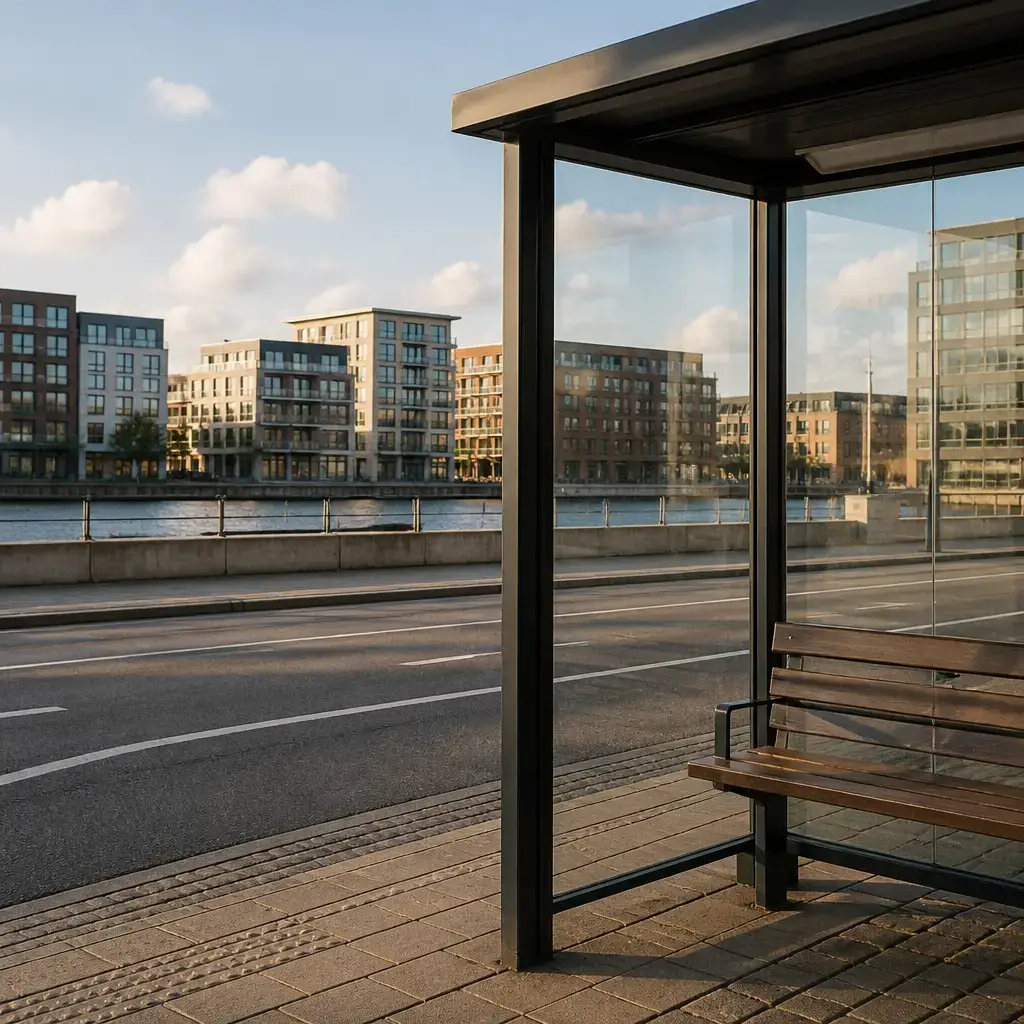
Undskyld
Undskyld means “excuse me” here and politely opens the question to get the other person’s attention. Use it before a question to a stranger or someone you do not know well.
er
Er asks whether the bus has a certain condition in “er bussen forsinket?” It is also used in “Der er” to say that something exists or is present. A common question pattern is Er + subject + description?
bussen
Bussen means “the bus” and refers to the particular bus being discussed at the stop. The form is definite, so it points to a specific bus rather than a bus in general. Use it when both speakers know which bus is meant.
forsinket
Forsinket describes the bus as delayed in “er bussen forsinket?” It is useful for transport that is not arriving at the expected time. It appears after er to describe the bus’s current condition.
Der
Der introduces an existence statement in “Der er meget trafik” and “Der er en.” It means that something is present or available, rather than naming a location. Reuse the pattern Der er + noun to say that something exists or is available.
meget
Meget means “much” or “a lot of” in “meget trafik,” describing a large amount of traffic. Here it comes before the uncounted noun trafik. Use meget before an uncounted amount when saying that there is a lot of something.
trafik
Trafik means “traffic” in the explanation for the delayed bus. In “meget trafik,” it refers to a large amount of road traffic nearby. Use it when talking about vehicles and congestion on roads.
i
I contributes the meaning “in” to the expression “i nærheden,” which means nearby or in the vicinity. It combines with a place or area expression. Use i when locating something within an area.
nærheden
Nærheden means “the vicinity” or “the nearby area” in “i nærheden.” Together, i nærheden says that the traffic is close to the bus stop. Use this expression when something is not far from the current place.
Ved
Ved means “know” in the question “Ved du, hvornår den kommer?” It is placed before du in this direct question. Use Ved du ...? to ask another person whether they know something.
du
Du means “you” and identifies the person being asked in “Ved du.” It addresses the other adult directly. Reuse du as the subject when asking or telling one person something.
hvornår
Hvornår means “when” and asks for the time of the bus’s arrival in “hvornår den kommer.” It introduces the part of the question that gives the requested time. A useful pattern is Ved du, hvornår + clause?
den
Den means “it” in “den kommer,” referring back to the bus. In “den tager længere tid,” it refers back to the alternative bus or option. Use den to refer to a known thing or option without repeating its noun.
kommer
Kommer means “comes” or, in this bus context, “arrives” in “den kommer.” It describes the bus reaching the stop. Use a subject followed by kommer when saying that someone or something arrives.
stadig
Stadig means “still” in “stadig på vej,” showing that the bus remains en route. It signals that the situation has not changed. Use stadig when an action or state continues.
på vej
På vej means “on the way” as a whole in “stadig på vej.” På contributes the idea of being on a route, while vej means “way” or “path”; together they say that the bus is travelling toward its destination. A common reusable pattern is være på vej.
Så
Så means “so” at the start of “Så ventetiden kan blive længere.” It introduces a consequence of the traffic and delay. Use Så before a conclusion that follows from what was just said.
ventetiden
Ventetiden means “the waiting time” and refers to the time spent waiting for this bus. The definite form presents it as the particular waiting time in this situation. It appears in “ventetiden kan blive længere” to say that the wait may increase.
kan
Kan expresses possibility in “kan blive længere,” meaning that the waiting time may become longer. It is followed by the infinitive blive. Reuse kan + infinitive to say that something can or may happen.
blive
Blive means “become” or “get” in “kan blive længere,” describing a change in the length of the wait. It follows kan and comes before the description længere. Reuse kan blive + description when describing a possible change.
længere
Længere means “longer” in both the longer waiting time and “tager længere tid.” With tid, it says that something requires more time. A useful pattern is tager længere tid for something that takes longer.
en
En means “a” in “en anden bus,” where it introduces one alternative bus. In “Der er en,” it stands for “one,” referring back to a bus or option. Use en before a noun when introducing one item, or on its own when the noun is understood.
anden
Anden means “another” in “en anden bus,” identifying an alternative bus. It comes before the noun it describes. Reuse the pattern en anden + noun when asking about or choosing an alternative.
bus
Bus means “bus” in “en anden bus.” It names the alternative vehicle that could serve the route. Use it after a determiner or description when talking about a bus.
på
På has two relevant uses here: “på den samme rute” links the bus to a route, while “venter på denne bus” means waiting for this bus. The second use is especially reusable in the pattern vente på + thing or person. Choose the meaning from the expression it forms with the following words.
samme
Samme means “same” in “den samme rute,” showing that the alternative bus follows the identical route. It comes after den and before the noun rute. Reuse den samme + noun when referring to an identical item or route.
rute
Rute means “route” in “den samme rute.” It refers to the path served by the bus. Use it when identifying which route a bus or other transport follows.
men
Men means “but” and contrasts the available alternative with its longer travel time. It connects the two parts of “Der er en, men den tager længere tid.” Use men to introduce information that limits or contrasts with what was just said.
tager
Tager means “takes” in “den tager længere tid,” describing how much time the alternative requires. It is used with a time expression rather than meaning physically taking an object here. Reuse the pattern tager + duration + tid to describe how long something takes.
tid
Tid means “time” in the duration expression “tager længere tid.” Together, the phrase says that the alternative takes longer. Use tid after a duration description when talking about the amount of time needed.
Jeg
Jeg means “I” and identifies the speaker who decides to remain at the stop. It is the subject of “Jeg bliver her.” Reuse Jeg before a verb when describing your own action or decision.
bliver
Bliver means “stay” in “Jeg bliver her,” saying that the speaker will remain at the bus stop. Here it describes remaining in a place, not becoming something. Reuse bliver + place when saying that you remain somewhere.
her
Her means “here” and refers to the current bus stop in “Jeg bliver her.” It identifies the place where the speaker will remain. Use her when pointing to the place where you and the listener are now.
og
Og means “and” and links the two actions in “bliver her og venter.” It shows that the speaker will remain there while waiting. Use og to connect actions or statements.
venter
Venter means “waits” in “venter på denne bus,” specifically “waits for this bus.” The preposition på identifies what is being awaited. Reuse vente på + noun when saying that someone waits for a person or thing.
denne
Denne means “this” in “denne bus,” pointing to the specific bus the speaker has chosen to wait for. It comes directly before the noun it identifies. Reuse denne + noun when indicating one particular nearby or discussed item.
Det
Det refers back to the choice to wait in “Det er nok bedst,” meaning that this choice is probably best. It lets the speaker evaluate the situation without repeating the whole choice. Use Det er ... when giving an evaluation or judgment about a situation.
nok
Nok means “probably” in “Det er nok bedst,” making the advice less absolute. It comes after er and before the evaluation bedst. Use nok to present a conclusion as likely rather than completely certain.
bedst
Bedst means “best” and recommends waiting for the current bus if the listener can wait. It evaluates that choice in “Det er nok bedst.” New example: Det er bedst at vente.
hvis
Hvis means “if” and introduces the condition “hvis du kan vente.” The advice depends on whether the other person is able to wait. Use hvis + clause when a result or recommendation depends on a condition.
vente
Vente means “wait” in “kan vente,” where it is the action that the listener may be able to do. It follows the modal kan in its infinitive form. Reuse kan + infinitive to say that someone can or may perform an action.