Undskyld
“Undskyld” means “excuse me” here and politely gets the staff member’s attention before a question. It can be used at the start of a request or question in a shop.
hvor
“hvor” means “where” and asks for the location of the stationery section. It is used in the question pattern “hvor er” when asking where something is.
er
“er” means “is” here and connects the section with its location. It is used in the question “hvor er” to ask where a known place or thing is.
afdelingen
“afdelingen” means “the section” or “the department” here, referring to the stationery area. The pattern “afdelingen med kontorartikler” identifies a section by what it contains.
med
“med” means “with” and connects the section to the office supplies found there. The pattern “afdelingen med kontorartikler” describes a section by its contents.
kontorartikler
“kontorartikler” means “stationery” or “office supplies” here. It names the goods in “afdelingen med kontorartikler,” a useful way to identify a shop section.
Den
“Den” means “it” here and refers back to “afdelingen.” In “Den ligger,” it is the known place whose location is being described.
ligger
“ligger” means “is located” here, describing where the section is. It is commonly used after a place or thing when giving its location, as in “Den ligger”.
forbi
“forbi” means “past” or “beyond” and gives a route marker for finding the section. It can be used before a landmark in a direction such as “forbi udstillingen”.
udstillingen
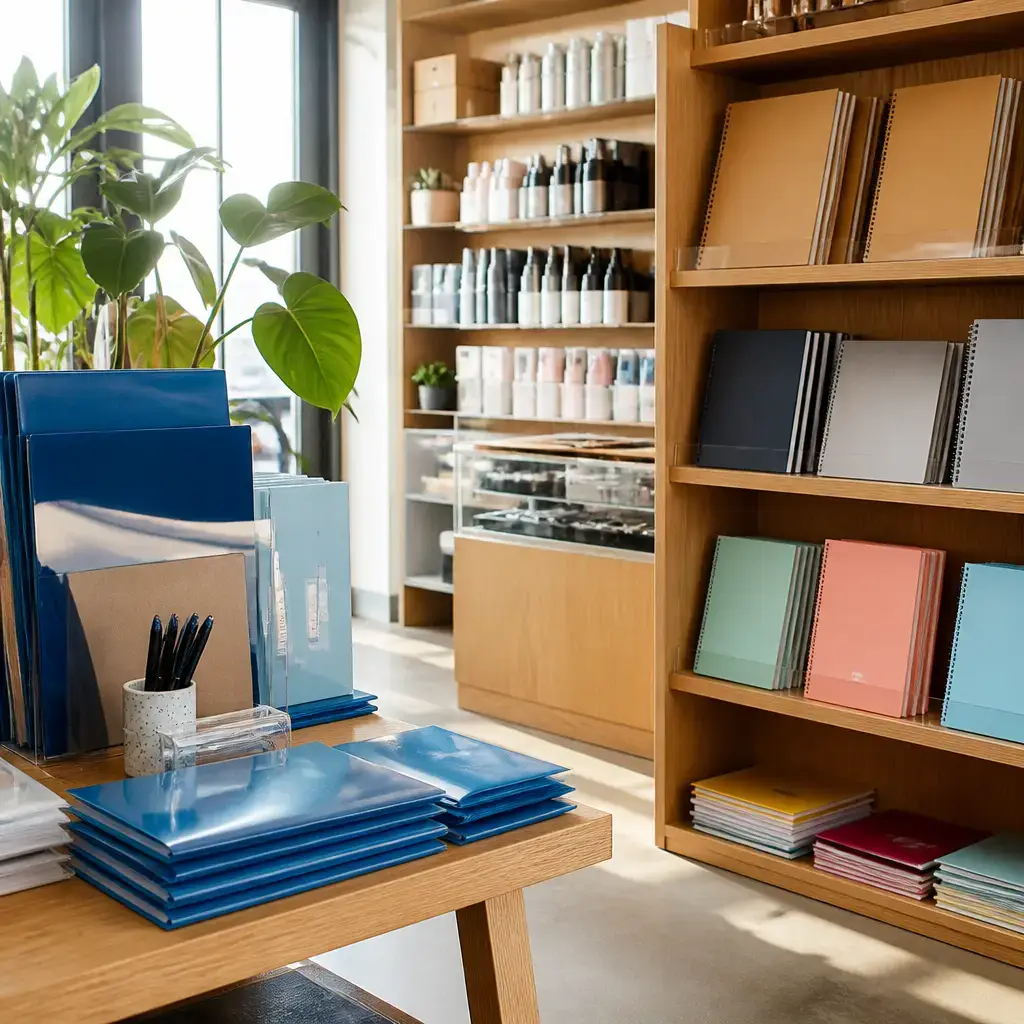
“udstillingen” means “the display” here, specifically the notebook display used as a landmark. The pattern “udstillingen med notesbøger” identifies the display by what is shown there.
notesbøger
“notesbøger” means “notebooks” and specifies what is on the display. It is used after “med” in “udstillingen med notesbøger” to describe the display’s contents.
på højre side
“på højre side” means “on the right-hand side” and completes the location instruction. The whole phrase contains “på” for the position, “højre” for the direction, and “side” for the side; it is useful when directing someone in a shop.
højre
“højre” means “right” here and describes which side the display is on. It is used before “side” in the exact phrase “på højre side”.
side
“side” means “side” here, as in the right-hand side of the shop. It appears in the location phrase “på højre side”.
Jeg
“Jeg” means “I” and marks the customer as the subject of the search. It can begin the reusable request “Jeg leder efter” when saying what you are looking for.
leder
“leder” means “am looking for” in “Jeg leder efter blå mapper,” rather than simply referring to leading. It is used with “efter” before the thing being sought.
efter
“efter” means “for” after “leder” and marks what the customer is searching for. The reusable pattern is “leder efter” followed by the desired item.
blå
“blå” means “blue” and describes the folders the customer wants. It appears before the noun in “blå mapper” when identifying a color and an item.
mapper
“mapper” means “folders,” the items being sought in the shop. It is used after the color word in “blå mapper” to specify the requested products.
Lad
“Lad” contributes the meaning “let” in “Lad mig se,” giving the staff member’s offer to check. “Lad mig” is useful when offering to do something for someone.
mig
“mig” means “me” and refers to the speaker in “Lad mig se.” It follows “Lad” in the expression used to offer to check something.
se
“se” means “see” in its basic sense, but “Lad mig se” means “let me check” in this dialogue. The expression “Lad mig se, om” is useful when checking whether something is true or available.
om
“om” means “if” or “whether” and introduces what the staff member will check. It follows “se” in “se, om de stadig er på lager”.
de
“de” means “they” here and refers to the folders being discussed. It is the subject of “de stadig er på lager” when asking or checking whether the items remain available.
stadig
“stadig” means “still” and shows that the folders may continue to be available. It appears before “er på lager” in “de stadig er på lager”.
på lager
“på lager” means “in stock” or “available” here. The phrase combines “på” with “lager” and is used in “er på lager” and “har nogle på lager” to talk about shop inventory.
der
“der” is an existential subject marker in “Er der nogen på lager?” rather than a reference to a particular place. The pattern “Er der” asks whether something is available or exists.
nogen
“nogen” means “any” here and refers to any folders available in stock. It is used in the question “Er der nogen på lager?” when asking whether some items are available.
i
“i” means “in” and forms the time expression “i dag.” It is used before a time expression to say when something is happening.
dag
“dag” means “day,” and in “i dag” the whole expression means “today.” “I dag” is useful for asking about availability on the current day.
Vi
“Vi” means “we” and refers to the shop staff or shop as the provider of the folders. It begins the statement “Vi har nogle på lager” when describing available stock.
har
“har” means “have” and states that the shop possesses some folders in stock. It is used in “Vi har nogle” to say what the shop has available.
nogle
“nogle” means “some” and refers to an unspecified quantity of folders. It is used in “har nogle på lager” when the exact number is not given.
baglokalet
“baglokalet” means “the back room,” where the shop keeps the folders. It follows “i” in “i baglokalet” to identify the storage location.
Kan
“Kan” means “can” here and begins a request to the staff member. The question pattern “Kan du” is useful when asking whether someone can do something.
du
“du” means “you” and addresses the staff member directly. It follows “Kan” in “Kan du hente en pakke til mig?” when making a request.
hente
“hente” means “fetch” or “bring back” here, referring to getting a pack from the back room. It is used with the requested object in “hente en pakke til mig.”
en
“en” means “a” or “one” here and introduces one pack requested by the customer. It appears before the noun in “en pakke.”
pakke
“pakke” means “pack,” the item the customer asks the staff member to fetch. It is used in the noun phrase “en pakke.”
til
“til” means “for” here and marks the person who should receive the pack. The pattern “til mig” identifies the intended recipient of an item or action.
kommer
“kommer” means “come” in “Jeg kommer med en pakke,” indicating that the staff member will come carrying the pack. The pattern “kommer med” is useful when saying that someone arrives with something.
Vent
“Vent” means “wait” and gives the customer an instruction. It is used at the beginning of “Vent venligst” when asking someone to wait politely.
venligst
“venligst” means “please” and softens the instruction “Vent.” It commonly follows an instruction, as in “Vent venligst.”
ved
“ved” means “by” or “near” and marks the place where the customer should wait. It is used before a nearby object or location, as in “ved denne udstilling.”
denne
“denne” means “this” and points to the particular display near the speaker. It comes before “udstilling” in “denne udstilling” to identify a specific nearby item.