Lad
In “Lad os holde os til indkøbslisten”, “Lad” starts a suggestion: let’s do something. It is used with “Lad os” to invite another person to act together, such as following a shopping list.
os
In “Lad os holde os til indkøbslisten”, “os” refers to the speaker and the other person together: us. The pattern “Lad os” is used when suggesting a shared action, for example in a shop.
holde
In “Lad os holde os til indkøbslisten”, “holde” contributes the idea of staying with or following something. Together with “holde os til”, it means to stick to the list; this pattern can be used for following a plan or agreement.
til
In “holde os til indkøbslisten”, “til” connects the action of staying with what is being followed: the grocery list. The reusable pattern is “holde sig til” something when someone intends to follow it.
indkøbslisten
“Indkøbslisten” means the grocery list the two people are using. The form refers to a specific list in this shopping situation, and it can be used when talking about checking or following that list.
Det
At the start of “Det burde hjælpe os med ikke at købe for meget”, “Det” refers to sticking to the grocery list. It presents that previous action as something expected to help, a useful pattern when referring back to an idea or action.
burde
In “Det burde hjælpe os med ikke at købe for meget”, “burde” expresses that something is expected to have a helpful result: it should help. It is useful for making a reasonable expectation about what an action will do.
hjælpe
“Hjælpe” means help in “burde hjælpe os med ikke at købe for meget”. The pattern “hjælpe nogen med” links a person receiving help to the activity that becomes easier or more manageable.
med
In “hjælpe os med ikke at købe for meget”, “med” links helping us to the activity of not buying too much. The pattern “hjælpe nogen med” is useful when describing help with an action or task.
ikke
In “ikke at købe for meget”, “ikke” makes the action negative: not buying too much. It is placed before the action it negates and is useful when stating that someone should avoid an action.
at
In “ikke at købe for meget”, “at” introduces the action connected to “hjælpe os med”: buying too much. The pattern “med at” can connect help with an action, including a negative action introduced by “ikke”.
købe
“Købe” means buy in “ikke at købe for meget”. Here it names the shopping action the speakers want to avoid doing excessively; it is useful when talking about purchasing something.
for
In “købe for meget”, “for” means too and shows that the amount would be excessive. Together with “for meget”, it describes an amount that goes beyond what is wanted, such as buying more groceries than planned.
meget
In “købe for meget”, “meget” refers to a large amount, and with “for” the phrase means too much. This quantity expression is useful when limiting how much of something someone buys.
Hvor
At the start of “Hvor er pastaen og risen?”, “Hvor” asks about a location: where. It commonly begins a question asking where a person or item is.
er
In “Hvor er pastaen og risen?”, “er” links the question to the location of the pasta and rice. It is used in location questions and answers about where something is.
pastaen
“Pastaen” means the pasta being sought in the shop. The form identifies a specific pasta item, and it is useful when referring to a particular product rather than pasta in general.
og
In “pastaen og risen”, “og” joins the two grocery items: the pasta and the rice. It is used to connect items that are mentioned together.
risen
“Risen” means the rice being sought in the shop. The form identifies a specific rice item, and it is useful when referring to that product together with another item in a list or question.
De
At the start of “De står i tørvaregangen”, “De” refers back to the pasta and rice: they. It is used to continue talking about those two items without repeating their names.
står
In “De står i tørvaregangen”, “står” says that the pasta and rice are located there. Danish uses this form for items standing or being placed in a shop, and it fits the pattern “står i” a place.
i
In “står i tørvaregangen”, “i” introduces the place where the items are located: in the dry-food aisle. It is a common location word used before a place or area.
tørvaregangen
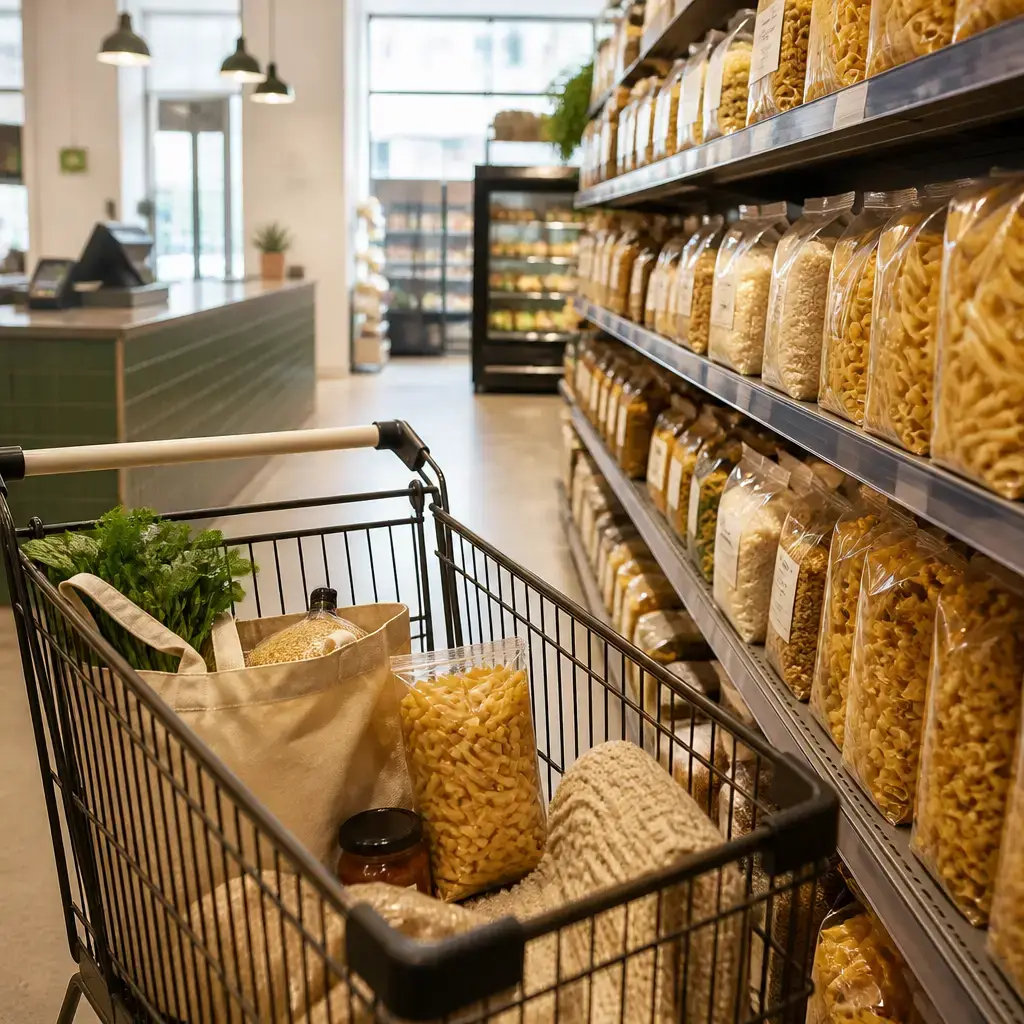
“Tørvaregangen” means the dry-food aisle, where the pasta and rice are located. It is useful for identifying a supermarket section containing dry goods.
den
In “den pasta, vi købte sidst”, “den” identifies the particular pasta being pointed out. The pattern “den” followed by a noun is useful when selecting or referring to one specific item.
pasta
In “den pasta, vi købte sidst”, “pasta” names the food product the speakers recognize. It is the item being identified as the one bought on the previous shopping trip.
vi
In “vi købte sidst”, “vi” refers to the speaker and the other adult together: we. It is used when the speaker describes an action done by both people.
købte
In “vi købte sidst”, “købte” means bought and refers to the earlier purchase of the pasta. It is useful for describing what someone purchased on a previous occasion.
sidst
In “vi købte sidst”, “sidst” means last time, referring to the previous occasion when the speakers shopped or bought this pasta. It is useful for comparing the current situation with the most recent earlier one.
lægge
In “Lad os lægge en pakke i indkøbsvognen”, “lægge” means put or place. The pattern “lægge” one thing “i” another place is useful when putting an item into a cart or container.
en
In “en pakke”, “en” indicates one pack. It introduces the single quantity being added to the cart, which is useful when choosing a specific number of items.
pakke
“Pakke” means pack in “en pakke”. Here it identifies the unit of pasta that the speakers want to place in the shopping cart.
indkøbsvognen
“Indkøbsvognen” means the shopping cart in “lægge en pakke i indkøbsvognen”. The form refers to the particular cart the shoppers are using, and it is useful when describing where groceries are placed.
Bagefter
At the start of “Bagefter mangler vi kun mælk”, “Bagefter” means after that and moves the conversation to the next step. It is useful as a time connector after an action has been completed.
mangler
In “mangler vi kun mælk”, “mangler” says that milk is still needed or still absent from the shopping. The pattern “mangle” something is useful for saying what remains to be obtained.
kun
In “mangler vi kun mælk”, “kun” limits what is still needed to milk alone: only milk. It is useful when emphasizing that no other item remains.
mælk
“Mælk” means milk, the final grocery item still needed in this dialogue. It names the product the shoppers must obtain before going to checkout.
Så
At the start of “Så kan vi gå direkte til kassen”, “Så” means then and shows the next step after getting the milk. It is useful for introducing a consequence or following action.
kan
In “kan vi gå direkte til kassen”, “kan” says that going to checkout is now possible. It is useful when describing what someone is able or allowed to do next.
gå
In “gå direkte til kassen”, “gå” means go or head. It describes the shoppers’ next movement, and the pattern “gå til” a place is useful when giving a destination.
direkte
In “gå direkte til kassen”, “direkte” means straight or directly, without another shopping stop mentioned. It is useful when telling someone to proceed to a destination immediately.
kassen
“Kassen” means the checkout in “gå direkte til kassen”. The form refers to the checkout area where the shoppers will pay, and it is useful when giving directions inside a shop.