Jeg
Jeg means “I” here and identifies the person speaking. It is used at the beginning of Jeg vil gerne have en snack and Jeg er ikke særlig sulten when talking about yourself.
vil
In vil gerne have, vil expresses the speaker’s wish to have something. This form is useful when stating what you want, as in Jeg vil gerne have en snack.
gerne
In vil gerne have, gerne helps express the wish politely and willingly. The full expression is used when asking for or saying that you would like something, as in Jeg vil gerne have en snack.
have
In vil gerne have en snack, have expresses having or getting the requested item. It follows vil gerne when the speaker says what they would like to have.
en
In en snack, en marks one unspecified snack. It comes directly before the noun snack when referring to one item of this kind.
snack
Snack means “snack” and names the food the speaker wants. In this dialogue it is used after en to refer to a light item eaten between meals, in Jeg vil gerne have en snack.
er
In Jeg er ikke særlig sulten, er links the speaker Jeg with the state of being not very hungry. It is used in this conversation to describe the speaker’s current condition.
ikke
Ikke makes the statement negative in Jeg er ikke særlig sulten. It is placed before the phrase it negates, and here it says that the speaker is not very hungry.
særlig
In ikke særlig sulten, særlig means “particularly” or “very” and limits the degree of hunger. Together with ikke, it gives the meaning “not very hungry,” useful when describing a mild state.
sulten
Sulten describes the state of being hungry in Jeg er ikke særlig sulten. It follows er when the speaker explains how hungry they are in this situation.
Så
Så means “then” at the beginning of Så vælg noget let, for eksempel yoghurt. It connects the speaker’s lack of hunger with the next suggestion, and can introduce a resulting action or suggestion.
vælg
Vælg tells the other person to choose something in Så vælg noget let, for eksempel yoghurt. It is useful when giving a direct suggestion about what someone should select.
noget
Noget means “something” in vælg noget let and refers to an unspecified food item. It can be followed by a description, as in the dialogue’s noget let.
let
In noget let, let describes the suggested food as light rather than heavy. It follows noget to characterize the unspecified snack, and is useful when recommending a small or mild food choice.
for eksempel
For eksempel means “for example” as a whole and introduces yoghurt as one illustration of noget let. In the expression, for contributes the linking element and eksempel names the example; the full phrase appears in for eksempel yoghurt. It is useful before a concrete item that illustrates a general idea.
yoghurt
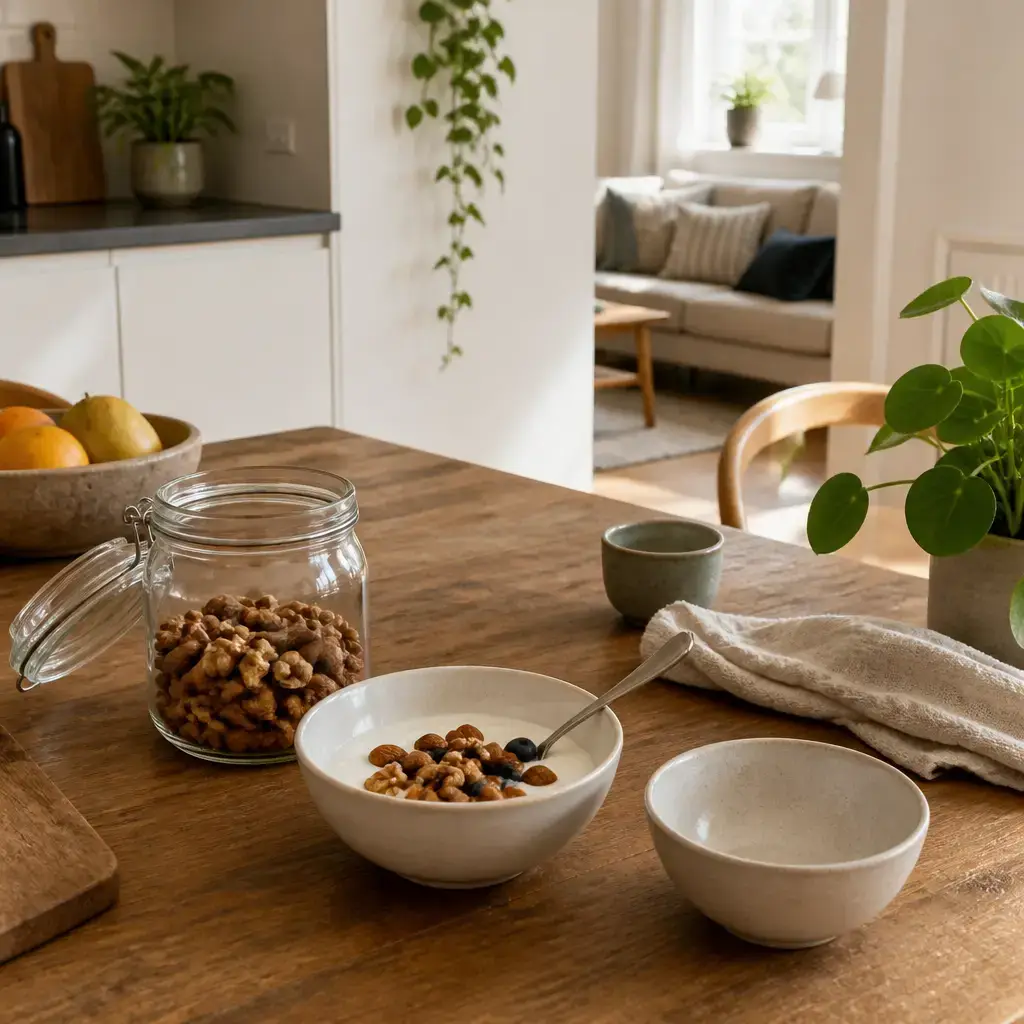
Yoghurt means “yogurt” and names the food suggested as a light snack. The dialogue uses yoghurt in for eksempel yoghurt and Yoghurt at the beginning of Yoghurt med nødder lyder godt; the capital letter in Yoghurt reflects its position at the start of the sentence.
Har
Har means “have” in the question Har vi også nødder? It begins a question about whether the household has another food item available.
vi
Vi means “we” in Har vi også nødder? and identifies the people included in the question. It is the subject after Har in this question about what is available at home.
også
Også means “also” or “too” in Har vi også nødder? It adds nuts to the food already being considered, and is useful when asking about an additional item.
nødder
Nødder means “nuts” and names the food being asked about and later combined with yoghurt. It appears in Har vi også nødder?, med nødder, and nogle nødder, showing how the item can be asked about, combined, or reserved.
Der
In Der er nogle i skabet, Der introduces the existence or presence of something. This form is useful for saying that an item is available in a particular place.
nogle
Nogle means “some” in Der er nogle i skabet and refers back to the nuts understood from the question. It also appears before the noun in nogle nødder, and is useful for referring to an unspecified amount.
i
I means “in” in i skabet and places the nuts inside the cupboard. It is used before the place that contains or holds something.
skabet
Skabet means “the cupboard” in i skabet and identifies the place where the nuts are kept. It is used after i when giving their location in the home.
med
Med means “with” in Yoghurt med nødder and connects the yoghurt with the nuts added to it. It is useful before an accompanying ingredient or item.
lyder
In Yoghurt med nødder lyder godt, lyder expresses how the combination seems or sounds to the speaker. It is useful when giving an impression of a proposed food, plan, or idea.
godt
In lyder godt, godt gives a positive evaluation of the yoghurt with nuts. Together with lyder, it says that the suggestion sounds good, a useful response to an idea.
Tag
Tag tells the listener to take something in Tag en lille skål. It is useful when giving a direct instruction about an object needed for an activity.
lille
Lille describes the bowl as small in en lille skål. It comes before skål and helps specify which kind or size of object to take.
skål
Skål means “bowl” and names the container requested in Tag en lille skål. It is the object taken when preparing the snack at home.
Det
In Det er ikke for meget, Det refers to the amount or portion being discussed. It introduces the statement that this amount is not excessive.
for
In ikke for meget, for marks an excessive degree and contributes the meaning “too.” This use differs from for in for eksempel, and here it is part of the quantity expression describing whether the amount is excessive.
meget
Meget refers to a large amount in ikke for meget. With for, it forms for meget, meaning that the amount would be too large; this is useful when judging a portion or quantity.
laver
In Jeg laver en nu, laver expresses making or preparing the item just chosen. It is useful when saying that you are preparing something immediately.
nu
Nu means “now” in Jeg laver en nu and places the preparation at the present moment. It is useful for emphasizing that an action is happening immediately.
Gem
Gem asks the listener to save or leave some nuts aside in Gem nogle nødder til mig, tak. It is useful when requesting that part of something be reserved for a person.
til
In Gem nogle nødder til mig, til marks the intended recipient of the reserved nuts. The pattern til mig identifies who the item is being kept for.
mig
Mig means “me” in til mig and identifies the person who should receive the reserved nuts. It follows til when the speaker names the intended recipient.
tak
At the end of Gem nogle nødder til mig, tak, tak makes the request polite and means “please” in this context. It is useful at the end of a request to soften the instruction.