Vores
“Vores” means “our” here and comes before the noun in “Vores gæst”. It is capitalized because it starts the sentence; the same possessive appears lowercase in “vores gæst”. It is useful before a noun when identifying something belonging to the speaker and another person or group.
gæst
“gæst” means “guest”, the person expected to arrive in “Vores gæst kommer snart”. It follows the possessive in “Vores gæst” and identifies the visitor in this situation. Use it for a person who is visiting someone.
kommer
“kommer” means “comes” or “arrives” in “Vores gæst kommer snart”. It is the form of komme used for the guest’s planned or expected arrival here. It can follow a person or thing and be followed by a time expression.
snart
“snart” means “soon” and places the arrival in the near future in “Vores gæst kommer snart”. It is a time word that modifies the action of arriving. Use it when an event is expected shortly.
Skal
“Skal” introduces a question about what the speakers should do in “Skal vi servere kaffe eller te?”. It comes before “vi” and the action “servere” in this question. This pattern is useful when suggesting or asking about a shared action.
vi
“vi” means “we” and refers to the speaker together with the listener in “Skal vi servere kaffe eller te?”. It follows “Skal” in the question and is the subject of the proposed action. Use it when including yourself and one or more other people.
servere
“servere” means “serve” in “Skal vi servere kaffe eller te?”. It is the action that follows “Skal” and takes the drink options “kaffe eller te” as its object. Use it when offering food or drinks to someone.
kaffe
“kaffe” means “coffee” and is one of the two drink choices in “kaffe eller te”. It functions as an object of “servere”. Use it when naming coffee as something to offer or serve.
eller
“eller” means “or” and connects the alternatives in “kaffe eller te”. It is used between two choices when asking which one is preferred. This is a reusable way to present alternatives.
te
“te” means “tea” in both “kaffe eller te” and “Te er nok bedre i aften”. It is lowercase after “eller” and capitalized at the beginning of the later sentence. Use it when naming tea as a drink.
er
“er” means “is” and links “Te” with the description “bedre” in “Te er nok bedre i aften”. It is the present form of være. A common reuse pattern is a subject followed by “er” and a description.
nok
“nok” means “probably” in “Te er nok bedre i aften”. It signals that the speaker considers this likely rather than stating it with complete certainty. It commonly appears in a statement when expressing a qualified judgment.
bedre
“bedre” means “better” in “Te er nok bedre i aften”, comparing tea with the other drink option in the conversation. It is the comparative form related to god. It can follow “er” when evaluating one option against another.
i
“i” means “in” as part of the time expression “i aften”, meaning “this evening”. Here it introduces the time period when tea is considered better. Use it before a time expression to locate an event in time.
aften
“aften” means “evening” in “i aften”. Together with “i”, it identifies the time period being discussed. Use it when referring to the evening as the time for an activity or event.
Jeg
“Jeg” means “I” and identifies the speaker as the person who will boil the water in “Jeg koger noget vand i elkedlen”. It is capitalized because it begins the sentence. Use it as the subject when stating your own action.
koger
“koger” means “boils” or “will boil” in “Jeg koger noget vand i elkedlen”. It is the form of koge used for the speaker’s planned action in this dialogue. It commonly takes a liquid or food as its object.
noget
“noget” means “some” in “noget vand”, referring to an unspecified amount of water. It comes before “vand”, which is not counted as separate individual items here. Use it before an unspecified amount of a substance or thing.
vand
“vand” means “water” and is the object of “koger” in “Jeg koger noget vand i elkedlen”. The quantity is introduced by “noget”. Use it when talking about water being boiled, poured, or used.
elkedlen
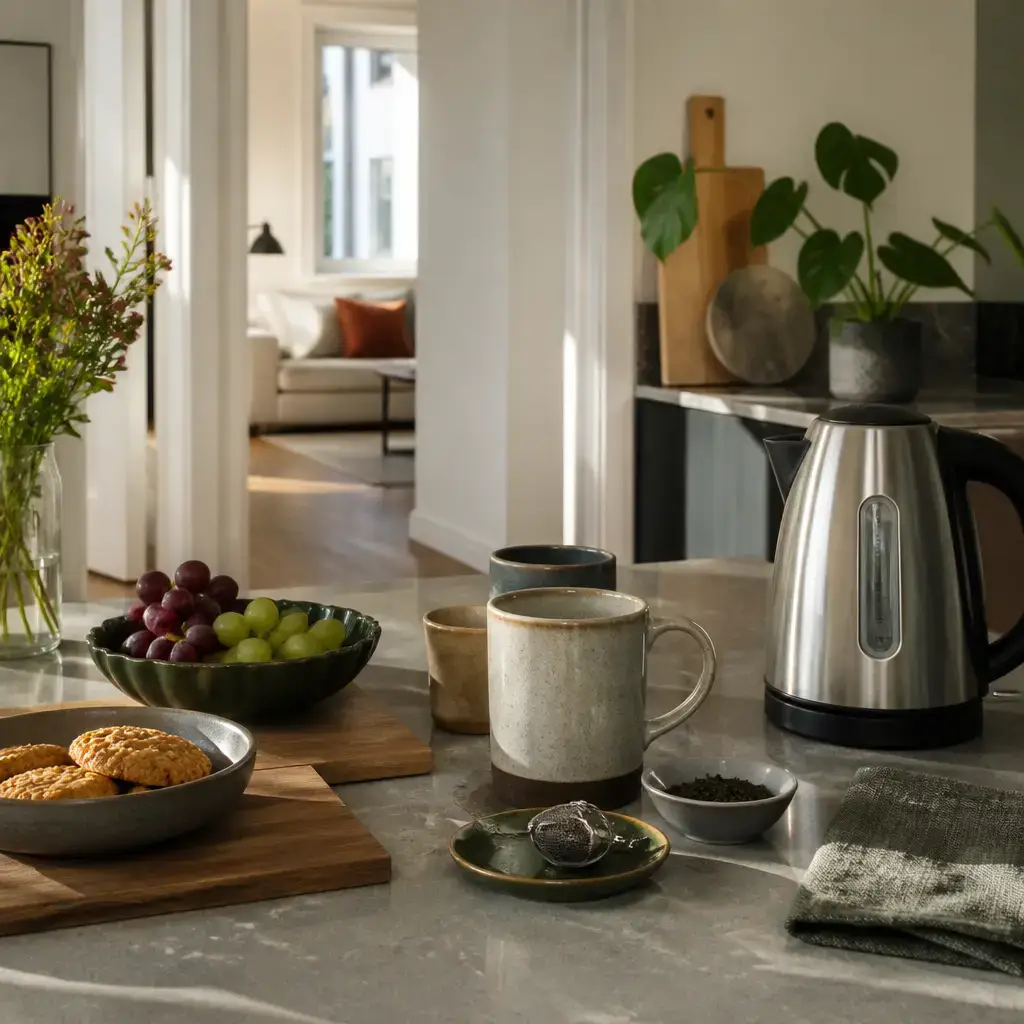
“elkedlen” means “the kettle” in “i elkedlen”. It is the definite form related to elkedel and refers to the specific kettle being used in the situation. Together with “i”, it identifies the container where the water is boiled.
Brug
“Brug” means “use” in the request “Brug venligst det store krus til vores gæst”. It is the command form of bruge and tells the listener what to do with the mug. Use it at the beginning of a request or instruction about an object.
venligst
“venligst” means “please” and makes “Brug venligst det store krus til vores gæst” a polite request. It appears directly after the command “Brug”. Use it to soften a direct instruction.
det
“det” helps form the definite noun phrase “det store krus”, referring to the specific mug intended for the guest. It occurs together with “store” and “krus”, rather than carrying the whole meaning of the phrase alone. Use it in a definite phrase of this type before an adjective and noun.
store
“store” means “large” in “det store krus” and describes the size of the mug. This form is used with “det” and “krus” in the definite noun phrase. Use it before a noun when describing something as large.
krus
“krus” means “mug” in “det store krus”. It is the object of “Brug” and names the drinking container selected for the guest. Use it when referring to a mug used for a hot or cold drink.
til
“til” means “for” in “til vores gæst”, identifying the intended user of the mug. It connects the mug with the guest who will receive or use it. Use it to mark a recipient or intended person.
Vil
“Vil” begins the question “Vil du have, at jeg også gør snacks klar?” and helps ask whether the listener wants the proposed action. It comes before “du” because this is a question. Use this opening when asking about another person’s wish or preference.
du
“du” means “you” and refers to the person being asked in “Vil du have, at jeg også gør snacks klar?”. It follows “Vil” in the question. Use it when addressing one person directly.
have
“have” contributes to the asking-for-a-wish construction “Vil du have, at jeg også gør snacks klar?”. It is the infinitive after “Vil” and is followed by an “at” clause describing the requested action. In this context, the construction asks whether the listener would like something to be done.
at
“at” means “that” in “at jeg også gør snacks klar” and introduces the clause describing the action the listener may want. It is followed by the subject “jeg” and the verb “gør”. Use it to connect a wish or request with a following clause.
også
“også” means “also” or “too” in “jeg også gør snacks klar”. It adds preparing snacks to the preparation of the drinks already being discussed. It appears before the action and can be used to add another item or activity.
gør
“gør” supplies the action of making or preparing in “gør snacks klar”. It is the form of gøre used with the object “snacks” and the resulting state “klar”. The reusable pattern places the thing being prepared between “gør” and “klar”.
snacks
“snacks” means “snacks” in “gør snacks klar”. It is the thing being prepared and is the object of “gør”. Use it when referring to small foods prepared to eat between or alongside meals.
klar
“klar” means “ready” in “gør snacks klar”, where it describes the state the snacks are being made into. The same word appears in “være klar”, where it describes readiness directly. Use it for something that is prepared and ready to use, serve, or do.
Læg
“Læg” means “put” or “place” in “Læg nogle kiks på den lille tallerken, tak”. It is the command form of lægge and tells the listener to move the biscuits to a location. Use it at the beginning of an instruction about placing something.
nogle
“nogle” means “some” in “nogle kiks” and indicates an unspecified quantity of biscuits. It comes before the noun it limits. Use it before plural countable items when the exact number is not important.
kiks
“kiks” means “biscuits” in “Læg nogle kiks på den lille tallerken, tak”. It is the object of “Læg” and names the food being placed. It follows the quantity word “nogle” in the noun phrase “nogle kiks”.
på
“på” means “on” in “på den lille tallerken”. It marks the plate as the surface where the biscuits should be placed. Use it with a surface or destination when something is put on top of it.
den
“den” helps form the definite noun phrase “den lille tallerken”, referring to the specific plate meant in the instruction. It appears before the adjective “lille” and noun “tallerken”. Use it in a definite phrase of this type when identifying a particular item.
lille
“lille” means “small” in “den lille tallerken” and describes the plate’s size. It appears between “den” and “tallerken” in the noun phrase. Use it before a noun when describing something as small.
tallerken
“tallerken” means “plate” in “den lille tallerken”. Together with “på”, it names the surface where the biscuits should be placed. Use it when referring to a plate for serving or holding food.
tak
“tak” means “please” at the end of the request “Læg nogle kiks på den lille tallerken, tak”. In this position, it politely softens the instruction. It is commonly used at the end of a request.
Alt
“Alt” means “everything” in “Alt vil være klar, før vores gæst kommer”. It makes all the preparations, including the drinks and snacks, the subject of the prediction. Use it when referring to all relevant things together.
være
“være” means “be” in “Alt vil være klar”. It is the infinitive that follows “vil” and connects “Alt” with the state “klar”. Use it after a modal such as “vil” when describing a future or expected state.
før
“før” means “before” in “før vores gæst kommer”. It introduces the event that will happen later than the preparations. Use it before a clause when ordering two events in time.