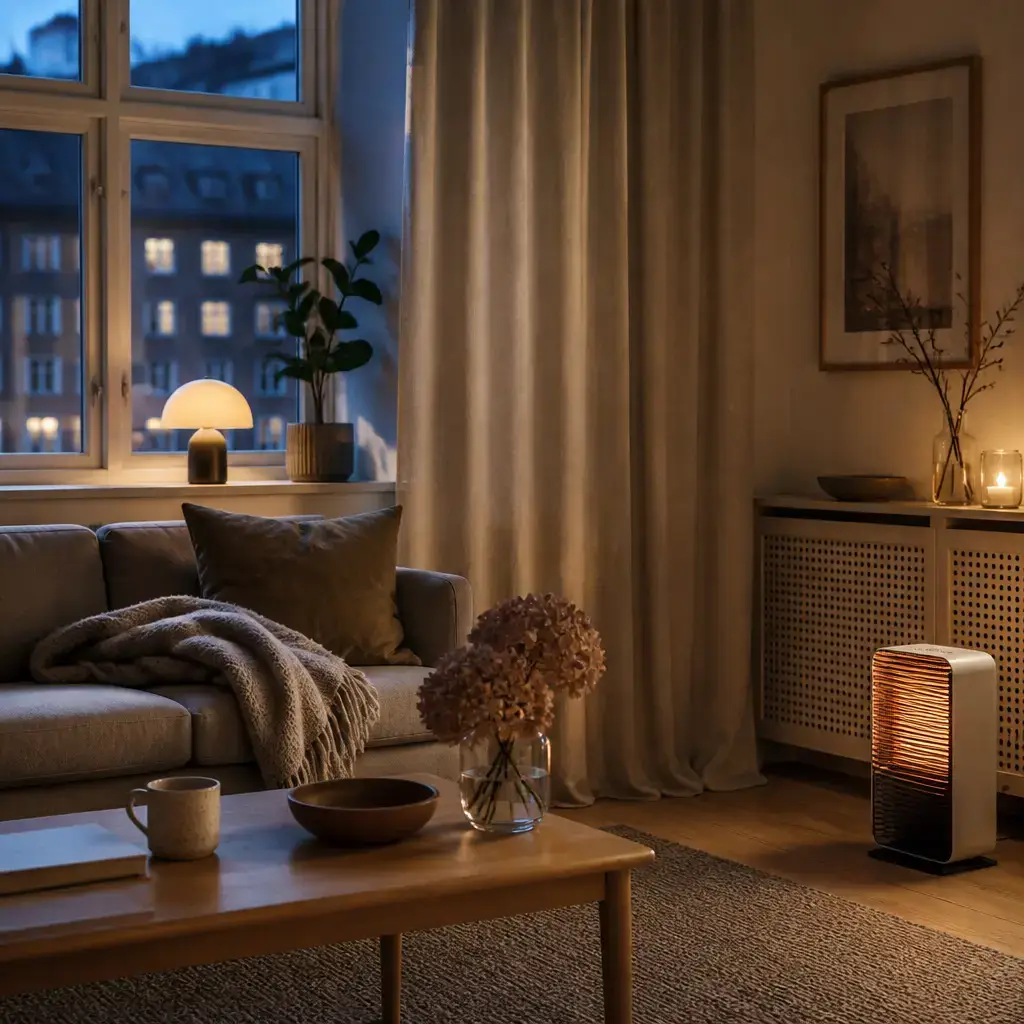
Det
In "Det bliver mørkt", "Det" introduces the situation without naming a person; in "gøre det", "det" refers back to the desired cozy result. It is useful when the situation or result is clear from context.
bliver
"bliver" means becomes or gets here, describing the change to darkness in "Det bliver mørkt". It is the form of blive used for this change, and it can describe something moving into a new state.
mørkt
"mørkt" means dark here and describes the condition in "Det bliver mørkt". It is the form of mørk used in this expression, and it can describe the changing light outside or in a room.
tidligere
"tidligere" means earlier here, showing that it gets dark earlier than before. It is the comparative form related to tidlig and is useful with an event that happens sooner.
for
In the exact expression "for tiden", "for" helps express the current period, meaning these days or at present. Reuse it as part of the complete time expression "for tiden".
tiden
In "for tiden", "tiden" refers to the current time or period, so the whole expression means these days. It is the definite form related to tid and is normally learned here together with "for".
Jeg
"Jeg" means I and identifies the person speaking in "Jeg lukker gardinerne". It is used before the action when the speaker says what they will do or can do.
lukker
"lukker" means closes or shuts here, referring to closing the curtains in "Jeg lukker gardinerne før aftensmaden". It is the form of lukke used for this action, with the thing being closed after it.
gardinerne
"gardinerne" means the curtains, specifically the curtains being closed in "lukker gardinerne". It is the definite form related to gardin and is used here as the object of the closing action.
før
"før" means before and places one event earlier than another in "før aftensmaden". It is useful for linking an action to a later meal, time, or event.
aftensmaden
"aftensmaden" means the dinner or evening meal in "før aftensmaden". It is the definite form related to aftensmad and names the meal used as the time reference.
Kan
At the beginning of "Kan du også tænde den lille varmeovn?", "Kan" asks whether the other person is able or willing to do something, so it means can or could. It is the form of kunne used in a request.
du
"du" means you and identifies the person being asked in "Kan du også tænde den lille varmeovn?". A useful request pattern is to place "du" after "Kan" when addressing one person.
også
"også" means also or too, adding this heater to the other actions in "Kan du også tænde den lille varmeovn?". It appears before the action "tænde" here and adds another requested task.
tænde
"tænde" means switch on or turn on, referring to the heater in "tænde den lille varmeovn". It is the infinitive form used after "Kan" and can be followed by the appliance being switched on.
den
In "den lille varmeovn", "den" identifies the specific heater, and in "sætte den på lav varme" it refers back to that heater. It is useful for pointing to a known item instead of repeating its noun.
lille
"lille" means small or little and describes the heater in "den lille varmeovn". It comes before the noun it describes and helps distinguish this heater from others.
varmeovn
"varmeovn" means heater and names the appliance in "den lille varmeovn". It is the object of "tænde" and the item referred to later by "den".
sætte
"sætte" means set or adjust here, as in adjusting the heater in "sætte den på lav varme". It is the infinitive form used after "kan" and is followed by the item and its selected setting.
på
In "sætte den på lav varme", "på" links the heater to the setting selected for it, meaning to or at that level. The complete pattern keeps the object before "på" and the setting after it.
lav
"lav" means low in "lav varme", describing the selected level of heat. It comes before the noun "varme" and is useful when choosing a low setting.
varme
"varme" means heat or warmth in "lav varme". Together with "lav", it names the low heat setting used for the heater.
Men
"Men" means but and introduces a contrast in "Men rummet føles allerede behageligt". It is useful when the next statement differs from or limits what was just suggested.
rummet
"rummet" means the room, the place whose condition is being discussed in "rummet føles allerede behageligt". It is the definite form related to rum and functions as the subject of the feeling described.
føles
"føles" means feels here, describing how the room seems in "rummet føles allerede behageligt". It is the form of føle used with the room as the thing being experienced, followed by a description of its state.
allerede
"allerede" means already and shows that the room is comfortable at this point in "føles allerede behageligt". It is useful for saying that a condition exists before an additional change is made.
behageligt
"behageligt" means comfortable or pleasant here and describes the room in "rummet føles allerede behageligt". It is the form related to behagelig used to describe this state.
vil
In "Jeg vil gerne have", "vil" contributes the speaker's wish or intention, so the phrase expresses wanting something. It is the form related to ville used in this desire construction.
gerne
"gerne" helps express a willing or desired action in "Jeg vil gerne have", giving the phrase the meaning would like or want to. It is commonly used together with "vil" when stating a wish.
have
In "vil gerne have, at rummet føles hyggeligt", "have" contributes the idea of wanting a particular result or state. It is followed here by "at" and the clause describing that result.
at
Here "at" introduces the clause "at rummet føles hyggeligt", which states the condition the speaker wants. It connects the wish in "vil gerne have" with the desired situation.
hyggeligt
"hyggeligt" means cozy or pleasantly comfortable and describes the desired feeling of the room in "rummet føles hyggeligt". It is the form related to hyggelig used for this cozy state.
i
In the time expression "i aften", "i" means in and places the situation in the evening. Reuse the complete expression when referring to this evening.
aften
"aften" means evening in "i aften", referring to the current evening. It names the time when the speaker wants the room to feel cozy.
En
"En" means a or one and introduces a non-specific lamp in "En lampe med blødere lys". It presents the lamp as a possible solution being suggested.
lampe
"lampe" means lamp and names the light source in "En lampe med blødere lys". It is the main noun of the suggestion and is described by the phrase that follows.
med
"med" means with and links the lamp to its softer light in "lampe med blødere lys". It is useful for describing an object together with a feature or accompanying thing.
blødere
"blødere" means softer and describes the light in "blødere lys". It is the comparative form related to blød and is used before the noun it describes.
lys
"lys" means light in "blødere lys", referring to the quality of light produced by the lamp. Together with "blødere", it describes a gentler lighting choice.
måske
"måske" means maybe and makes the suggestion less certain in "kan måske gøre det". It is useful when presenting a possible solution rather than a definite one.
gøre
"gøre" means make or do here, as part of "gøre det" for achieving the desired result. It is the infinitive form used after "kan" and refers to the effect of using the softer lamp.
uden
"uden" means without and introduces the result that should be avoided in "uden at gøre rummet for varmt". It is followed here by "at" and an action.
varmt
"varmt" means warm in "gøre rummet for varmt", describing the unwanted result that the room becomes too warm. It is the form related to varm used in this description.
får
In "får rummet til at føles meget roligere", "får" expresses causing the room to have a calmer feeling. It is the form of få used in the construction "får ... til at".
til
In "får rummet til at føles meget roligere", "til" is part of the construction that links the cause to the resulting feeling. The complete pattern includes the thing affected before "til at" and the resulting action after it.
meget
"meget" means much or very and intensifies the comparison in "meget roligere". It is placed before the describing word to make the difference in calmness stronger.
roligere
"roligere" means calmer and describes how the room feels in "føles meget roligere". It is the comparative form related to rolig and expresses a calmer result after the softer light is used.
Så
"Så" means then or so and introduces the result in "Så kan vi slappe af". It links relaxing to the earlier plan of eating and preparing the room.
vi
"vi" means we and identifies the people who will relax in "Så kan vi slappe af". It is used as the subject before the modal verb "kan".
slappe af
"slappe af" means relax in "Så kan vi slappe af, efter vi har spist". "slappe" carries the relaxing action and "af" completes this expression; it is useful after an activity when the purpose is to rest.
efter
"efter" means after and introduces the earlier activity in "efter vi har spist". It places relaxing after the meal and can link an action to a completed event.
har
In "har spist", "har" combines with "spist" to refer to eating completed before the later relaxing. It is the auxiliary used in this past-time clause.
spist
"spist" means eaten in "efter vi har spist", referring to the meal being finished before relaxing. It is the form related to spise used together with "har" in this clause.