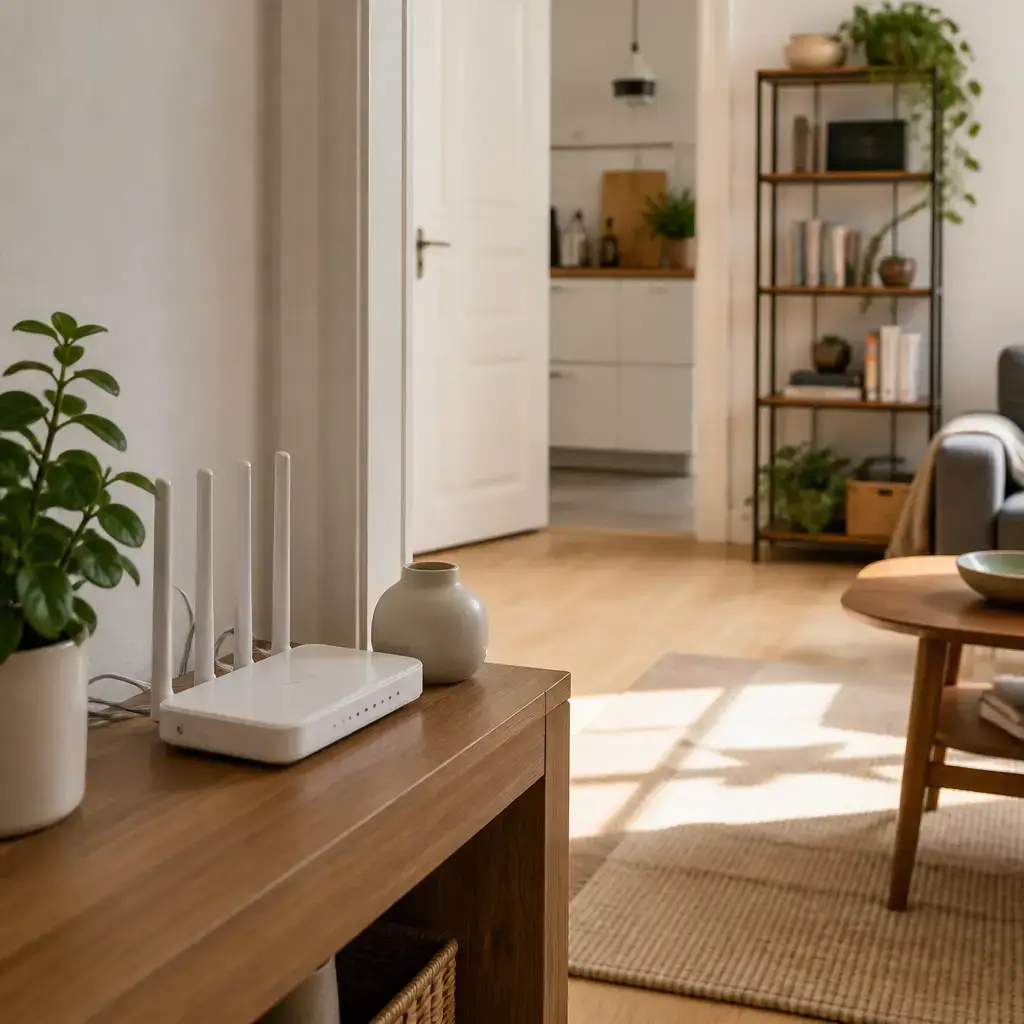
Internetforbindelsen
Internetforbindelsen means “the internet connection” in this sentence. It is the definite form of internetforbindelse, referring to the connection being discussed. Use it for a specific internet connection, as in Internetforbindelsen er svag.
er
Er means “is” here and links the internet connection with its description svag. It is the present form used in statements such as Internetforbindelsen er svag.
svag
Svag describes the internet connection as weak in this room. It follows er in Internetforbindelsen er svag. Use it to describe a connection or another thing that does not have much strength.
i
I means “in” and places the weak connection in a location: i dette rum. Use i with a place when saying where something is or happens.
dette
Dette means “this” in dette rum and points to the particular room where the speakers are. It is used directly before the noun in this expression. A reusable pattern is dette plus a place or object being identified.
rum
Rum means “room” in dette rum. The word refers to the room where the internet connection is weak. Use rum when talking about an indoor space, as in i dette rum.
Routeren
Routeren means “the router” and refers to the specific device that may need restarting. It is the definite form of router. Use it when a particular router is already known in the conversation.
har
Har means “has” in Routeren har måske brug for en hurtig genstart. Here it begins the expression for what the router needs. A reusable pattern is har brug for followed by the thing that is needed.
måske
Måske means “maybe” and makes the statement uncertain: the router may need a restart. It is placed before brug for in Routeren har måske brug for en hurtig genstart. Use måske when presenting a possibility rather than a certainty.
brug for
Brug for is the complete expression meaning “need” in Routeren har måske brug for en hurtig genstart. Brug supplies the need or use element, while for links it to the thing needed. Use har brug for followed by a noun or another needed thing.
en
En means “a” before hurtig genstart and introduces one unspecified restart. It appears directly before the adjective and noun phrase en hurtig genstart. Use en with a common-gender singular noun when introducing an unspecified item.
hurtig
Hurtig means “quick” and describes the restart as taking little time. It comes before genstart in en hurtig genstart. Use hurtig before a noun when describing a quick action or event.
genstart
Genstart means “restart” and names the action the router may need. It is the noun in en hurtig genstart. Use genstart when talking about restarting a device or system.
Skal
Skal means “should” in Skal jeg slukke den og tænde den igen? It asks whether the speaker ought to perform the suggested action. Use Skal plus a person and an action when asking what should be done.
jeg
Jeg means “I” and identifies the person who may turn the router off and on. It follows Skal in Skal jeg slukke den og tænde den igen? Use jeg when referring to yourself as the person doing an action.
slukke
Slukke means “turn off” in slukke den and refers to switching the router off. It follows Skal jeg in the question. Use slukke den when the object being turned off is understood from the conversation.
den
Den means “it” in slukke den and refers back to the router. It is placed after slukke as the object of that action. Use den when referring to a known object of the relevant type.
og
Og means “and” and joins the two actions slukke den and tænde den igen. It keeps the actions in the order they should happen. Use og to connect related actions or statements.
tænde
Tænde means “turn on” in tænde den igen and describes switching the router back on. It is coordinated with slukke by og. Use tænde den when turning a known device on.
igen
Igen means “again” and shows that the router is turned on once more after being turned off. It follows tænde den in tænde den igen. Use igen when an action is repeated or returned to a previous state.
Gør
Gør means “do” in the instruction Gør det. It tells the other person to carry out the action just discussed. This is a direct instruction, so use Gør det when telling someone to do that.
det
Det means “that” in Gør det and refers to turning the router off and on. It points back to the previous action rather than naming it again. Use Gør det when the action is already clear from the conversation.
vent
Vent means “wait” in vent så, til statuslampen lyser igen. It instructs the listener to pause while the router starts again. Use vent followed by a time or til-clause when saying how long someone should wait.
så
Så means “then” in vent så and marks the next step after turning the router off and on. It helps connect the instruction sequence. Use så to indicate what should happen next.
til
Til means “until” in til statuslampen lyser igen. It introduces the event that marks the end of the waiting period. Use vent til followed by an event when saying what someone should wait for.
statuslampen
Statuslampen means “the status light” and refers to the router’s particular indicator light. It is the definite form of statuslampe. Use it when discussing a known status light on a device.
lyser
Lyser means “lights up” or “is lit” in statuslampen lyser igen. It describes the status light becoming active again after the restart. Use lyser when describing a light that is shining or showing its status.
Siden
Siden means “the page” and refers to the page that is loading after the router restart. It is the definite form of side. Use it for a specific page already understood in the situation.
indlæses
Indlæses means “is loading” in Siden indlæses bedre nu. The form describes the page as being loaded, rather than naming a person who loads it. Use Siden indlæses when describing what is happening to a web page.
bedre
Bedre means “better” and shows that the page is loading more successfully than before. It modifies indlæses in Siden indlæses bedre nu. Use bedre when comparing the current result with an earlier one.
nu
Nu means “now” and places the improved loading in the present moment. It comes at the end of Siden indlæses bedre nu. Use nu to say that something is happening or true at this time.
kan
Kan expresses possibility in Det kan måske hjælpe: the proposed placement might help. Together with måske, it makes the suggestion tentative. Use kan followed by an action to say that something may be able to produce a result.
hjælpe
Hjælpe means “help” in Det kan måske hjælpe endnu mere. It describes producing a useful improvement, here for the internet connection. Use kan hjælpe followed by the person or thing that benefits when that object is stated.
endnu
Endnu means “even” in endnu mere and strengthens the comparison. It shows that the proposed change may improve the situation more than it already has. Use endnu before a comparative expression such as endnu mere.
mere
Mere means “more” in endnu mere and refers to an additional improvement. The phrase endnu mere means “even more.” Use mere when comparing an amount or degree with an earlier amount or degree.
at
At introduces the action phrase at stille den på en åben hylde. In the sentence, placing the router on an open shelf is presented as something that might help. Use at before an action phrase when that action functions as part of a larger statement.
stille
Stille means “put” or “place” in at stille den på en åben hylde. It describes placing the router somewhere. Use stille followed by the object and a location, as in stille den på en hylde.
på
På means “on” in på en åben hylde and shows the surface where the router would be placed. Use på with a surface or location when describing where something is put.
åben
Åben means “open” and describes the shelf as not enclosed. It comes before hylde in en åben hylde. Use åben before a noun when describing something that is open or unobstructed.
hylde
Hylde means “shelf” in en åben hylde. It names the place where the router might be put. Use hylde when talking about a raised storage surface.
vi
Vi means “we” and identifies the speakers together as the people who might move the router. It follows Skal in Skal vi flytte den hen ved døren? Use vi when referring to yourself and at least one other person.
flytte
Flytte means “move” in flytte den hen ved døren and refers to changing the router’s location. It follows Skal vi in the question. Use flytte followed by the object and its destination or new location.
hen
Hen adds the sense of moving the router over to a particular place in flytte den hen ved døren. It emphasizes the direction toward that location. Use hen with a movement expression when focusing on movement over to a place.
ved
Ved means “near” or “by” in ved døren and places the router close to the door. Use ved before a noun when describing something located near a person, object, or place.
døren
Døren means “the door” and refers to the specific door near which the router might be moved. It is the definite form of dør. Use it when a particular door is clear from the situation.
signalet
Signalet means “the signal” and refers to the internet signal that should reach the room. It is the definite form of signal. Use it when discussing a specific signal in the situation.
med
Med means “with” in hjælpe signalet med at nå ind i dette rum. In this construction, it introduces the action that the signal is helped to carry out. Use hjælpe someone or something med at followed by an action.
nå
Nå means “reach” in nå ind i dette rum and describes the signal getting into the room. It follows at in hjælpe signalet med at nå ind i dette rum. Use nå with a destination when saying that something reaches a place.
ind
Ind means “in” or “into” in nå ind i dette rum and adds movement into the room. It is used together with i dette rum to specify the destination. Use nå ind i followed by a place when something reaches the inside of that place.