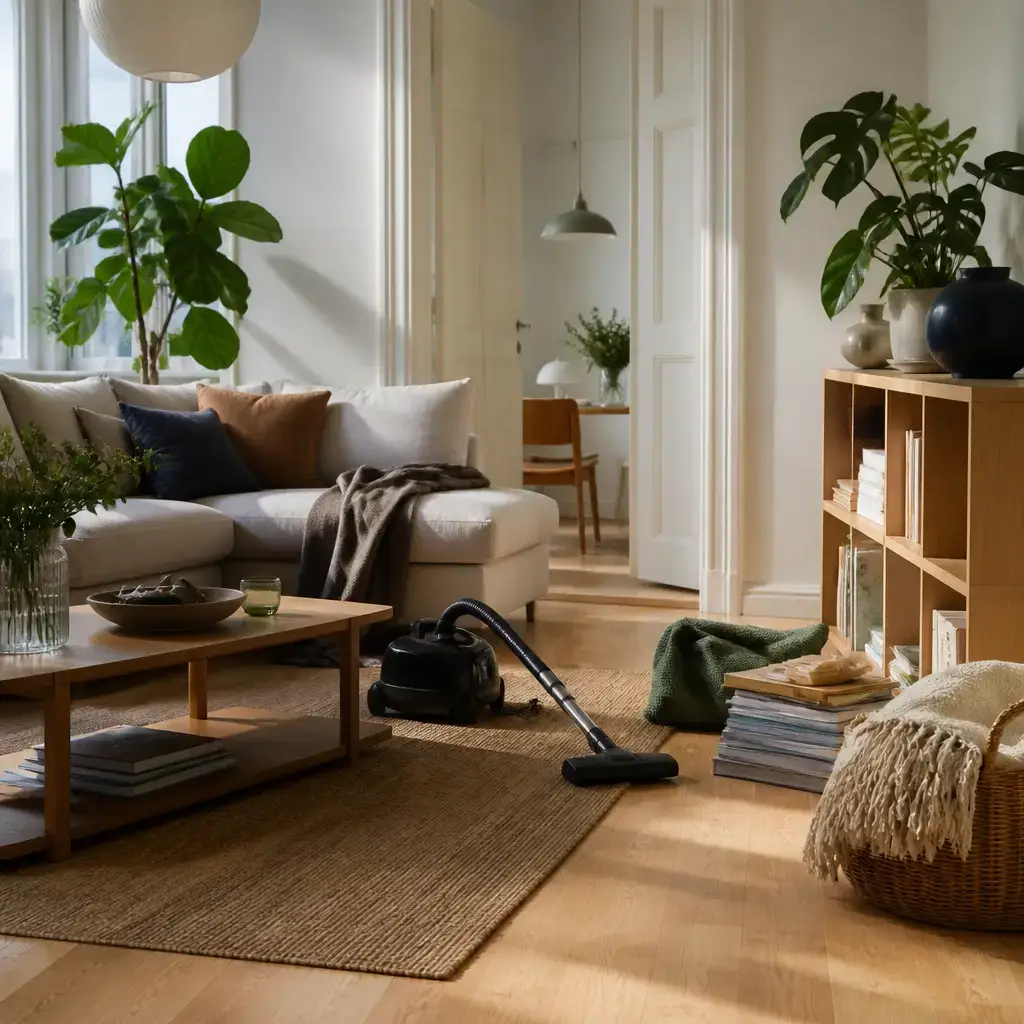
Vores
“Vores” means “our” in “Vores gæster”, showing that the guests are connected to the speakers. It can be reused before a plural noun, as in “Vores gæster”. Use it when talking about something belonging to or associated with a group that includes the speaker.
gæster
“Gæster” means “guests” in “Vores gæster”. It refers here to people who are expected to visit the home. Reuse it after a possessive such as “Vores gæster” when talking about visitors.
kommer
“Kommer” means “are coming” in “Vores gæster kommer snart”. It describes the guests’ expected arrival. Reuse it with a time expression, as in “kommer snart”, when saying that someone is arriving soon.
snart
“Snart” means “soon” in “Vores gæster kommer snart”. It places the arrival in the near future. Reuse it after an action or event when saying it will happen shortly.
Så
“Så” means “then” in “Så bør vi rydde stuen”. It connects the guests’ expected arrival with the action the speakers think they should take. Use “Så” at the beginning of a sentence to introduce a resulting suggestion or action.
bør
“Bør” expresses that the speakers ought to do something in “Så bør vi rydde stuen”. It gives advice or indicates an appropriate action. Reuse it before an action word, as in “bør vi rydde”, when suggesting what should happen.
vi
“Vi” means “we” in “bør vi rydde stuen”. It refers to the two speakers together. Reuse it as the subject when describing an action that the speaker and at least one other person will do.
rydde
“Rydde” means “clear” or “tidy” in “rydde stuen”. It describes putting the living room in order before the guests arrive. Reuse it with a place or area, as in “rydde stuen”, when talking about tidying that space.
stuen
“Stuen” means “the living room” in “rydde stuen”. It is the room the speakers plan to tidy and later describe as more comfortable. Reuse it after an action word when referring to the living room as the object of the action.
før
“Før” means “before” in “før de kommer”. It introduces the time that must pass before the guests arrive. Reuse it before a clause, as in “før de kommer”, to place one event earlier than another.
de
“De” means “they” in “før de kommer”, referring to the guests. It is the subject of the arrival clause. Reuse it before an action word when referring to several people already understood from the conversation.
Jeg
“Jeg” means “I” in “Jeg lægger bøgerne tilbage på hylden”. It identifies the speaker as the person putting the books back. Reuse it as the subject when describing your own action.
lægger
“Lægger” means “put” or “place” in “Jeg lægger bøgerne tilbage på hylden”. It describes placing the books somewhere, rather than merely having them there. The dialogue form comes from “lægge”; reuse it with an object and a location, as in “lægger bøgerne ... på hylden”.
bøgerne
“Bøgerne” means “the books” in “Jeg lægger bøgerne tilbage på hylden”. It refers to the particular books being returned to their place. Reuse it as the object after an action such as “Jeg lægger bøgerne”.
tilbage
“Tilbage” means “back” in “lægger bøgerne tilbage”. It shows that the books are being returned to an earlier location. Reuse it after an action of moving or placing something when it is being returned.
på
“På” means “on” in “på hylden”, identifying the surface where the books are placed. It is used here with the location “hylden”. Reuse “på” before a surface or place when describing where something is placed.
hylden
“Hylden” means “the shelf” in “på hylden”. It is the destination where the books are placed. Reuse it after a location word such as “på” when referring to the shelf.
retter
“Retter” means “straighten” or “adjust” in “Jeg retter puderne”. It describes arranging the cushions so they are in a neater position. The dialogue form comes from “rette”; reuse it with an object that can be adjusted, such as “retter puderne”.
puderne
“Puderne” means “the cushions” in “Jeg retter puderne på sofaen”. It refers to the particular cushions being arranged. Reuse it as the object after an action such as “retter”.
sofaen
“Sofaen” means “the sofa” in “på sofaen”. It identifies where the cushions are located. Reuse it after “på” when describing something positioned on the sofa.
Skal
“Skal” helps form the suggestion question “Skal vi også støvsuge tæppet?” Here it asks whether the speakers should vacuum the rug as an additional task. Reuse “Skal vi ...?” to suggest doing an action together.
også
“Også” means “also” or “as well” in “Skal vi også støvsuge tæppet?”. It adds vacuuming to the tidying tasks already mentioned. Reuse it before the added action or activity that someone is considering.
støvsuge
“Støvsuge” means “vacuum” in “støvsuge tæppet”. It names the cleaning action directed at the rug. Reuse it with the thing being cleaned, as in “støvsuge tæppet”.
tæppet
“Tæppet” means “the rug” or “the carpet” in “støvsuge tæppet”. It is the item that the speakers are considering vacuuming. Reuse it after a cleaning action when referring to this particular rug or carpet.
Det
“Det” means “it” in “Det ville hjælpe”. It refers to the suggested action of vacuuming as something that would be helpful. Reuse “Det ville ...” when referring back to an action or situation already understood.
ville
“Ville” expresses “would” in “Det ville hjælpe”. It presents the helpful result as a possible or expected consequence of vacuuming. Reuse it before an action word when describing what would happen under a condition or suggestion.
hjælpe
“Hjælpe” means “help” in “Det ville hjælpe”. It describes the positive effect that vacuuming would have. Reuse it after “ville”, as in “ville hjælpe”, to describe an action that would be useful.
at
“At” introduces the action “støvsuge” in “hjælpe at støvsuge”. It links the verb “hjælpe” with the action being discussed. Reuse “at” before an action word when that action is treated as the thing that helps or is being considered.
især
“Især” means “especially” in “især nær døren”. It highlights the area near the door as particularly important for vacuuming. Reuse it before the person, place, or thing that deserves special emphasis.
nær
“Nær” means “near” in “nær døren”. It identifies the location close to the door. Reuse it before a place or object when describing something that is close by.
døren
“Døren” means “the door” in “nær døren”. It is the reference point for the area that especially needs vacuuming. Reuse it after “nær” when referring to the door as a nearby location.
føles
“Føles” means “feels” in “Stuen føles allerede mere behagelig”. It describes the impression or quality the living room has after tidying. The dialogue form comes from “føle”; reuse it with a place or thing followed by a description of how it feels.
allerede
“Allerede” means “already” in “Stuen føles allerede mere behagelig”. It shows that the improvement can be noticed at this point. Reuse it when an action or change has happened sooner than or by the time expected.
mere
“Mere” means “more” in “mere behagelig”. It indicates an increase in comfort compared with before. Reuse it before a description when comparing the current quality with an earlier one.
behagelig
“Behagelig” means “comfortable” in “Stuen føles allerede mere behagelig”. It describes the living room as pleasant to be in after it has been tidied. Reuse it after “føles” when describing a comfortable or pleasant impression.
Lad
“Lad” helps form the suggestion “Lad os lave te”, meaning “let’s make tea”. It invites the other person to do the action together. Reuse “Lad os” before an action word when proposing a joint activity.
os
“Os” means “us” in “Lad os lave te”. Together with “Lad”, it includes the speaker and the other person in the proposed action. Reuse it in the pattern “Lad os” followed by an action when making a suggestion for the group.
lave
“Lave” means “make” in “lave te”. It describes preparing tea. Reuse it with something being prepared or made, as in “lave te”.
te
“Te” means “tea” in “lave te”. It is the drink the speakers plan to prepare once the room is ready. Reuse it after “lave” when talking about making tea.
når
“Når” means “when” or “once” in “når alt er klart”. It introduces the condition or time at which the speakers will make tea. Reuse it before a clause when one action will happen when another situation is reached.
alt
“Alt” means “everything” in “alt er klart”. It refers broadly to all the preparations that need to be finished. Reuse it as the subject when referring to all relevant things together.
klart
“Klart” means “ready” in “alt er klart”. It says that all the preparations are complete. Reuse it after “er” to describe something as ready.