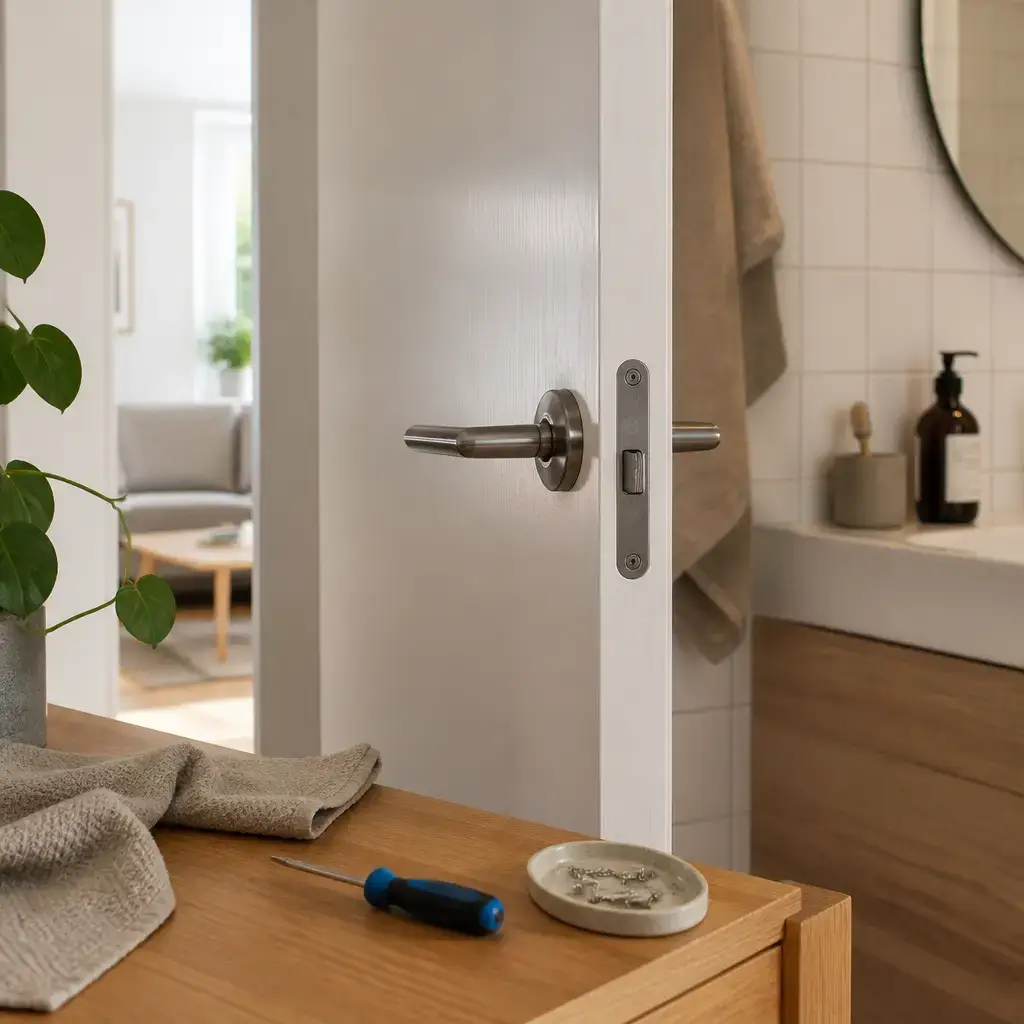
Håndtaget
“Håndtaget” means “the handle” in this dialogue. The ending makes it the specific handle being discussed, and “Håndtaget på badeværelsesdøren” is a useful pattern for naming a particular object.
på
In “på badeværelsesdøren”, “på” means “on” and links the handle to the door. A reusable pattern is one object “på” another object.
badeværelsesdøren
“Badeværelsesdøren” means “the bathroom door” here. It names the door where the handle is located, as in the expression “Håndtaget på badeværelsesdøren”.
føles
“Føles” means “feels” and describes how the handle seems when touched. “Det føles” is a useful pattern for describing how something feels.
løst
“Løst” means “loose” here and describes the condition of the handle after “føles”. The exact combination “føles løst” can be used when an object does not feel firmly attached.
igen
“Igen” means “again”, showing that the handle has become loose another time. It commonly comes at the end of a statement such as “føles løst igen”.
Jeg
“Jeg” means “I” and identifies the person who noticed the problem and forgot to tighten it. It is used as the subject in “Jeg lagde mærke til det”.
lagde mærke til
“Lagde mærke til” means “noticed” as a whole expression. “Lagde” provides the verb part, “mærke” contributes the idea of noticing, and “til” completes the expression; it can be followed by an object, as in “lagde mærke til det”.
det
“Det” means “it” and refers here to the loose handle. It is used as the object in “lagde mærke til det” and “stramme det”.
i
In the time expression “i går”, “i” means “in” and forms part of the meaning “yesterday”. The complete expression “i går” is used to place an action in the previous day.
går
In “i går”, “går” contributes to the meaning “yesterday”; the meaning comes from the whole time expression. Use the exact phrase “i går” when saying when something happened yesterday.
men
“Men” means “but” and connects the fact that the handle was noticed with the contrasting fact that it was not tightened. It is useful for joining two contrasting statements.
glemte
“Glemte” means “forgot” here and introduces an action that was not carried out. A reusable pattern is “glemte at” followed by an action, as in “glemte at stramme det”.
at
Here “at” marks the action that was forgotten in “glemte at stramme det”. It is used before the verb form “stramme” in this construction.
stramme
“Stramme” means “tighten”, referring to making the handle secure. In “at stramme det”, it follows “at” and takes “det” as the thing being tightened.
Har
“Har” means “have” in the question “Har vi en skruetrækker i skuffen?”. At the beginning of this question, it asks whether the needed tool is available.
vi
“Vi” means “we” and refers to the people at home together. In “Har vi”, it is the group being asked about having a screwdriver.
en
“En” means “a” before the noun “skruetrækker”. It introduces one non-specific screwdriver in “en skruetrækker”.
skruetrækker
“Skruetrækker” means “screwdriver”, the tool needed for the repair. It is used after “en” in “en skruetrækker” to name the tool being looked for.
skuffen
“Skuffen” means “the drawer” and identifies the place where the screwdriver may be. In “i skuffen”, it follows “i” to express location in a specific drawer.
Den
“Den” means “the one” and stands for the screwdriver already mentioned. In “Den lille”, it lets the speaker identify the smaller tool without repeating “skruetrækker”.
lille
“Lille” means “small” and describes the screwdriver in “Den lille”. The pattern “Den lille” can identify a small one among several objects.
burde
“Burde” means “should” here and expresses an expectation that the small screwdriver will be suitable. It is used before “virke” in “burde virke”.
virke
“Virke” means “work” in the sense of functioning successfully for the repair. The reusable pattern “burde virke til” expresses that something should be suitable for a particular object or task.
til
In “virke til de her skruer”, “til” means “for” and marks the screws the screwdriver is intended to work with. The pattern “virke til” can be followed by the relevant object.
de
“De” contributes the meaning “these” in the expression “de her skruer”. Together with “her”, it points to the particular screws at hand.
her
In “de her”, “her” adds the idea of “here” and helps point to the screws being discussed. The full expression “de her skruer” means “these screws”.
skruer
“Skruer” means “screws” and refers to the screws being tightened. In “de her skruer”, it names the specific screws nearby.
Kan
“Kan” means “can” or “could” in “Kan du holde håndtaget?”. At the beginning of the question, it introduces a request for the other person to do something.
du
“Du” means “you” and refers to the person being asked to hold the handle. It is the person addressed in “Kan du holde håndtaget?”.
holde
“Holde” means “hold” and describes keeping the handle in place. It follows “Kan” in “Kan du holde håndtaget?” and is followed by the object “håndtaget”.
mens
“Mens” means “while” and links two actions happening at the same time. In “mens jeg strammer det”, it introduces the action that takes place during the holding.
strammer
“Strammer” describes the tightening action in “mens jeg strammer det”. It is used with “det” for the thing being tightened, and the full clause is “jeg strammer det”.
holder
“Holder” means “hold” or “keep” in “Jeg holder det fast”. It describes keeping the handle from moving while the other person turns it; “holder ... fast” is a useful combination.
fast
“Fast” means “steady” here and describes the way the handle is being held. In “holder det fast”, it indicates that the object is kept firmly in place.
drejer
“Drejer” means “turns” and refers to turning the handle while it is being held. The pattern “drejer det” places the object after the action.
meget
“Meget” means “much” and strengthens the comparison in “meget mere stabilt”. It is useful before “mere” when emphasizing a greater change.
mere
“Mere” means “more” and shows that the handle is now more stable than before. In “meget mere stabilt”, it modifies the description of how the handle feels.
stabilt
“Stabilt” means “firm” or “stable” here and describes the improved feel of the handle. The full expression “føles meget mere stabilt” can describe something that feels noticeably steadier after a repair.
nu
“Nu” means “now” and marks the handle’s current condition after tightening. It is placed at the end of “Det føles meget mere stabilt nu”.
Lad
“Lad” means “let” in the suggestion “Lad os tjekke det igen senere”. The pattern “Lad os” is used to suggest doing an action together.
os
“Os” means “us” and refers to the speakers as a group in “Lad os”. It follows “Lad” in a suggestion for shared action.
tjekke
“Tjekke” means “check” and refers to examining the handle again later. It follows “Lad os” in the reusable pattern “Lad os tjekke det”.
senere
“Senere” means “later” and postpones the suggested check to a future time. In “tjekke det igen senere”, it tells when the checking should happen.
bare
“Bare” means “just” here and makes the precaution sound like a simple extra check. It appears in “bare for en sikkerheds skyld” to introduce the reason for checking again.
for en sikkerheds skyld
“For en sikkerheds skyld” means “just in case” as a whole expression. “For” frames the precaution, “en sikkerheds” builds the idea of safety, and “skyld” completes the fixed expression; it can follow an action, as in “tjekke det igen senere, bare for en sikkerheds skyld”.