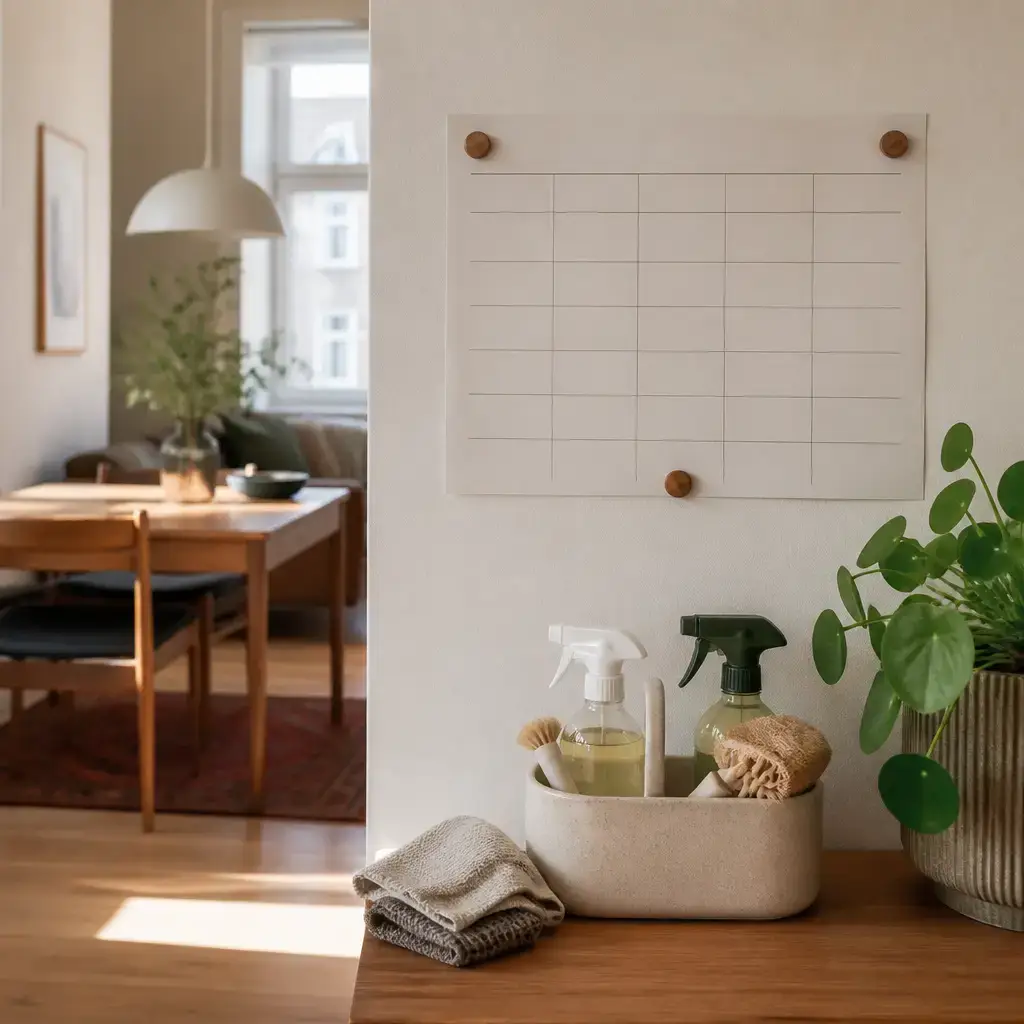
Vi
"Vi" means "we" and is the subject referring to both adults. At the beginning of a sentence it is capitalized; the same pronoun appears as lowercase "vi" later in the dialogue.
har
In "Vi har brug for", "har" is part of the Danish expression meaning "need". Reuse the pattern "har brug for" followed by the thing that is needed.
brug
In "har brug for", "brug" contributes to the expression for needing something; the whole expression means "need" here. Use "har brug for" before the needed person or thing.
for
In "har brug for", "for" completes the expression meaning "need" and introduces what is needed. The same pattern is used in "har brug for en bedre rengøringsplan".
en
"En" means "a" or "an" before "rengøringsplan", introducing one cleaning schedule. Reuse "en" before a singular noun when referring to one non-specific item.
bedre
"Bedre" means "better" and shows that the speakers want an improved schedule. It is used before the noun in "en bedre rengøringsplan".
rengøringsplan
"Rengøringsplan" means "cleaning schedule", the plan they need for organizing the chores. In "en bedre rengøringsplan for lejligheden", it is the thing they need.
lejligheden
"Lejligheden" means "the apartment", referring to the specific apartment where the speakers live. In "for lejligheden", it identifies what the cleaning schedule is for.
ikke
"Ikke" means "not" and makes the statement negative in "Vi har ikke delt pligterne ligeligt". It appears after "har" and before the action being negated.
delt
"Delt" means "divided" or "shared" in "har ikke delt pligterne ligeligt". The reusable pattern is "delt pligterne", referring to dividing the chores between people.
pligterne
"Pligterne" means "the chores", the household duties being divided. It is the object in "delt pligterne ligeligt".
ligeligt
"Ligeligt" means "evenly" and describes how the chores have or have not been divided. It is placed after "delt pligterne" in "delt pligterne ligeligt".
Jeg
"Jeg" means "I" and refers to the speaker doing the cleaning task. It is capitalized at the beginning of the sentence; the same pronoun appears as lowercase "jeg" later in the dialogue.
kan
"Kan" means "can" and expresses that the speaker is able or willing to take responsibility for the task. It is followed by the action in "kan tørre støv af hylderne".
tørre
"Tørre" means "wipe" in the dusting expression "tørre støv af hylderne". The pattern connects the wiping action with the dust and the surface being cleaned.
støv
"Støv" means "dust", the material being removed in "tørre støv af hylderne". It is used as the object of the dusting action.
af
In "tørre støv af hylderne", "af" contributes the idea of wiping dust off a surface. It completes the expression used for dusting.
hylderne
"Hylderne" means "the shelves", the surfaces from which the dust will be removed. In "støv af hylderne", it identifies the cleaned surface.
lørdag
"Lørdag" means "Saturday", the day chosen for dusting. It combines with "morgen" in the time expression "lørdag morgen".
morgen
"Morgen" means "morning" and specifies when on Saturday the task will happen. The dialogue uses the reusable time pattern "lørdag morgen".
Så
"Så" means "then" and links the speaker's proposed task to the previous arrangement. It introduces the next action in "Så vasker jeg gulvet".
vasker
In "vasker jeg gulvet", "vasker" means "wash" in the context of mopping the floor. It is used before the object "gulvet".
gulvet
"Gulvet" means "the floor", the surface that will be mopped. It is the object in "vasker jeg gulvet".
i
"I" means "in" and locates the floor in the kitchen in "gulvet i køkkenet". It is used before the place being specified.
køkkenet
"Køkkenet" means "the kitchen", the room where the floor is being mopped. In "i køkkenet", it gives the location.
efter
"Efter" means "after" and places the mopping after lunch in "efter frokost". It introduces the event used as the time reference.
frokost
"Frokost" means "lunch", the time reference for when the mopping will happen. The dialogue uses it after "efter" in "efter frokost".
Skal
"Skal" means "should" or "shall" in the question "Skal vi gøre badeværelset rent hver søndag?". Together with "vi", it proposes a shared plan.
gøre
In "gøre badeværelset rent", "gøre" contributes the idea of making the bathroom clean; the whole expression means "clean the bathroom". This pattern describes making something reach a condition.
badeværelset
"Badeværelset" means "the bathroom", the room that may be cleaned every Sunday. It is the object in "gøre badeværelset rent".
rent
In "gøre badeværelset rent", "rent" means "clean" and describes the condition the bathroom should reach. The expression as a whole means to clean the bathroom.
hver
"Hver" means "every" or "each" and indicates that the proposed cleaning should happen on each Sunday. It is used before the day in "hver søndag".
søndag
"Søndag" means "Sunday", the recurring day selected for cleaning the bathroom. It appears in the time expression "hver søndag" and again as "Søndag" at the start of the reply.
passer
In "Søndag passer godt", "passer" means "fits" or "works" for the plan. It is useful when evaluating whether a day or time is suitable.
godt
"Godt" means "well" in "passer godt", so the phrase means that Sunday works well. The phrase can be used to say that an arrangement is suitable.
fordi
"Fordi" means "because" and introduces the reason Sunday works well. It connects "Søndag passer godt" with the explanation that follows.
hurtigt
"Hurtigt" means "quickly" and describes how soon the bathroom becomes dirty in "hurtigt bliver beskidt". It is placed before the change described by "bliver beskidt".
bliver
"Bliver" means "becomes" or "gets" in "bliver beskidt", describing a change into a dirty condition. The pattern "bliver" followed by a description expresses a change of state.
beskidt
"Beskidt" means "dirty", the condition the bathroom reaches in "bliver beskidt". It completes the description of what happens to the bathroom.
sætter
"Sætter" means "puts" or "places" in "sætter rengøringsplanen på køleskabet". The pattern places an object on a surface or location.
rengøringsplanen
"Rengøringsplanen" means "the cleaning schedule", referring to the specific schedule they have just discussed. It is the object in "sætter rengøringsplanen på køleskabet".
på
"På" means "on" and shows that the schedule is placed on the fridge in "på køleskabet". It identifies the surface receiving the object.
køleskabet
"Køleskabet" means "the fridge", the place where the schedule will be put. In "på køleskabet", it names the surface or location.
Det
"Det" means "that" or "it" and refers to the preceding idea of putting the schedule on the fridge. It is the subject of "Det burde hjælpe os".
burde
"Burde" means "should" or "ought to" and expresses an expected helpful result in "Det burde hjælpe os". It is followed by the action that is expected to happen.
hjælpe
"Hjælpe" means "help" in "hjælpe os med at huske hver opgave". The pattern says who is helped and what activity the help supports.
os
"Os" means "us" and refers to the two adults who are expected to benefit from the schedule. It follows "hjælpe" in "hjælpe os med at huske".
med
In "hjælpe os med at huske", "med" connects the help with the activity being supported. A reusable pattern is "hjælpe" someone "med at" do an activity.
at
"At" introduces the activity in "med at huske hver opgave". It connects "med" with the action that the speakers need help carrying out.
huske
"Huske" means "remember", the activity the schedule should help them carry out. It appears after "at" in "at huske hver opgave".
opgave
"Opgave" means "task", referring to each individual cleaning duty in "hver opgave". The pattern "hver opgave" identifies the tasks one by one.