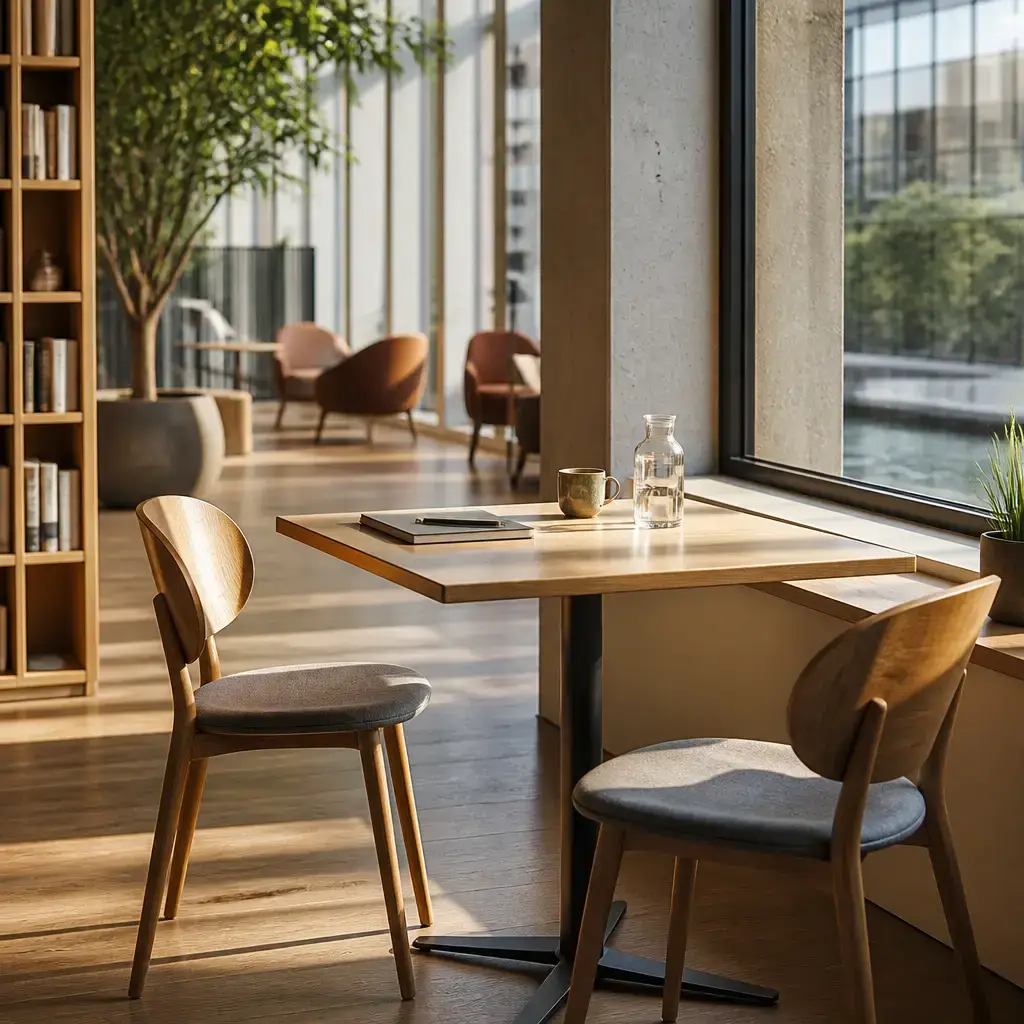
Hvor
Hvor means “where” here and asks for the place where the speakers should sit. It commonly comes at the beginning of a question about location, as in Hvor skal vi sidde?
skal
Skal expresses “should” in Hvor skal vi sidde? and presents sitting as something to decide or arrange. It is used with the infinitive sidde in this question.
vi
Vi means “we” and refers to the two people deciding together. It is the subject in Hvor skal vi sidde? and commonly appears before the main verb in this question pattern.
sidde
Sidde means “sit” in Hvor skal vi sidde? and Lad os sidde ved dette bord. It is used in the infinitive after skal and in the invitation Lad os sidde.
Bordet
Bordet means “the table” and identifies the specific table being discussed. It is the definite form of bord and is the subject in Bordet i hjørnet står et roligt sted.
i
I means “in” in i hjørnet, locating the table in relation to the corner. It commonly comes before a place expression, as in Bordet i hjørnet.
hjørnet
Hjørnet means “the corner” in i hjørnet. It is the definite form referring to a particular corner, and the phrase i hjørnet identifies which table is meant.
står
Står means “stands” or “is located” in Bordet i hjørnet står et roligt sted. With an object such as a table, it describes where the object is positioned.
et
Et means “a” in et roligt sted and introduces one unspecified place. Here it is used before the neuter noun sted in the phrase et roligt sted.
roligt
Roligt means “quiet” and describes the place as calm rather than busy in et roligt sted. It appears directly before sted and gives a quality of the proposed sitting location.
sted
Sted means “place” or “spot” in et roligt sted. It is used after an adjective to describe a location, and here it identifies where the table is situated.
Der
Der introduces the existence statement Der er også godt lys ved dette bord, meaning that there is also good light by this table. It is used at the beginning of this type of statement to present something as present or available.
er
Er is the verb form used in Der er også godt lys ved dette bord to say that the light exists or is present there. Together with Der, it forms an existence statement about the light by the table.
også
Også means “also” or “too” and adds good light as another positive feature of the table. It can be placed before the information being added, as in Der er også godt lys.
godt
Godt means “good” or “nice” here and describes the light in godt lys. It comes before lys and presents the lighting as suitable for the speakers’ purpose.
lys
Lys means “light” in godt lys and refers to the lighting available by the table. It can be used after a describing word such as godt when discussing the quality of lighting.
ved
Ved means “at” or “by” in ved dette bord and locates the light next to the table. It is also used in læse ved to indicate the table at which someone reads.
dette
Dette means “this” and points to the particular table the speakers are considering. It comes directly before bord in dette bord to identify the nearby or selected table.
bord
Bord means “table” in dette bord and names the piece of furniture being chosen. It follows the demonstrative dette in the phrase dette bord.
ville
Ville means “would” in Dette bord ville være bedre at læse ved and presents an evaluation or suggestion about the table. It is used with være to express that the table would be more suitable for reading.
være
Være means “be” in ville være bedre and links the table with the evaluation better. It follows ville in the expression Dette bord ville være bedre.
bedre
Bedre means “better” and compares this table with another possible place for reading. In Dette bord ville være bedre at læse ved, it evaluates the table’s suitability for that activity.
at
At introduces the infinitive læse in bedre at læse ved. The expression at læse ved describes reading at or by the table, so at connects the activity to the evaluation.
læse
Læse means “read” in at læse ved and names the activity for which the table would be better. It is used after at in the infinitive expression bedre at læse ved.
disse
Disse means “these” and points to the particular chairs nearby in Er disse stole behagelige? It comes before the plural noun stole to identify more than one chair.
stole
Stole means “chairs” and refers to the seats whose comfort is being checked. It is the plural form used after disse in disse stole.
behagelige
Behagelige means “comfortable” and describes the chairs in Er disse stole behagelige? It follows er as the description being asked about and agrees with the plural chairs in this sentence.
De
De means “they” and refers back to the chairs in the reply De føles helt fine for mig. It is used as the subject when giving an assessment of those chairs.
føles
Føles means “feel” in De føles helt fine for mig and describes the impression the chairs give to the speaker. It is used with a subject such as De and a description such as helt fine.
helt
Helt means “quite” or “completely” in helt fine and strengthens the positive assessment. It comes before fine to show that the chairs feel fully okay to the speaker.
fine
Fine means “fine” or “okay” in De føles helt fine for mig. Together with føles, it gives a practical assessment of the chairs’ comfort.
for
For means “for” or “to” in for mig and marks whose personal assessment is being expressed. The phrase helt fine for mig means that the chairs feel fine from the speaker’s point of view.
mig
Mig means “me” in for mig and identifies the person giving the assessment. It follows for in this phrase to show whose experience or opinion is meant.
Lad os
Lad os means “let’s” in Lad os sidde ved dette bord and introduces a suggestion for joint action. Lad contributes the idea of letting or inviting, while os means “us”; together they form an invitation followed by the activity sidde.
Jeg
Jeg means “I” and identifies the person who will put the bags away. It is the subject at the beginning of Jeg lægger vores tasker under det.
lægger
Lægger means “put” or “place” in Jeg lægger vores tasker under det and describes placing the bags somewhere. It is used with an object, vores tasker, and a location, under det.
vores
Vores means “our” and shows that the bags belong to both speakers in vores tasker. It comes directly before the noun tasker to mark shared possession.
tasker
Tasker means “bags” and refers to the items being placed under the table. It is the plural noun in Jeg lægger vores tasker under det.
under
Under means “under” and identifies the bags’ destination in under det. It is used before the reference to the object beneath which something is placed.
det
Det means “it” in under det and refers back to the table, not to the bags. It allows the speaker to avoid repeating the table while preserving the location under the table.