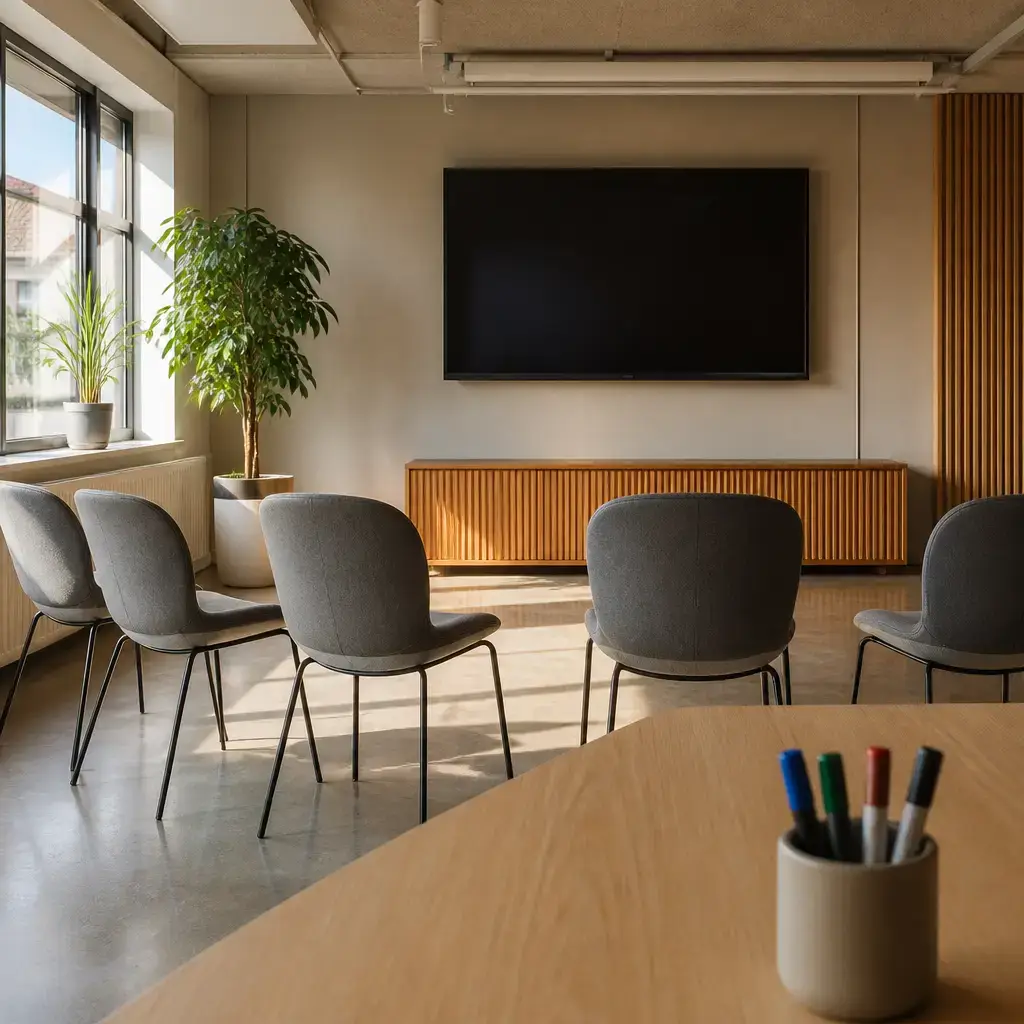
About This Lesson
Use Checking the room to practice Danish conversation, pronunciation, vocabulary, grammar, and quizzes.
Dialogue
A
Er lokalet klart?
air loh-KAY-luhth KLAHD? Is the room ready?
B
Stolene står på plads.
STOH-luh-nuh staw poh PLASS. The chairs are in place.
A
Virker skærmen?
VAIR-guh SKAIR-mun? Is the screen working?
B
Billedet ser tydeligt ud.
BEL-uh-thuh say TEW-thuh-lee oo. The picture looks clear.
A
Har vi tuscher?
hah vee TOOS-guh? Do we have markers?
B
De ligger på bordet.
dee LEH-guh poh BOHR-thuh. They're on the table.
A
Er der plads til at gå rundt?
air dah PLASS till eh goh ROHN? Is there space to move around?
B
Der er plads nok til at gå rundt.
dah air PLASS nawk till eh goh ROHN. There's enough room to walk around.Word by Word
Er
“Er” means “is” in “Er lokalet klart?” It comes before the subject to form a yes-or-no question. Use this question pattern to check whether something is ready or in a certain condition.
lokalet
“lokalet” means “the room” being checked. The form refers to one specific room, not a room in general. Use it when talking about the particular room involved in the situation.
klart
“klart” means “ready” in “Er lokalet klart?” It describes the condition of the room. Use it after “er” when asking or stating whether a room or setup is ready.
Stolene
“Stolene” means “the chairs” in “Stolene står på plads.” It refers to the specific chairs in the room and is plural. Use it when identifying those chairs as the subject of a statement about their position.
står
“står” means “are standing” or “are positioned” here. In “Stolene står på plads,” it says that the chairs are in their intended positions. Use this form to describe how an object is positioned.
på
In “på plads,” “på” helps express the relation to a position; the whole phrase means “in place.” The dialogue also uses “på bordet” to express location on a surface. Use it as part of a location phrase.
plads
In “på plads,” “plads” means a place or position, so the whole phrase means “in place.” In “Er der plads til at gå rundt?” the same word instead means available space. The surrounding construction determines which meaning applies.
Virker
“Virker” means “works” or “is functioning” in “Virker skærmen?” It comes before the subject to form a yes-or-no question. Use this question pattern when checking whether equipment is functioning.
skærmen
“skærmen” means “the screen” in “Virker skærmen?” It refers to the specific screen being checked. Use it when talking about that screen as the subject of a question or statement.
Billedet
“Billedet” means “the picture” in “Billedet ser tydeligt ud.” It refers to the specific picture shown on the screen. Use this form when discussing that particular picture.
ser
In “ser tydeligt ud,” “ser” contributes the idea of looking or appearing; the whole construction means “looks clear.” Use this construction when reporting how something appears.
tydeligt
“tydeligt” means “clear” in “Billedet ser tydeligt ud.” It describes the picture’s appearance inside the construction with “ser” and “ud.” Use it to describe something that appears clear.
ud
In “ser tydeligt ud,” “ud” completes the construction that means “looks clear” or “appears clear.” It does not mean “out” by itself in this sentence. Use it with “ser” and a description when stating how something looks.
Har
“Har” means “have” in “Har vi tuscher?” It comes before “vi” because the sentence is a question. Use this pattern to check whether the group has a needed item.
vi
“vi” means “we” and refers to the speaker together with another person or group. In “Har vi tuscher?” it is the subject after the question verb. Use it when including yourself with others.
tuscher
“tuscher” means “markers” in “Har vi tuscher?” It names the markers that the speakers are checking for. Use it after “har” when asking whether markers are available.
De
“De” means “they” here and refers back to “tuscher.” In “De ligger på bordet,” it is the subject describing where the markers are. Use it to refer back to plural items already mentioned.
ligger
“ligger” means “are located” or “lie” here. In “De ligger på bordet,” it tells where the markers are. Use it to state the location of an item together with a location phrase.
bordet
“bordet” means “the table” in “De ligger på bordet.” It refers to the specific table where the markers are located. Use it after a location word such as “på” when identifying that table.
der
“der” introduces the existence or availability of space in “Er der plads til at gå rundt?” It is also part of “Der er plads nok til at gå rundt.” Use “der er” to say that something is present or available.
til
In “plads til at gå rundt,” “til” links the available space with the activity it permits; the whole phrase means “space to walk around.” Use it before an activity in this construction.
at
“at” marks the infinitive “gå” in “til at gå rundt.” Together with “til,” it introduces the activity for which there is space. Use it before the verb in this kind of infinitive construction.
gå
“gå” means “walk” or “go” in “gå rundt.” Here it describes moving around the room. Use it with “rundt” when talking about movement around an area.
rundt
“rundt” means “around” in “gå rundt.” It specifies that the movement takes place around the room rather than in only one direction. Use it after “gå” to describe moving around a place.
nok
“nok” means “enough” in “Der er plads nok til at gå rundt.” It comes after “plads” to say that the amount of space is sufficient. Use a noun followed by “nok” to state that there is enough of something.
Grammar Points
klar → klart
Lokalet er klart.
loh-KAY-luhth air KLAHDThe room is ready.
Adjectives take -t after neuter nouns such as et lokale.
stol → stolene
Stolene står på plads.
STOH-luh-nuh staw poh PLASSThe chairs are in place.
Danish often marks definite plural nouns with the suffix -ene.
Danish Vocabulary
billede
noun
BEL-uh-thuh
picture
billedet
- Gender
- neuter
have
verb
HEH-vuh
to have
har
klar
adj
KLAHR
ready
klart
- Gender
- neuter
lokale
noun
loh-KAY-luh
room
lokalet
- Gender
- neuter
på plads
phrase
poh PLASS
in place
se
verb
SAY
to look; to seem
ser
skærm
noun
SKAIR-m
screen
skærmen
- Gender
- common
stol
noun
STOHL
chair
stolene
- Gender
- common
stå
verb
STAW
to stand
står
tydelig
adj
TEW-thuh-lee
clear
tydeligt
- Gender
- neuter
virke
verb
VAIR-guh
to work; to function
virker
være
verb
VAIR-uh
to be
er
Quiz
Word Order
Arrange the words in the correct order.
Is the room ready?
Show Answer
Er lokalet klart?The chairs are in place.
Show Answer
Stolene står på plads.Is the screen working?
Show Answer
Virker skærmen?Spelling
Tap the letters to spell the word.
chair
Show Answer
stolenescreen
Show Answer
skærmenroom
Show Answer
lokaletready