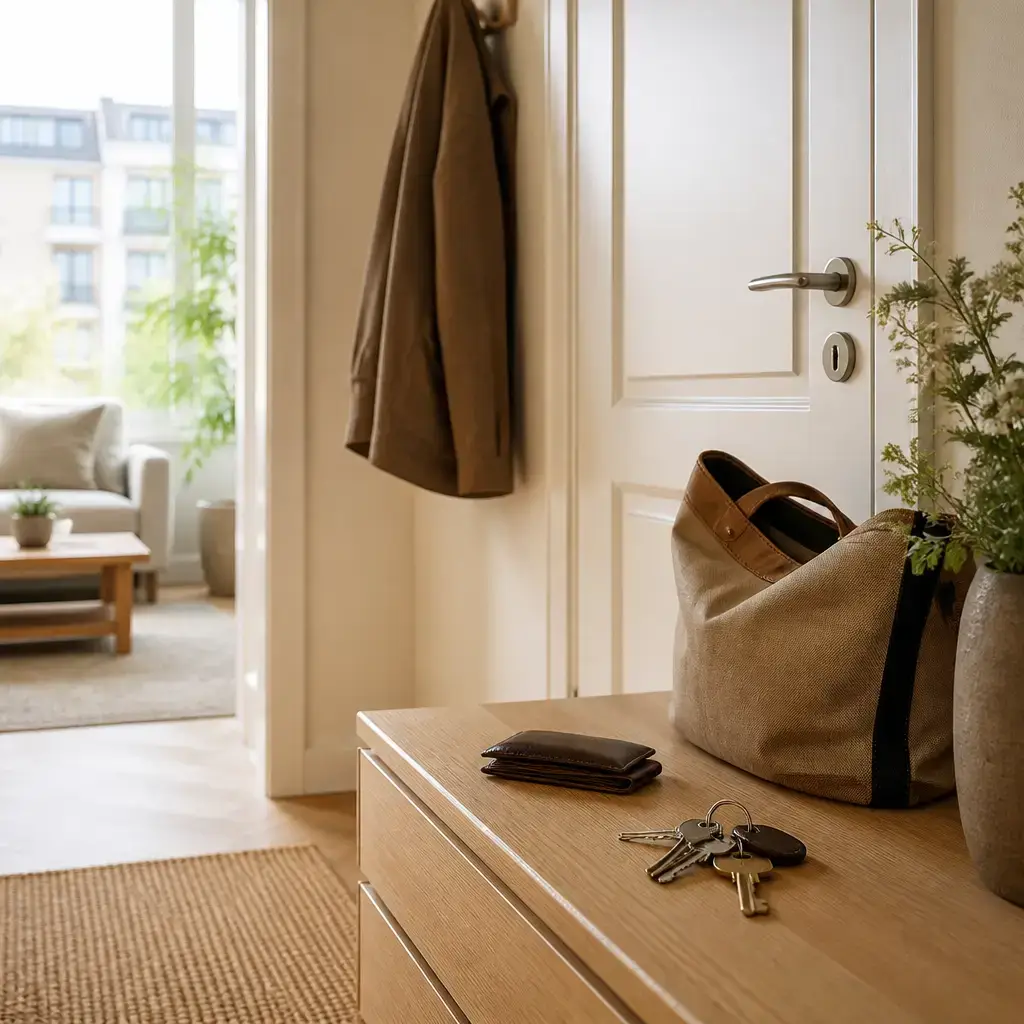
About This Lesson
Use Checking before leaving to practice Danish conversation, pronunciation, vocabulary, grammar, and quizzes.
Dialogue
A
Har vi alt, før vi går?
hah vee AHL, fuh vee GOH? Do we have everything before we leave?
B
Lad os tjekke nu.
lah ohs CHEH-guh NOO. Let's check now.
A
Har du dine nøgler?
hah doo DEE-nuh NUR-luh? Do you have your keys?
B
De er i min lomme.
dee air ee meen LAW-muh. They're in my pocket.
A
Er din pung i din taske?
air din PONG ee din TAS-guh? Is your wallet in your bag?
B
Jeg lagde den derind.
yai LEH-dhuh den dair-EN. I put it in there.
A
Er døren låst?
air DUR-uh LOHST? Is the door locked?
B
Jeg tjekkede den lige før.
yai CHEH-guh-dhuh den LEE-uh fuh. I checked it just now.Word by Word
Har
Here, “Har” means “have” and starts the question “Har vi alt” about whether everything is available. In a question, it comes before the subject, as in “Har du dine nøgler?” You can use “Har + person + thing?” to ask whether someone has something.
vi
“vi” means “we” and is the subject of “Har vi alt”. It refers to the two people checking their things together. Use it before the verb when talking about yourself and at least one other person, as in “vi går”.
alt
“alt” means “everything” and is the thing the speakers ask whether they have. In “Har vi alt”, it refers to all the necessary items before leaving. You can use “Har vi alt?” when checking that nothing important is missing.
før
“før” means “before” and introduces the event that must happen first in “før vi går”. It links one action or time to another. Use “før + subject + verb” for a time relationship, such as “før vi går”.
går
Here, “går” means “go” or “leave” in “før vi går”. It describes the speakers leaving home. Use it after “vi” when saying that you or the group are going somewhere or leaving.
Lad
“Lad” helps form the suggestion “Lad os tjekke nu”, meaning “Let’s check now”. Together with “os”, it invites the other person to do something with the speaker. A common pattern is “Lad os + verb”, such as “Lad os tjekke”.
os
“os” means “us” in the suggestion “Lad os tjekke nu”. It identifies the people who should do the action together. Use it after “Lad” in the reusable pattern “Lad os + verb”.
tjekke
“tjekke” means “check” in “Lad os tjekke nu”. It names the action the speakers suggest doing. Use it after “Lad os” and add the thing being checked when needed: “Lad os tjekke + thing”.
nu
“nu” means “now” and says that the checking should happen at the present time. It comes after the action in “tjekke nu”. Use it with an action to make clear that it should happen immediately or at this moment.
du
“du” means “you” and is the person being asked about the keys in “Har du dine nøgler?” It refers directly to the other speaker. Use it after “Har” when asking whether the other person has something.
dine
“dine” means “your” and refers to the listener’s keys in “dine nøgler”. It is placed before the plural item that belongs to the listener. Use the pattern “dine + plural item”, as in “dine nøgler”.
nøgler
“nøgler” means “keys” and is the item asked about in “Har du dine nøgler?” The word appears after “dine” to identify the listener’s keys. You can use “dine nøgler” when checking whether someone has their keys.
De
“De” means “they” and refers back to the keys in “De er i min lomme”. It is the subject of the answer about where the keys are. Use it to refer to the keys after they have already been mentioned.
Er
At the beginning of “Er din pung i din taske?”, “Er” means “is” and starts a question about the wallet’s location. The lowercase form “er” in “De er i min lomme” means “are”. Use “Er” before the subject when asking whether something is in a particular place.
i
“i” means “in” and shows location in “i min lomme” and “i din taske”. It is followed by the place or container where something is located. Use “i + place”, such as “i min lomme”.
min
“min” means “my” in “min lomme”. It shows that the pocket belongs to the speaker. Use it before the item or place that belongs to you, as in “min lomme”.
lomme
“lomme” means “pocket” and identifies the place where the keys are in “i min lomme”. It follows “min” in this expression. You can use “i min lomme” when saying that something is in your pocket.
din
“din” means “your” in “din pung” and “din taske”. It shows that the wallet and bag belong to the person being addressed. Use it before the owned item, as in “din pung” or “din taske”.
pung
“pung” means “wallet” in “Er din pung i din taske?” It identifies the item whose location is being checked. Use “din pung” when asking or talking about the listener’s wallet.
taske
“taske” means “bag” in “i din taske”. It identifies the container where the wallet may be located. You can use “i din taske” when saying that something is in the other person’s bag.
Jeg
“Jeg” means “I” and introduces the speaker’s actions in “Jeg lagde den derind” and “Jeg tjekkede den lige før”. It comes before the verb when the speaker describes what they did. A reusable pattern is “Jeg + verb”, as in “Jeg tjekkede”.
lagde
“lagde” means “put” or “placed” in “Jeg lagde den derind”. It says that the speaker placed the wallet inside the bag. Use “Jeg lagde + object + place”, keeping the object and destination in the sentence.
den
“den” means “it” and refers back to the wallet in “Jeg lagde den derind”. It is the item that the speaker placed in the bag. Use it after a verb such as “lagde” when the item has already been mentioned.
derind
“derind” means “in there” in “Jeg lagde den derind”. It points to an inside location that is understood from the context, here the bag. Use it after a placement verb when the destination is clear.
døren
“døren” means “the door” in “Er døren låst?” It refers to the particular door the speakers are checking before leaving. Use “Er døren låst?” when asking whether that door is locked.
låst
“låst” means “locked” and describes the door’s condition in “Er døren låst?” It comes after “er” to describe the door. Use “er + låst” when checking whether a door or another relevant object is locked.
tjekkede
“tjekkede” means “checked” in “Jeg tjekkede den lige før”. It says that the speaker checked the door. Use the pattern “Jeg tjekkede + object” when saying that you checked something.
lige
“lige” is part of the exact expression “lige før”, which means “just before” or “a short time ago” here. It makes the time reference in “Jeg tjekkede den lige før” immediate or recent. Use “lige før” as a time expression when referring to something that happened shortly before.
Grammar Points
lad os + infinitiv
Lad os tjekke alt nu.
lah ohs CHEH-guh AHL NOO.Let's check everything now.
Use lad os + infinitive to suggest an action together. The verb stays in the infinitive form.
lige før
Lige før.
LEE-uh FUH-uh.Just now.
Lige før is a fixed expression meaning “just now”; it refers to a very recent moment.
Danish Vocabulary
alt
pron
AHL
everything
før
conj
FUH-uh
before
gå
verb
GOH
to go
går
have
verb
HEH-vuh
to have
har
lad os
phrase
lah ohs
let's
lomme
noun
LAW-muh
pocket
- Gender
- common
lægge
verb
LEH-uh
to put
lagde
nu
adv
NOO
now
nøgle
noun
NUR-luh
key
nøgler
pung
noun
PONG
wallet
- Gender
- common
taske
noun
TAS-guh
bag
- Gender
- common
tjekke
verb
CHEH-guh
to check
Quiz
Word Order
Arrange the words in the correct order.
Do we have everything before we leave?
Show Answer
Har vi alt, før vi går?Let's check now.
Show Answer
Lad os tjekke nu.Do you have your keys?
Show Answer
Har du dine nøgler?Spelling
Tap the letters to spell the word.
Show Answer
lommekey
Show Answer
nøglerto check
Show Answer
tjekkebag