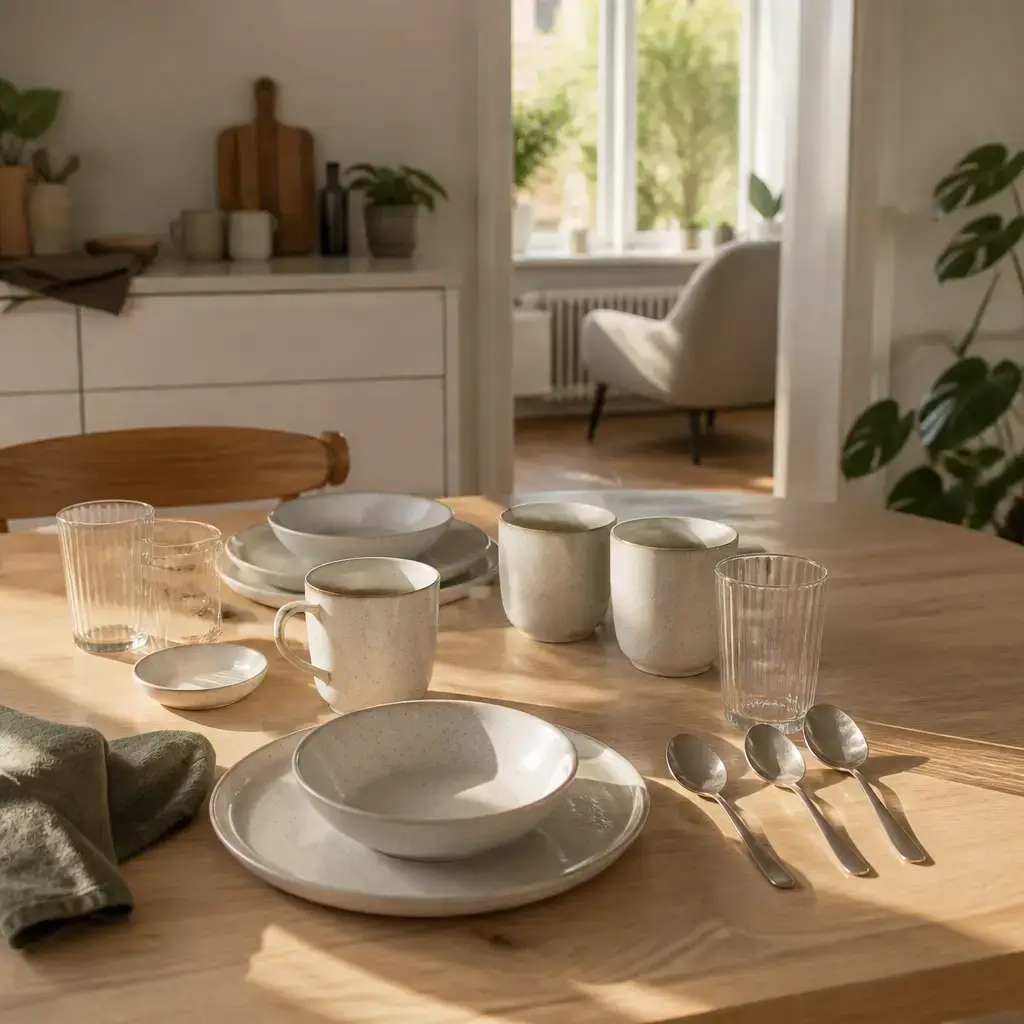
About This Lesson
Use Checking a table-setting list to practice Danish conversation, pronunciation, vocabulary, grammar, and quizzes.
Dialogue
A
Lad os se på listen.
LAD uhs SAY paw LESS-duh. Let's look at the list.
B
Jeg har den her.
YAI hah den HAIR. I have it here.
A
Er kopperne klar?
AIR KUB-uh-nuh klah? Are the cups ready?
B
Jeg vaskede dem alle sammen.
YAI VAS-guh-thuh dem AL-uh SAM-uhn. I washed them all.
A
Mangler der noget?
MANG-luh dah NOH-uh? Is anything missing?
B
Vi mangler stadig en ske.
vee MANG-luh STAI-thee uhn SKAY. We still need one spoon.
A
Jeg kan hente en til.
YAI kan HEN-duh uhn TEHL. I can get another one.
B
Så er bordet dækket.
SOH air BOHR-thuh DEH-guhth. Then the table is set.Word by Word
Lad
“Lad” means “let” in the suggestion “Lad os se på listen.” Together with “os,” it invites the other person to do something. A reusable pattern is “Lad os” followed by an action.
os
“Os” means “us” in “Lad os se på listen.” It identifies the people included in the suggestion. It is commonly used after “Lad” in the pattern “Lad os” followed by an action.
se
“Se” means “look” in “Lad os se på listen.” Here it is used with “på” to form “se på,” meaning to look at something. A reusable pattern is “se på” followed by the thing being viewed.
på
In “se på listen,” “på” connects the action of looking with the list being viewed. The expression “se på” means “look at.” Use “på” as part of this construction before the thing someone looks at.
listen
“Listen” means “the list” in “se på listen.” It refers to the specific list the two people are checking. A reusable pattern is “se på listen” when directing attention to a list.
Jeg
“Jeg” means “I” in “Jeg har den her.” It marks the speaker as the person who has the list. It is used as the subject before the verb in a statement such as “Jeg har ...”.
har
“Har” means “have” in “Jeg har den her.” It says that the speaker has the list with them. A reusable pattern is “Jeg har” followed by the thing someone has.
den
“Den” means “it” or “that one” in “Jeg har den her,” referring to the list. It stands for the already mentioned item instead of repeating “listen.” It can be used after “har” when the item is known from the context.
her
“Her” means “here” in “Jeg har den her.” It indicates that the list is in the speaker’s current location or possession. The expression “den her” points to the item that is here.
Er
“Er” means “is” or “are” at the beginning of “Er kopperne klar?” Here it starts a question about whether the cups are ready. A reusable question pattern is “Er” followed by the person or thing being asked about.
kopperne
“Kopperne” means “the cups” in “Er kopperne klar?” It refers to the particular cups needed for setting the table. Use it as the thing being checked in a question such as “Er kopperne klar?”.
klar
“Klar” means “ready” in “Er kopperne klar?” It describes the cups as prepared for use. It is used after the thing being checked in this question.
vaskede
“Vaskede” means “washed” in “Jeg vaskede dem alle sammen.” It says that the speaker washed the cups. A reusable pattern is “Jeg vaskede” followed by the things that were washed.
dem
“Dem” means “them” in “Jeg vaskede dem alle sammen,” referring to the cups. It stands for several already mentioned items. It is used after the washing action when the objects are known from the context.
alle
“Alle” contributes the meaning “all” in “dem alle sammen.” The phrase refers to every one of the cups, not just some of them. It is commonly used with “sammen” in the expression “alle sammen.”
sammen
“Sammen” means “together” in “dem alle sammen.” With “alle,” it emphasizes that every one of the cups was included. The reusable expression “alle sammen” refers to a complete group.
Mangler
“Mangler” means “is missing” in “Mangler der noget?” The question asks whether something is still absent or needed. In a statement, the same form appears in “Vi mangler stadig en ske,” meaning that something is needed.
der
In “Mangler der noget?” “der” is part of the question structure and has little separate meaning in the English translation. It helps present the question about whether something is missing. Learn the full pattern “Mangler der noget?” for checking whether anything is absent.
noget
“Noget” means “anything” in the question “Mangler der noget?” It refers to an unspecified thing that might be missing. In a question, it can be used when the speaker does not know which item, if any, is involved.
Vi
“Vi” means “we” in “Vi mangler stadig en ske.” It identifies the speakers together as the people who need the spoon. It is used as the subject before the verb in a statement such as “Vi mangler ...”.
stadig
“Stadig” means “still” in “Vi mangler stadig en ske.” It shows that the need for a spoon continues at this point. A reusable pattern is to place “stadig” in a statement about something that remains needed or missing.
en
“En” means “one” in “en ske,” referring to one spoon that is needed. It introduces the singular item being requested here. The reusable pattern is “en” followed by the name of one item, as in “en ske.”
ske
“Ske” means “spoon” in “en ske.” It names the table-setting item that is still needed. Use it after “en” when referring to one spoon.
kan
“Kan” means “can” in “Jeg kan hente en til.” It expresses that the speaker is able or willing to fetch another item. It is followed here by the action “hente” in the pattern “kan hente ...”.
hente
“Hente” means “get” or “fetch” in “Jeg kan hente en til.” It describes going to get the additional spoon. A reusable pattern is “kan hente” followed by the item to be fetched.
til
In “en til,” “til” adds the meaning “another” or “one more” to the already mentioned spoon. The full expression refers to an additional item of the same kind. Use “en til” when asking for or offering one more known item.
Så
“Så” means “then” in “Så er bordet dækket.” It introduces the result after the missing spoon has been fetched. It is useful at the start of a statement describing what follows from an action.
bordet
“Bordet” means “the table” in “Så er bordet dækket.” It refers to the particular table being prepared at home. The phrase “bordet dækket” describes the state of that table after setting it.
dækket
“Dækket” means “set” in “Så er bordet dækket.” It describes the table as fully prepared for the meal. A reusable pattern is “er bordet dækket” when checking or stating whether the table has been set.
Grammar Points
Bestemt form: kop + -perne → kopperne; bord + -et → bordet
kopperne på bordet
KUB-uh-nuh paw BOHR-thuhthe cups on the table
Danish often marks “the” by adding an ending to the noun: -et for singular and -ene for plural.
Danish Vocabulary
alle sammen
phrase
AL-uh SAM-uhn
all of them; all together
have
verb
HEH-vuh
have
har
her
adv
HAIR
here
klar
adj
klah
ready
kop
noun
KUB
cup
kopperne
liste
noun
LESS-duh
list
listen
mangle
verb
MANG-luh
be missing; need
mangler
noget
pron
NOH-uh
something; anything
på
prep
paw
at; on
se
verb
SAY
look; see
stadig
adv
STAI-thee
still
vaske
verb
VAS-guh
wash
vaskede
Quiz
Word Order
Arrange the words in the correct order.
Let's look at the list.
Show Answer
Lad os se på listen.I have it here.
Show Answer
Jeg har den her.Are the cups ready?
Show Answer
Er kopperne klar?Spelling
Tap the letters to spell the word.
wash
Show Answer
vaskedelist
Show Answer
listencup
Show Answer
kopperneready