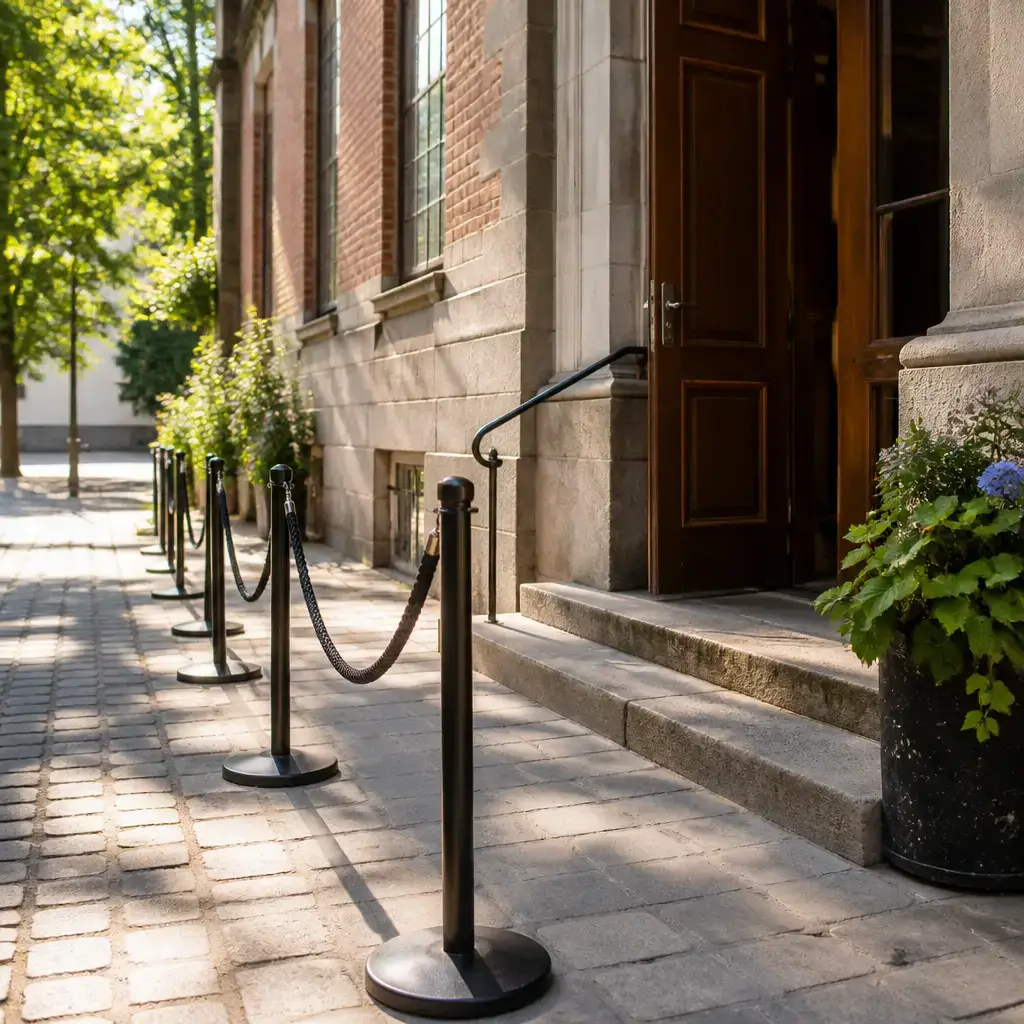
Hvor
“Hvor” asks for a location: here it means “where” in “Hvor er enden af køen?”. The reusable pattern “Hvor er ...?” asks where something or someone is. You would use it when asking another person to identify a place.
er
“Er” says where something is in “Hvor er enden af køen?” and “Enden er henne ved døren.” It is a form of være used with a location or description. The pattern “... er ...” connects a subject with its location.
enden
“Enden” means “the end” or, here, the back end of the queue. It is the definite form of ende. In “enden af køen”, it identifies the end belonging to this queue, which is useful when asking where to join.
af
In “enden af køen”, “af” links the end to the queue and means “of”. It also appears in “ved siden af døren”, where it is part of the expression for a position next to the door. The surrounding words determine the full relationship.
køen
“Køen” means “the line” or “the queue” in “enden af køen”. It is the definite form of kø and identifies the particular queue people are joining. The phrase “i kø” also refers to being in a queue.
henne
“Henne” points to a place over there in “Enden er henne ved døren.” Together with “ved døren”, it directs the listener to the area by the door. It is useful when indicating a location that is not right next to the speaker.
ved
“Ved” gives the location relation in “henne ved døren”: the end is by the door. In “ved siden af døren”, the complete expression means “next to the door”, with “ved” introducing the location phrase. Use it with a nearby place or object.
døren
“Døren” means “the door” in “ved døren” and “ved siden af døren”. It is the definite form of dør, referring to a specific door in the scene. The word can follow a location expression to say where something is.
Skal
“Skal” asks whether the speaker should do something in “Skal jeg vente der?”. It is the form of skulle used here as a modal for asking what is appropriate. The pattern “Skal jeg ...?” is useful when asking someone what you should do.
jeg
“Jeg” means “I” and identifies the speaker as the person who may wait, saw the sign, or heads to the back. It is the subject in “Skal jeg vente der?” and “Jeg går om til enden af køen.” Use it before an action the speaker will perform.
vente
“Vente” means “wait” in “Skal jeg vente der?”. It names the action that follows “Skal jeg” in the question. The phrase “vente der” combines the action with the place where the speaker may wait.
der
In “Skal jeg vente der?”, “der” means “there” and points to the place already mentioned. In “Det er der, folk stiller sig i kø”, it points to the place where people join the queue. It is useful for referring back to a location.
Stil
“Stil” tells someone to stand or place themselves in “Stil dig bag den sidste person.” It is the imperative form of stille. The word order “Stil dig ...” gives an instruction about where the listener should position themselves.
dig
“Dig” refers to the person being instructed in “Stil dig bag den sidste person.” In this sentence, “Stil dig” means to place yourself or stand yourself. It follows the instruction word and identifies who should move.
bag
“Bag” gives the position “behind” in “bag den sidste person.” It introduces the person or object that marks the position. This pattern is useful when telling someone to stand behind another person in a line.
den
“Den” means “the” before “sidste person” and helps identify a specific person. It is part of the noun phrase “den sidste person”, rather than carrying the whole meaning of the phrase by itself. It comes before the describing word and noun here.
sidste
“Sidste” identifies the person at the end of the line in “den sidste person.” It describes which person the instruction refers to. The pattern “den sidste ...” is useful when pointing out the final person or item in an ordered group.
person
“Person” means “person” in “den sidste person.” Here it identifies the individual who is currently at the back of the queue. It follows “den sidste” to specify the person’s position.
så
“Så” means “saw” in “Jeg så ikke skiltet.” It is the form of se used for the speaker’s earlier failure to notice the sign. Together with “ikke”, “så ikke” says that the speaker did not see something.
ikke
“Ikke” negates the action in “Jeg så ikke skiltet”, so the speaker says they did not see the sign. It comes after “så” in this sentence. The pattern “så ikke ...” is useful for saying that something was not noticed.
skiltet
“Skiltet” means “the sign” in “Jeg så ikke skiltet.” It is the definite form of skilt and refers to the specific sign near the door. It is the thing that the speaker did not see.
Det
“Det” refers to the sign in “Det hænger ved siden af døren”, meaning “it”. In “Det er der, folk stiller sig i kø”, it introduces the place being identified, meaning “that”. Its reference is determined by the surrounding sentence.
hænger
“Hænger” says that the sign is hanging or posted in “Det hænger ved siden af døren.” It is a form of hænge. The pattern “Det hænger ...” can describe something displayed or hanging in a particular place.
siden
In “ved siden af døren”, “siden” means “the side” and helps describe the position beside the door. It is the definite form of side. The complete expression “ved siden af” is used for something located next to something else.
går
“Går” means “go” or “head” in “Jeg går om til enden af køen.” It is a form of gå describing the speaker moving toward the back of the queue. The phrase places the destination after “til”.
om
In “Jeg går om til enden af køen”, “om” contributes the idea of moving around or over toward the destination. The complete phrase “går om til” means heading over to a place. It comes before “til” in this movement expression.
til
“Til” marks the destination in “om til enden af køen”, meaning “to” the end of the queue. It introduces the place toward which the speaker is going. A location or destination follows it here.
folk
“Folk” means “people” in “folk stiller sig i kø.” It is the group who are joining the queue. It functions as the subject of the action that follows.
stiller
“Stiller” says that people place themselves in “folk stiller sig i kø.” It is a form of stille, and the action is completed with “sig”. The construction “stiller sig i kø” describes joining a queue.
sig
“Sig” refers back to “folk” in “folk stiller sig i kø”, meaning that the people place themselves in the queue. It is used with “stiller” to form the reflexive construction. The surrounding phrase specifies that the placement is “i kø”.
i
“I” means “in” in “stiller sig i kø.” It marks the queue as the place where people position themselves. The complete construction “stiller sig i kø” is useful when describing people joining a line.