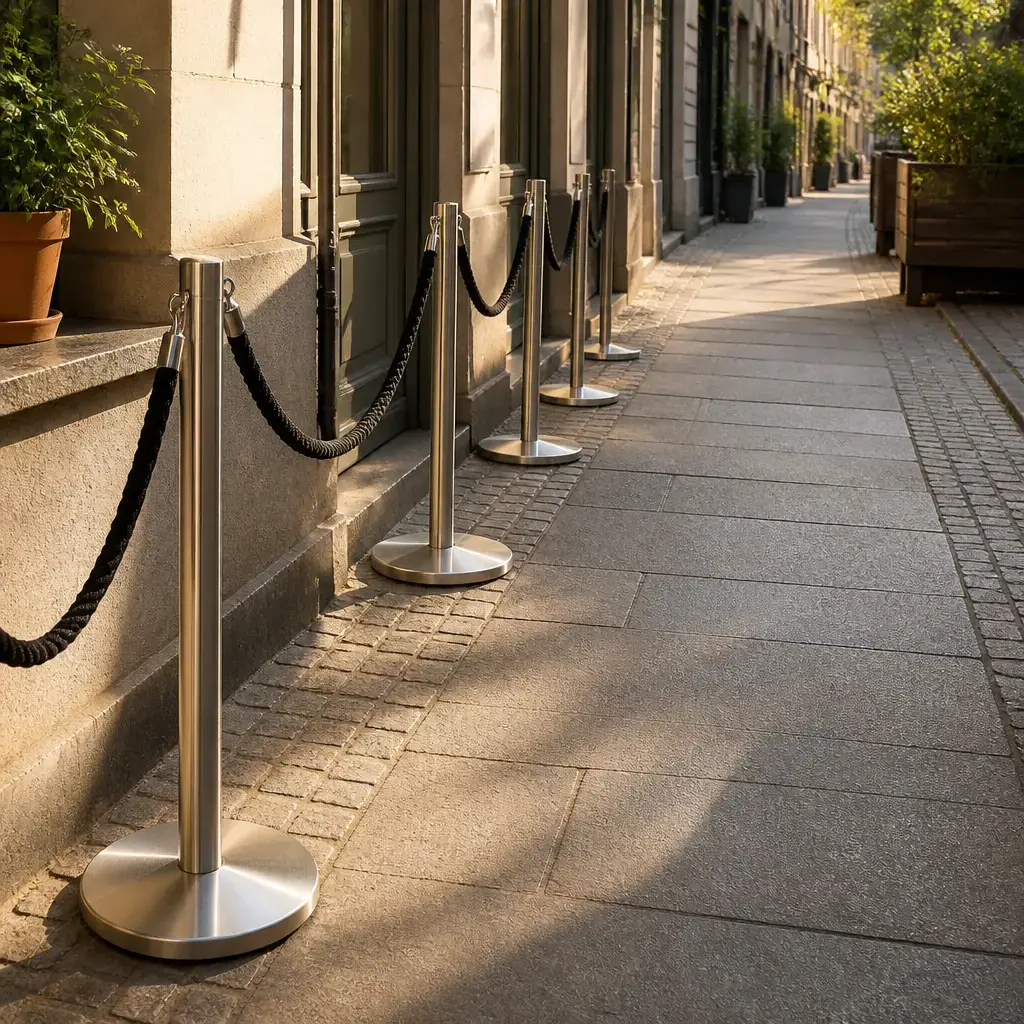
Der
In 'Der bliver virkelig trangt i køen.', Der is an existential sentence starter that introduces the situation. It is commonly used at the beginning of statements about what exists or what is happening.
bliver
In 'Der bliver virkelig trangt i køen.', bliver means 'becomes' or 'is getting', showing that the situation is changing into a crowded one. The basic form is blive. It is useful with a description of a changing situation.
virkelig
In 'Der bliver virkelig trangt i køen.', virkelig means 'really' and intensifies trangt. It can be placed before a description to make it stronger.
trangt
In 'Der bliver virkelig trangt i køen.', trangt describes the space as cramped or crowded. The adjective's basic form is trang; trangt is the form used here for this situation. It is useful when limited space is becoming a problem.
i
In 'i køen', i means 'in' and places the situation inside or within the line. The pattern i + a place or group is used to say where someone or something is.
køen
In 'i køen', køen means 'the line' or 'the queue'. The basic form is kø; køen is the form used for the specific line in this scene. Use it with i when referring to being in the line.
Lad
In 'Lad os give lidt plads i siden.', Lad helps form a suggestion meaning 'let's'. Together with os, it introduces an action that the speakers can do together. The reusable pattern is Lad os followed by a verb for a shared suggestion.
os
In 'Lad os give lidt plads i siden.', os means 'us' and refers to the speaker and the other person together. The basic pronoun form is vi; os is used here after Lad. Lad os is a common way to suggest a joint action.
give
In 'give lidt plads', give means 'give' or 'leave' in the sense of making room. The expression is used here to create space for other people. It is useful when talking about making room or allowing space.
lidt
In 'give lidt plads', lidt means 'a little' or 'some' and limits the amount of space being given. It is commonly placed before a quantity or an uncounted thing.
plads
In 'give lidt plads', plads means 'space' or 'room'. It is the thing the speakers want to leave available in the crowded line. The word is useful in expressions about making or leaving room.
siden
In 'i siden', siden means 'the side', referring to the side area where space should be left. The basic form is side; siden is the form used here for the specific side. Use i siden when indicating that something is on the side.
Skal
In 'Skal jeg flytte mig lidt tilbage?', Skal asks whether the speaker should do something. The basic form is skulle, while Skal is the form used at the beginning of this question. Skal jeg followed by an action is useful when asking for permission or checking what to do.
jeg
In 'Skal jeg flytte mig lidt tilbage?', jeg means 'I' and identifies the speaker as the person who may move. It is used as the subject before an action such as flytte.
flytte
In 'flytte mig lidt tilbage', flytte means 'move'. With mig, it describes the speaker moving themselves backward. The expression is useful when proposing or describing a change of position.
mig
In 'flytte mig lidt tilbage', mig means 'me' or 'myself' and refers to the speaker as the person being moved. The basic pronoun form is jeg; mig is used here after flytte. It makes the action refer to the speaker's own position.
tilbage
In 'flytte mig lidt tilbage', tilbage means 'back' and gives the direction of the movement. It is useful after a movement verb when someone returns to or moves toward a position behind the current one.
Så
In 'Så er det lettere for folk at komme forbi.', Så means 'then' or 'so' and connects the action of making space with its result. It is also used in 'Så er der fri passage.' to introduce the resulting situation.
er
In 'Så er det lettere for folk at komme forbi.', er means 'is' and states the resulting condition. The basic form is være. It is used to link a subject such as det with a description such as lettere.
det
In 'Så er det lettere for folk at komme forbi.', det means 'it' and refers to the situation being discussed. It is used as the subject in a statement about how easy the situation is. Det er is a common pattern for describing a situation.
lettere
In 'det lettere for folk at komme forbi', lettere means 'easier' and describes the improved possibility of passing. The basic adjective is let; lettere is its comparative form. The pattern lettere for folk at komme forbi shows who benefits and what becomes easier.
for
In 'lettere for folk at komme forbi', for means 'for' and marks the people who benefit from the clearer space. It is used before folk in this construction to show for whom something is easier.
folk
In 'for folk at komme forbi', folk means 'people' and refers to the people who need to pass through. It is used here after for to identify who benefits from the open space.
at
In 'at komme forbi', at marks the following action as an infinitive, meaning 'to pass by' in the full expression. It also appears after lettere in the construction that describes what becomes easier.
komme
In 'komme forbi', komme means 'come' or 'get' and, together with forbi, describes people getting past the line. The basic form is komme. The expression komme forbi is useful when someone needs to pass an obstacle or a group.
forbi
In 'komme forbi', forbi means 'past' or 'by' and completes the meaning of getting past the line. It is useful with komme when describing movement past a person, place, or obstruction.
langt
In 'langt nok', langt means 'far' and describes the distance of the moved position. The adjective's basic form is lang; langt is the form used here. Together with nok, it asks whether the distance is sufficient.
nok
In 'langt nok', nok means 'enough' and shows that the distance may be sufficient. It follows langt here to express a sufficient degree. The same placement can be used when checking whether something reaches the needed amount or degree.
fri
In 'fri passage', fri means 'clear' or 'unobstructed'. It describes the passage as available for people to use. The expression is useful when confirming that a route is not blocked.
passage
In 'fri passage', passage means 'passage' or 'path', referring to the route through which people can move. Together with fri, it describes a clear route. It is useful when talking about access through a crowded area.
nu
In 'Der er fri passage nu.', nu means 'now' and marks the current situation after space has been made. It is commonly placed at the end of a statement to emphasize that a condition has changed.
kan
In 'Jeg kan stille mig tættere på væggen.', kan means 'can' and expresses the speaker's ability or possibility to take that position. The basic form is kunne. Kan is commonly followed by an action in its basic form.
stille
In 'stille mig tættere på væggen', stille means 'place' or 'position' and describes deliberately taking a position. With mig, it means positioning oneself. It is useful when explaining where someone will stand or place themselves.
tættere
In 'tættere på væggen', tættere means 'closer' and compares the new position with the previous one. The basic adjective is tæt; tættere is the comparative form. The pattern tættere på + a place or object is used to describe moving nearer to it.
på
In 'tættere på væggen', på means 'to' or 'against' and marks the wall as the reference point for the distance. The pattern tættere på + a place or object is useful when describing a position nearer to something.
væggen
In 'på væggen', væggen means 'the wall', the reference point beside which the speaker can stand. The basic form is væg; væggen is the form used for the specific wall. Use it after på when describing this position in the scene.