Det
In "Det regner udenfor." Det is the impersonal subject used for the weather statement. In "Det vil hjælpe dig med at holde dig tør.", it refers to the umbrella-taking idea as “that”; use Det at the start of both sentences.
regner
In "Det regner udenfor.", regner says that rain is falling. It is used with Det when describing rain. A reusable pattern is Det regner + a place or time expression.
udenfor
In "Det regner udenfor.", udenfor means outside and gives the place where the rain is falling. Use it as a place expression when saying that something happens outside.
Tag
In "Tag dine støvler på, før du går.", Tag gives a direct instruction to put on or wear something. The reusable pattern is Tag [thing] på, with the thing between Tag and på. Use it when telling someone what to put on.
dine
In "Tag dine støvler på, før du går.", dine means your and comes before støvler. It is used with this plural item. A reusable pattern is dine + noun when referring to someone’s plural things.
støvler
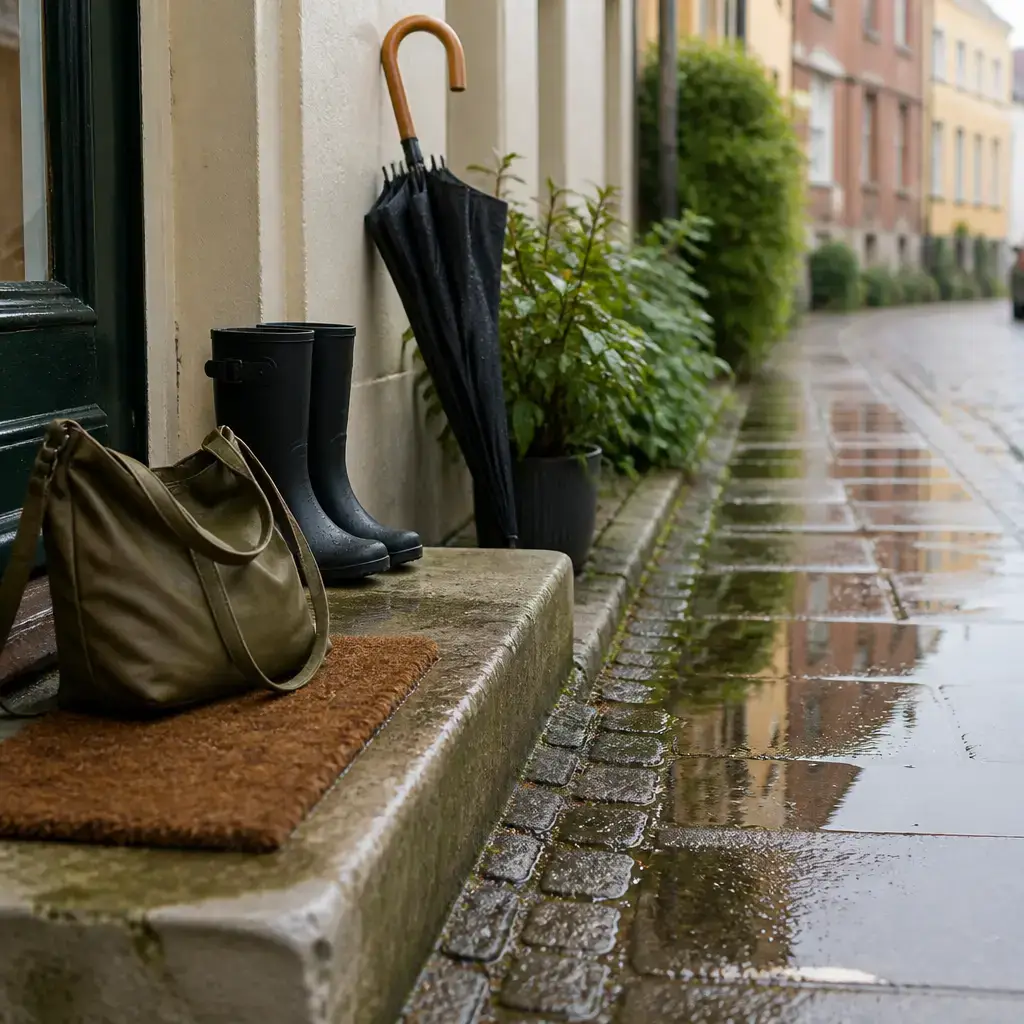
In "Tag dine støvler på, før du går.", støvler means boots, the footwear being put on. It follows the possessive dine. Use støvler when talking about boots in a situation such as getting ready to go outside.
på
In "Tag dine støvler på, før du går.", på is part of the expression Tag ... på and adds the meaning of putting something on. Use the complete pattern Tag [thing] på rather than treating på as the whole action by itself.
før
In "før du går", før means before and introduces the action that must happen first. It connects the instruction about the boots with leaving. A reusable pattern is før + a clause.
du
In "før du går", du means you and is the subject of går. It identifies the person who is leaving. Use du before the verb when speaking directly about what the other person does.
går
In "før du går", går means go or leave in the context of going out. It completes the clause introduced by før. Use it in the pattern før du går when referring to someone leaving.
Der
In "Der er vandpytter på stien.", Der introduces the existence of something rather than pointing to a place. It opens the statement that puddles are present. A reusable pattern is Der er + thing.
er
In "Der er vandpytter på stien.", er connects Der with the puddles and states that they exist. It is part of the pattern Der er + thing. Use this pattern to say that something is present.
vandpytter
In "Der er vandpytter på stien.", vandpytter means puddles. It names the things that are present on the path. It can be reused after Der er when describing puddles that are somewhere.
stien
In "på stien", stien means the path and identifies the specific path where the puddles are. It follows the place word på. Use the pattern på stien when saying that something is on the path.
Gå
In "Gå langsomt uden om dem.", Gå gives a direct instruction to go or step. It is followed by information about how to move and where to move. Use Gå when telling someone to move in a particular way.
langsomt
In "Gå langsomt uden om dem.", langsomt means slowly and describes how the person should move. It comes after Gå. A reusable pattern is verb + langsomt when instructing someone to do something slowly.
uden om
In "Gå langsomt uden om dem.", uden om means around them, with the idea of avoiding the puddles rather than stepping through them. Uden contributes the idea of being without or outside something, while om contributes the surrounding relation; together they form the construction uden om. Use uden om + object when describing moving around something.
dem
In "Gå langsomt uden om dem.", dem means them and refers back to the puddles. It is the object after uden om. Use dem when referring to people or things already mentioned as the object of an action.
Min
In "Min taske bliver måske våd.", Min means my and identifies the bag as belonging to the speaker. It comes directly before taske. Use Min + noun when referring to one thing belonging to the speaker.
taske
In "Min taske bliver måske våd.", taske means bag. It is the thing that may get wet. Use it after a possessive, as in Min taske, when talking about the speaker’s bag.
bliver
In "bliver måske våd", bliver means gets or becomes and describes a change into a wet state. It is followed here by våd. A reusable pattern is bliver + adjective when something comes to have a new state.
måske
In "Min taske bliver måske våd.", måske means maybe and shows that the bag getting wet is only possible, not certain. It comes before the part of the sentence that is uncertain. Use måske to express possibility.
våd
In "bliver måske våd", våd means wet and describes the possible state of the bag. It follows bliver. Use våd to describe something that has water on it or may acquire that state.
Hold
In "Hold den under din frakke.", Hold gives a direct instruction to keep or hold something in a particular place. It is followed by the object and its location. A reusable pattern is Hold + object + place expression.
den
In "Hold den under din frakke.", den means it and refers to the bag already mentioned. It is the object of Hold. Use den when the singular thing being discussed is clear from the context.
under
In "under din frakke", under gives the position below or beneath the coat. It introduces the place where the bag should be kept. Use under + noun to describe this kind of location.
din
In "under din frakke", din means your and comes before frakke. It identifies the coat as belonging to the person being addressed. Use din + noun when referring to one thing belonging to that person.
frakke
In "under din frakke", frakke means coat. It names the covering beneath which the bag should be kept. Use it after din when talking about the other person’s coat.
Jeg
In "Jeg bør også tage en paraply med.", Jeg means I and identifies the speaker. It appears at the beginning of the sentence before the action. Use Jeg when stating what you think or intend to do.
bør
In "Jeg bør også tage en paraply med.", bør means should and presents taking an umbrella as advisable. It is followed by tage. A reusable pattern is Jeg bør + verb when saying what you ought to do.
også
In "Jeg bør også tage en paraply med.", også means also or too and adds taking an umbrella to the other preparations. It comes before the action tage. Use også to add another action or item.
tage
In "tage en paraply med", tage means take, with the idea that the umbrella will accompany the speaker. It follows bør and comes before the object. A reusable pattern is tage + thing + med.
en
In "en paraply", en introduces one unspecified umbrella, meaning a or an. It comes directly before paraply. Use en before a noun in a similar indefinite expression.
paraply
In "tage en paraply med", paraply means umbrella. It is the item the speaker plans to take along. Use it in the pattern tage en paraply med when preparing to go out in the rain.
med
In "tage en paraply med", med adds the idea that the umbrella accompanies the speaker. It completes the expression for taking something along. A reusable pattern is tage + thing + med.
vil
In "Det vil hjælpe dig med at holde dig tør.", vil presents the help as something expected to happen. It comes before hjælpe. A reusable pattern is vil + verb when describing an expected action or result.
hjælpe
In "Det vil hjælpe dig med at holde dig tør.", hjælpe means help and describes the umbrella’s useful effect for you. It follows vil and is followed by the person helped. A reusable pattern is hjælpe + person + med at + verb.
dig
In "hjælpe dig med at holde dig tør", dig means you and identifies the person who receives the help. It follows hjælpe. Use the pattern hjælpe + dig + med at + action when saying what helps you do something.
at
In "med at holde dig tør", at introduces the action connected with the help. It comes directly before holde. A reusable pattern is med at + verb when naming the action involved.
holde
In "holde dig tør", holde contributes the idea of maintaining a state. Together with dig and tør, the expression means keeping you dry. A reusable pattern is holde + person + adjective when describing maintaining someone’s condition.
tør
In "holde dig tør", tør means dry and describes the state the person is meant to remain in. It completes the expression with holde dig. Use the pattern holde + person + adjective to describe the condition being maintained.