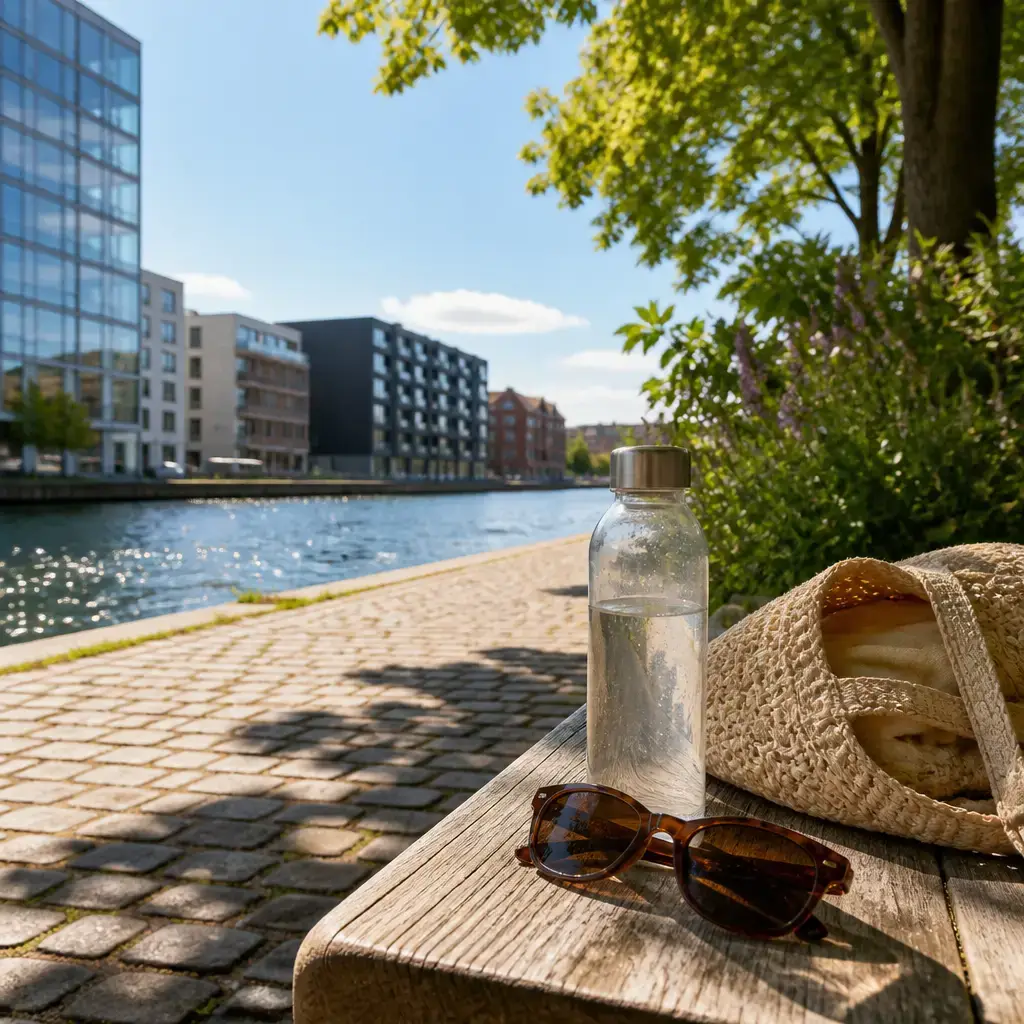
Solen
“Solen” means “the sun” in “Solen skinner udenfor.” This is the definite form related to “sol”, and it is the subject of the weather statement. Use it when talking about the sun as a known object in the sky.
skinner
“skinner” means “shines” in “Solen skinner udenfor.” It describes the sun giving light and follows the subject “Solen”. Use this form for a current observation about sunny weather.
udenfor
“udenfor” means “outside” in “Solen skinner udenfor.” It is a place adverb that locates the sunny condition outside and appears at the end of the sentence. Use it when saying that something is outdoors or outside.
Tag
“Tag” means “bring” or “take” in the instruction “Tag dine solbriller med.” It is the form used to tell someone directly to bring something along. Use the pattern “Tag ... med” when asking someone to take an item with them.
dine
“dine” means “your” in “Tag dine solbriller med.” It shows that the sunglasses belong to the person being addressed and comes before the plural noun “solbriller”. Use it before a plural noun when addressing someone directly.
solbriller
“solbriller” means “sunglasses” in “dine solbriller.” It names the item that the listener should bring, and this exact form is plural. Use it when talking about eye protection in bright sunlight.
med
“med” contributes the meaning “along” or “with” in “Tag dine solbriller med.” Together with “Tag”, it expresses bringing or taking the sunglasses along. Use “tage ... med” when someone should carry an item to another place.
Er
“Er” means “is” in “Er det for varmt til en gåtur?” It begins the yes-or-no question and comes before “det” because of the question word order. Use it to ask whether a present condition applies.
det
“det” means “it” in “Er det for varmt til en gåtur?” Here it refers to the general weather or temperature situation being discussed. Use “det” as the subject when asking about a situation or condition.
for
“for” means “too” in “for varmt til en gåtur.” It comes before “varmt” and shows that the temperature may be higher than suitable for the walk. Use “for” before an adjective when describing something as excessively so.
varmt
“varmt” means “warm” or “hot” in “Er det for varmt til en gåtur?” and “Det er varmt”. This exact form is used in the impersonal temperature description with “det er”. Use it to state or assess the temperature.
til
“til” means “for” in “for varmt til en gåtur.” It introduces the activity that the temperature may be unsuitable for and comes before “en gåtur”. Use the pattern “for ... til” when judging whether something is suitable for an activity.
en
“en” means “a” in “en gåtur.” It introduces one non-specific walk before the noun. Use “en” before a singular common-gender noun when referring to one item or activity.
gåtur
“gåtur” means “walk” in “en gåtur.” It names a walk as an activity and appears after the article “en”. The related definite form “gåturen” appears later when referring to the specific planned walk.
men
“men” means “but” in “Det er varmt, men vi kan stadig gå.” It connects the warm weather with the contrasting idea that they can still go. Use it between two clauses that contrast with each other.
vi
“vi” means “we” in “vi kan stadig gå” and “Vi kan blive i skyggen.” It refers to the speaker together with the other person. Use it before a verb when describing a shared action or possibility.
kan
“kan” means “can” or “are able to” in “vi kan stadig gå.” It expresses that going remains possible despite the heat and is followed by the infinitive “gå” or “blive”. Use “kan” before an infinitive to express ability or possibility.
stadig
“stadig” means “still” in “vi kan stadig gå.” It shows that going remains possible even though it is warm. It appears before the infinitive “gå”; use it to say that an action or possibility continues.
gå
“gå” means “go” or “walk” in “vi kan stadig gå.” It is the infinitive following “kan” and refers here to going on the planned walk. Use “kan” followed by “gå” when saying that someone can go.
blive
“blive” means “stay” in “Vi kan blive i skyggen.” With “i skyggen”, it expresses remaining in the shade rather than leaving. Use “kan blive i” followed by a place when saying that someone can stay somewhere.
i
“i” means “in” in “i skyggen.” It introduces the place where the speakers can remain. Use “i” before a place or area when describing being or staying inside it.
skyggen
“skyggen” means “the shade” in “Vi kan blive i skyggen.” This is the definite form related to “skygge” and names the specific shaded place they have in mind. It follows “i” when describing staying in the shade.
Træerne
“Træerne” means “the trees” in “Træerne bør holde os kølige.” This definite plural form identifies the trees as a known group in the scene and serves as the subject. Use it when talking about particular trees as a group.
bør
“bør” means “should” in “Træerne bør holde os kølige.” It expresses an expectation about what the trees should do and is followed by the infinitive “holde”. Use it before an infinitive to express advice or an expected result.
holde
“holde” means “keep” in “holde os kølige.” With “os” and “kølige”, it describes maintaining the speakers in a cool state, and it is the infinitive after “bør”. Use “holde” with an object and an adjective when describing keeping someone or something in a condition.
os
“os” means “us” in “holde os kølige.” It refers to the speaker and companion as the people affected by the trees’ cooling effect. It appears after “holde” and before “kølige”; use it as an object pronoun for the speaker and others.
kølige
“kølige” means “cool” in “holde os kølige.” It describes the state that the trees should maintain for the speakers, and this exact form is plural in the dialogue. Use it after “holde os” when describing keeping several people cool.
Jeg
“Jeg” means “I” in “Jeg tager en flaske vand med.” It identifies the speaker as the person who will bring the water. Use it as the subject before a verb when talking about your own action.
tager
“tager” means “bring” or “take” in “Jeg tager en flaske vand med.” With the final “med”, it expresses bringing the bottle along for the walk. Use “tager ... med” when announcing that you will bring an item.
flaske
“flaske” means “bottle” in “en flaske vand.” It names the container for the water and follows the article “en”. Use “en flaske” before a substance when referring to one bottle of it.
vand
“vand” means “water” in “en flaske vand.” It identifies what the bottle contains and follows the container noun “flaske”. Use it when discussing drinking water or water being taken along.
Den
“Den” means “it” in “Den bliver god at have med på gåturen.” It refers back to “en flaske vand” without repeating the noun. Use “Den” as the subject when referring to a known common-gender noun.
bliver
“bliver” means “becomes” or “will be” in “Den bliver god at have med på gåturen.” It presents the bottle as something expected to be useful during the walk. Use it after a subject when describing what something will be like or become.
god
“god” means “good” or “useful” in “bliver god at have med.” It evaluates the bottle positively as something useful to have along. It follows “bliver” and comes before “at have”; use “god at have” to describe something worth having.
at
“at” means “to” in “at have med.” It introduces the infinitive “have” in the expression describing what is good. Use “at” before an infinitive after an adjective such as “god”.
have
“have” means “have” in “at have med.” Together with “med”, it describes having the bottle along during the walk, and it is the infinitive after “at”. Use it after “at” when describing having something with you.
på
“på” means “during” in “på gåturen.” It introduces the activity or time period when the bottle will be useful. Use “på” before an activity noun when saying that something happens during that activity.
gåturen
“gåturen” means “the walk” in “på gåturen.” This is the definite form related to “gåtur” and refers to the specific walk the speakers plan to take. It follows “på” to identify the activity during which the water will be useful.