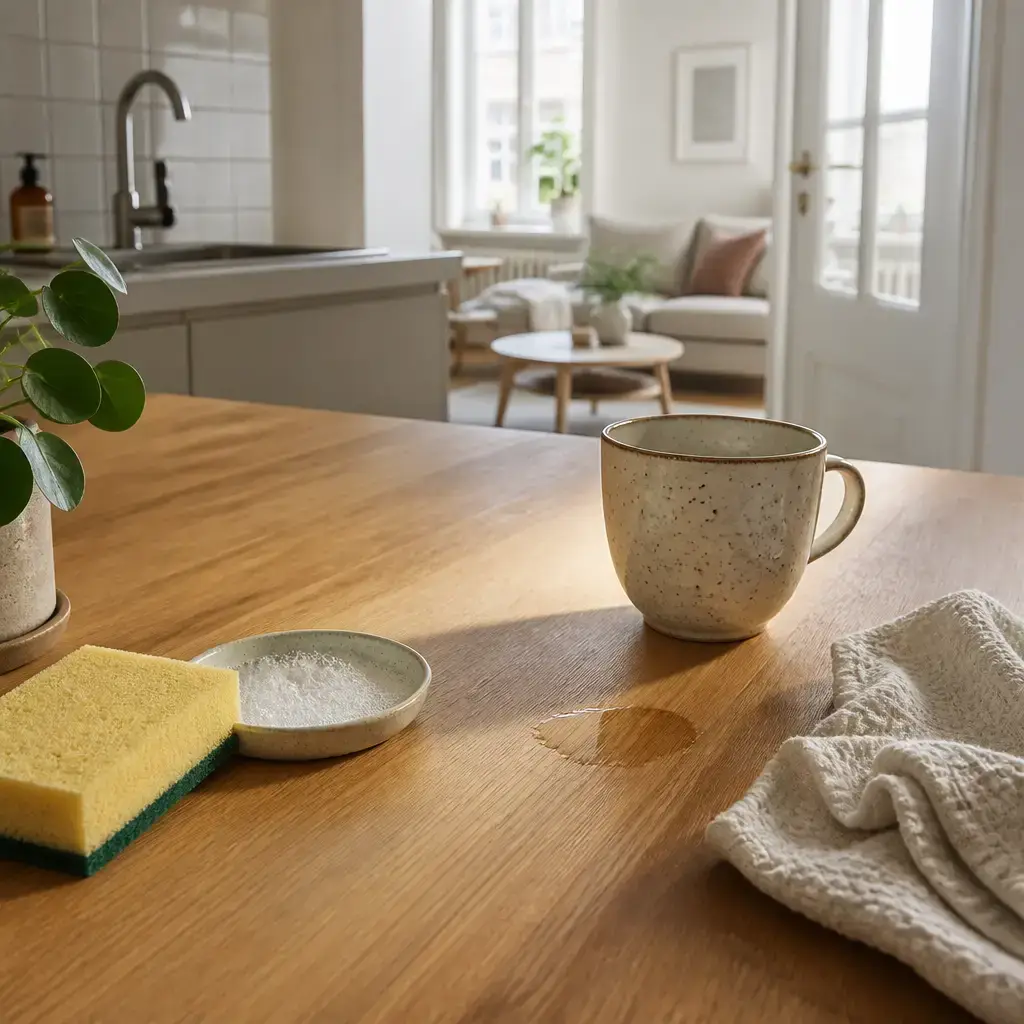
Der
In “Der er en plet på bordet.”, “Der” introduces the existence of something: there is a stain. It is used in the reusable expression “Der er” when stating that something exists or is present. You can use it when pointing out a problem or object in a room.
er
In “Der er en plet på bordet.”, “er” means is and forms the statement that the stain exists. Together with “Der” it makes “Der er”, meaning there is. Use this expression to say that something is present in a place.
en
In “en plet”, “en” means a and introduces one unspecified item. It comes directly before the noun “plet”; the same pattern appears in “en ren svamp”. Use it before an unspecified noun when mentioning something for the first time.
plet
“Plet” means stain in “en plet på bordet.” It names the mark that is on the table. You can reuse it with a location, as in “en plet på” something.
på
In “på bordet”, “på” means on and locates the stain on the table’s surface. The dialogue also uses “på svampen” for something placed on the sponge. Use it with an object or surface to describe where something is.
bordet
“Bordet” means the table in “på bordet.” It refers to the specific table in the scene. It is the definite form related to “bord”, and you can reuse it after a location word such as “på” in “på bordet”.
Jeg
“Jeg” means I in “Jeg kan se den nær koppen.” It identifies the person who can see the stain. Use it as the subject when talking about your own action, ability, or observation.
kan
In “Jeg kan se den”, “kan” expresses ability: I can see it. It is followed here by the verb “se”, giving the reusable pattern “Jeg kan se”. Use it when saying that you are able to notice or do something.
se
“Se” means see in “Jeg kan se den.” It describes the act of noticing the stain, and it follows “kan” in this sentence. Use it when saying what you can see, as in “kan se” followed by the thing being seen.
den
In “Jeg kan se den”, “den” means it and refers back to the stain. It is the thing seen after “se”. Use it to refer to a specific item already understood in the conversation.
nær
“Nær” means near in “nær koppen.” It gives the location of the stain in relation to the cup. Use it before the nearby reference point, as in “nær” followed by a noun.
koppen
“Koppen” means the cup in “nær koppen.” It identifies the specific cup near the stain. It is the definite form related to “kop”, and you can use it after a location word such as “nær”.
Har
At the beginning of “Har vi en ren svamp?”, “Har” means have and asks whether something is available. The question uses the pattern “Har vi” followed by the item being asked about. Use it when checking whether you and others have something.
vi
“Vi” means we in “Har vi en ren svamp?” It refers to the speaker and the other person together. Use it as the subject when asking or saying whether a group has or does something.
ren
In “en ren svamp”, “ren” means clean and describes the sponge being requested. It comes before the noun “svamp” in this phrase. Use it before an object when describing that it is clean.
svamp
“Svamp” means sponge in “en ren svamp.” It names the cleaning object they need. Use it after an article or description, as in “en ren svamp”.
Svampen
“Svampen” means the sponge in “Svampen er ved vasken.” It refers to the specific sponge already mentioned. It is the definite form related to “svamp”, used when the listener knows which sponge is meant.
ved
In “ved vasken”, “ved” means by or beside and gives the sponge’s location. It is followed here by “vasken”, the nearby place. Use it to say that an object is located beside something.
vasken
“Vasken” means the sink in “Svampen er ved vasken.” It identifies the specific sink beside which the sponge is located. It is the definite form related to “vask”, and it follows “ved” in this location phrase.
Skal
At the beginning of “Skal jeg bruge lidt sæbe?”, “Skal” asks whether the speaker should do something. It is followed by “jeg” and the action “bruge”. Use “Skal jeg” when asking whether you ought to take an action.
bruge
“Bruge” means use in “Skal jeg bruge lidt sæbe?” It names the action the speaker is considering, with “lidt sæbe” as the thing to use. Use it when talking about using an object or material for a task.
lidt
In “lidt sæbe”, “lidt” means a little or some and indicates a small amount. It comes before “sæbe”, the material being used. Use it when asking for or describing a small amount of something.
sæbe
“Sæbe” means soap in “lidt sæbe.” It is the material the speaker considers using and then putting on the sponge. Use it after an amount expression such as “lidt” when referring to soap.
Kom
In “Kom lidt sæbe på svampen.”, “Kom” tells someone to put or apply something. The instruction keeps the material, “lidt sæbe”, before the destination, “på svampen”. Use it when telling someone to place or apply something onto a surface or object.
Pletten
“Pletten” means the stain in “Pletten er næsten væk.” It refers to the specific stain already discussed. It is the definite form related to “plet”, used because the listener knows which stain is meant.
næsten
“Næsten” means almost in “næsten væk.” It shows that the stain is very close to being gone but is not completely gone yet. Use it before a word describing a state that is nearly reached.
væk
In “Pletten er næsten væk”, “væk” means gone or no longer present. Together, “næsten væk” says that the stain has nearly disappeared. Use it to describe an object or problem that is no longer in its previous place or state.
ser
In “Bordet ser rent ud”, “ser” contributes the meaning looks or appears. It is part of the complete expression “ser rent ud”, which describes how the table appears. Use this construction when giving an impression based on what you see.
rent
In “ser rent ud”, “rent” means clean and describes the table’s apparent condition. It is placed between “ser” and “ud” in this expression. Use it to describe something that looks clean.
ud
In “Bordet ser rent ud”, “ud” completes the expression meaning looks clean or appears clean. Its contribution belongs to the whole pattern “ser rent ud”, rather than meaning simply out here. Use it after the describing word in this construction.