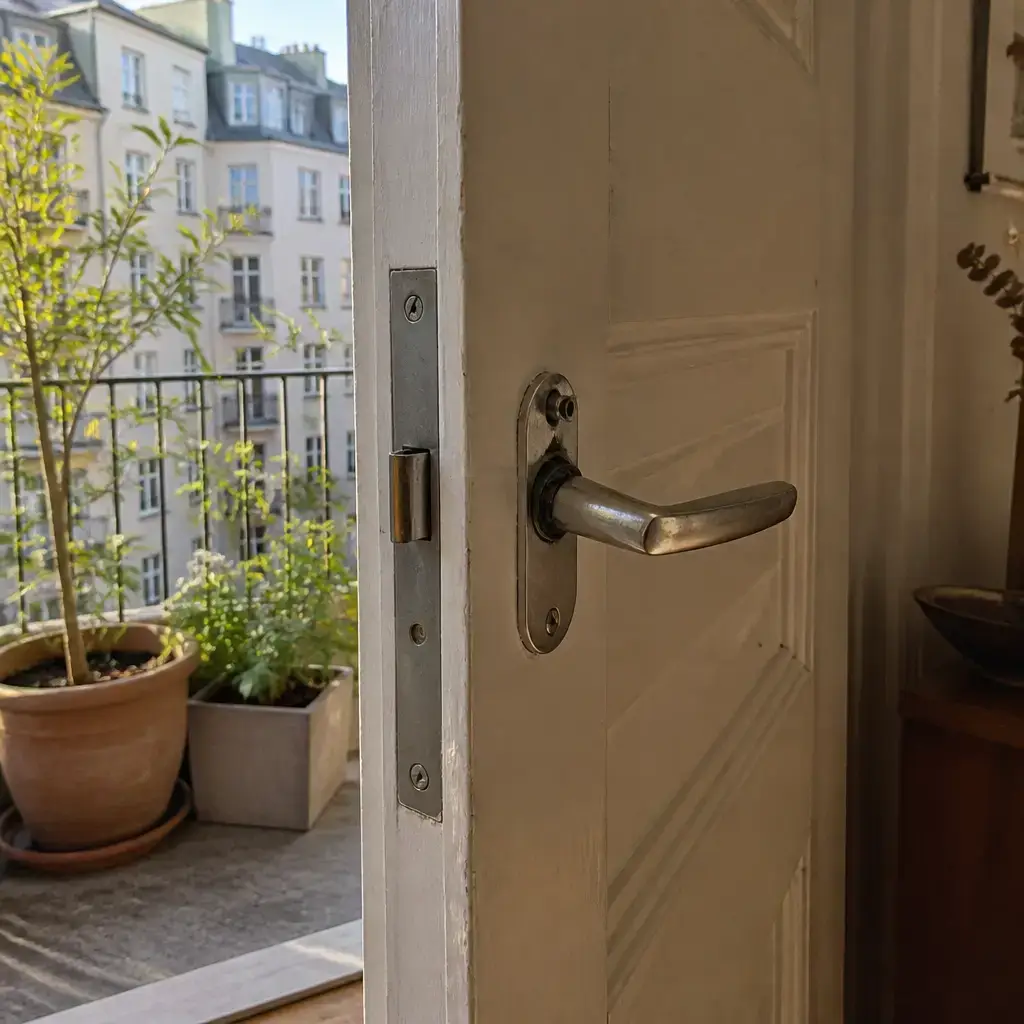
Døren
Døren means “the door” here and is the subject of the sentence about being stuck. It refers to the specific door already being discussed. Use Døren when referring to this particular door.
sidder fast
Sidder fast means “is stuck” as a whole in this dialogue. Sidder contributes the idea of being in a state or position, while fast adds the idea of being held in place. A useful pattern is a subject followed by sidder fast when something cannot move.
Prøv
Prøv means “try” as a direct suggestion to the other person. Here it begins advice about how to open the door. A useful pattern is Prøv at followed by an action.
at
At introduces the action connected to Prøv in Prøv at trække i håndtaget. It links the suggestion to what the other person should try doing. Reuse at before an action after this type of suggestion.
trække
Trække means “pull” in the action Prøv at trække i håndtaget. It appears after at to name the action being suggested. A useful pattern is trække i followed by the thing being pulled.
i
I is the preposition used in trække i håndtaget, meaning that the handle is what someone pulls on. Its meaning here comes from the whole pulling construction. Reuse trække i followed by an object when describing pulling on something.
håndtaget
Håndtaget means “the handle” here and is the object connected to pulling. It identifies the specific handle on the door. Use håndtaget when referring to that particular handle.
Jeg
Jeg means “I” and identifies the person who pulled the handle. It is the subject of Jeg trak i håndtaget. A useful reuse pattern is Jeg followed by an action when reporting what you did.
trak
Trak means “pulled” and reports the completed pulling action in Jeg trak i håndtaget. It describes what the speaker did before explaining that the door remained closed. Reuse Jeg trak i followed by the object that was pulled on.
men
Men means “but” and connects the completed pull with the contrasting result that the door is still closed. It signals that the second part did not have the expected result. Use men to join two contrasting parts of a sentence.
er
Er means “is” and links døren with its current state in døren er stadig lukket. It presents the door’s condition now. A useful pattern is a subject followed by er and a description.
stadig
Stadig means “still” and shows that the door remains closed after the attempted pull. It emphasizes that the state has continued. Reuse er stadig followed by a description of an unchanged state.
lukket
Lukket means “closed” and describes the door’s current condition in døren er stadig lukket. Together with er, it says that the door remains closed. Reuse er lukket to describe something that is closed.
Skub
Skub means “push” as a direct instruction. Here it tells the other person how to try moving the door. A useful pattern is Skub followed by an adverb or location phrase.
langsomt
Langsomt means “slowly” and describes the manner of pushing. It tells the other person to use a gentle, slow movement. Reuse a verb followed by langsomt to describe doing an action slowly.
tæt
Tæt contributes the meaning “close” in the location expression tæt på kanten. The whole expression tells the listener where to push, rather than describing the edge by itself. A useful pattern is tæt på followed by a place or object.
på
På works with tæt in tæt på kanten to mean “near” or “close to” the edge. Its location meaning here comes from the complete expression tæt på. Reuse tæt på followed by the place or thing that is nearby.
kanten
Kanten means “the edge” in tæt på kanten and names the edge near which the person should push. It refers to a specific edge of the door. Use kanten when talking about that particular edge.
åbnede
Åbnede means “opened” and reports that the door moved to an open position. In Døren åbnede lidt, it describes a completed change in the door’s state. Reuse åbnede lidt to say that something opened only slightly.
lidt
Lidt means “a little” and limits how far the door opened. It shows that the opening was small, not complete. Reuse a verb followed by lidt when describing a small degree of an action or change.
føles
Føles means “feels” and describes the impression the handle gives when touched. In Håndtaget føles løst, it links the handle with the tactile description løst. A useful pattern is a subject followed by føles and a description.
løst
Løst means “loose” and describes the condition of the handle in Håndtaget føles løst. It tells the listener that the handle does not feel firmly attached. Reuse føles løst when describing something that feels loose.
Skal
Skal means “should” in the question Skal vi holde op med at bruge denne dør? It introduces a suggestion for a shared action. A useful pattern is Skal vi followed by an action when proposing something to do together.
vi
Vi means “we” and refers to the two people making a decision together. It is the subject of the suggestion in Skal vi holde op med at bruge denne dør? It also appears as Vi when introducing what they can do next.
holde op med
Holde op med means “stop doing something” as a whole in holde op med at bruge denne dør. Holde op signals ending an activity, and med connects that idea to the activity that follows. Reuse holde op med at followed by an action that should stop.
bruge
Bruge means “use” in at bruge denne dør. It names the activity that the speakers are considering stopping. Reuse bruge followed by the object being used.
denne
Denne means “this” and points to the specific door being discussed in denne dør. It identifies the door as the one close to the speakers. A useful pattern is denne followed by the noun being pointed out.
dør
Dør means “door” in denne dør and names the object they may stop using. The same noun appears as Døren earlier when referring to the specific door as the subject. Use dør after denne to identify this door.
kan
Kan means “can” and expresses possibility in Vi kan reparere håndtaget. It shows that repairing the handle is an available action. A useful pattern is kan followed by an action.
reparere
Reparere means “fix” or “repair” and names the action the speakers can take with the handle. It follows kan in kan reparere håndtaget. Reuse reparere followed by the thing that needs fixing.
før
Før means “before” and introduces the event that should not happen again until the handle is repaired. Here it connects the repair with someone getting stuck again. A useful pattern is før followed by a clause describing the later event.
nogen
Nogen refers to an unspecified person in før nogen sidder fast igen. In this context, it is naturally understood as “anyone” who might get stuck. Reuse før nogen followed by an action or situation that should be prevented.
igen
Igen means “again” and shows that getting stuck would be a repeated event. Here it modifies sidder fast, referring back to the earlier stuck-door problem. Reuse sidder fast igen when saying that the same problem happens another time.