Der
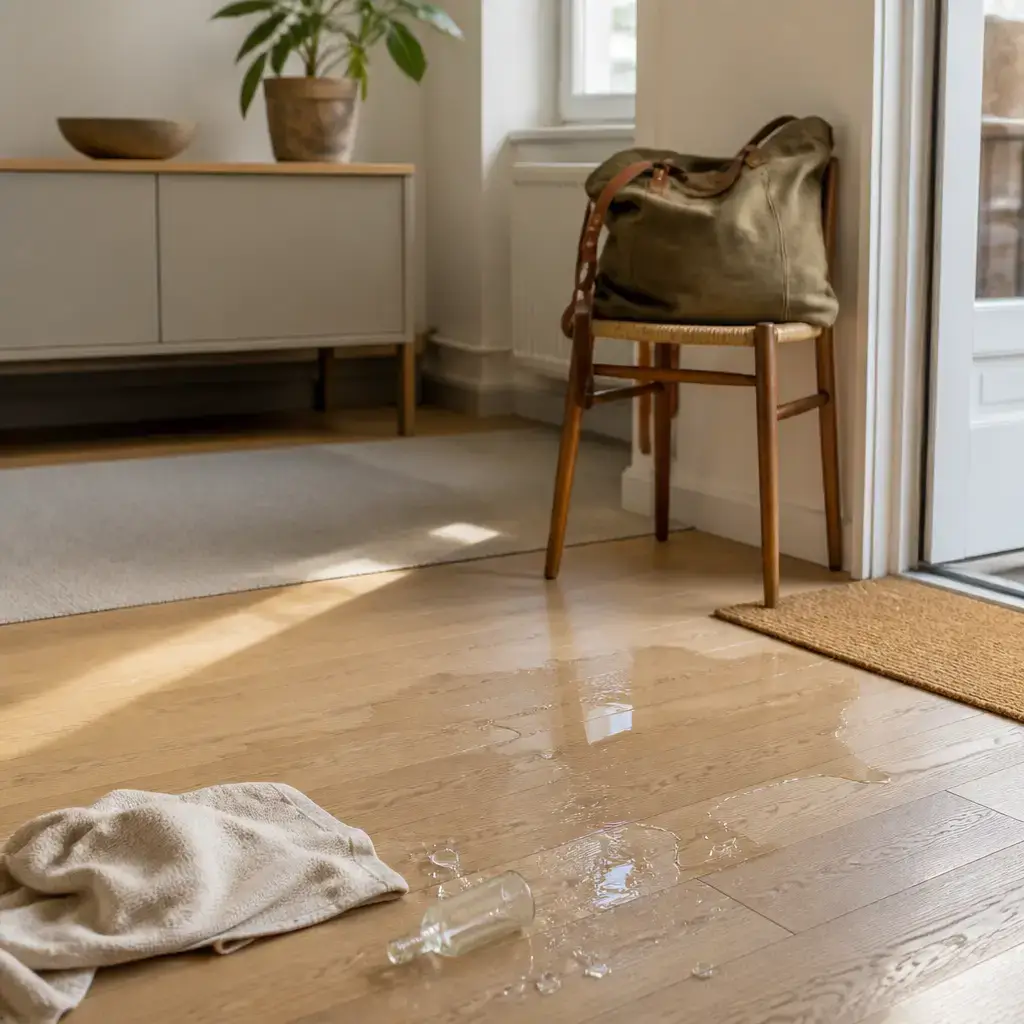
At the start of “Der er vand på gulvet.”, “Der” introduces the existence of something: there is water on the floor. It is the existential “there” in this sentence, and its capital letter comes from sentence position. A common reusable pattern is “Der er ...” for saying that something is present.
er
In “Der er vand på gulvet.”, “er” states that the water exists there. Together with “Der”, it forms the common pattern “Der er ...”; the thing being introduced follows it, here “vand”.
vand
“Vand” means water, referring here to the water on the floor. In “Der er vand på gulvet.”, it is used without an article when referring to water as a substance.
på
In “på gulvet”, “på” means on and identifies the floor as the surface where the water is. Reuse “på” before a surface or location when describing where something is.
gulvet
“Gulvet” means the floor in “på gulvet”. It is the definite form of “gulv”, and it follows “på” to name the specific surface.
Det
In “Det breder sig hen mod døren.”, “Det” refers to the water already mentioned. The capital letter comes from sentence position; the following expression “breder sig” describes what the water does.
breder
In “Det breder sig hen mod døren.”, “breder” contributes the idea of spreading. With “sig”, the expression “breder sig” means that the water spreads; it can be followed by a direction such as “hen mod døren”.
sig
In “Det breder sig hen mod døren.”, “sig” is the reflexive element that completes “breder sig”. The expression means that the water spreads, so “sig” alone does not carry the whole meaning “spreads”.
hen
In “hen mod døren”, “hen” helps show direction toward the door. Together with “mod”, it forms the directional phrase “hen mod døren”; reuse “hen mod” before a destination or direction.
mod
In “hen mod døren”, “mod” marks the direction toward the door. It follows “hen” here and can be reused in the pattern “hen mod” followed by a destination.
døren
“Døren” means the door in “hen mod døren”. It is the definite form of “dør” and follows “mod” as the destination toward which the water is spreading.
Den
In “Den lille flaske”, “Den” means “the” and identifies a specific bottle. The same word appears lowercase as “den” in “Jeg lægger den på stolen.”, where it means “it” and refers to the bag; the capitalization reflects sentence position.
lille
“Lille” means small in “Den lille flaske”. It comes before the noun “flaske” and describes its size; reuse “lille” before a noun when describing something as small.
flaske
“Flaske” means bottle in “Den lille flaske”. It is the noun described by “lille” and identified by “Den”; use it for a container that is a bottle.
gik
In “Den lille flaske gik i stykker.”, “gik” is part of the expression “gik i stykker” used to say that the bottle broke. The meaning “broke” belongs to the whole expression, not to “gik” alone.
i stykker
The exact expression “gik i stykker” means broke. In it, “i” introduces “stykker” (“pieces”), so the construction presents the bottle as going into pieces; keep “i stykker” together after a verb such as “gik”.
Jeg
“Jeg” means I in “Jeg henter et tørt håndklæde.”. It is the subject and comes before “henter”; reuse “Jeg” before an action that you are describing.
henter
In “Jeg henter et tørt håndklæde.”, “henter” means get or fetch. It is followed by the thing being fetched, here “et tørt håndklæde”, so reuse it before the object you are going to get.
et
In “et tørt håndklæde”, “et” is the indefinite article “a” before this noun. It comes before the descriptive word “tørt” and the noun “håndklæde”; reuse “et” with a neuter noun.
tørt
In “et tørt håndklæde”, “tørt” means dry and describes the towel. It is the form of “tør” used after “et” with “håndklæde”; reuse it in this adjective-plus-noun pattern.
håndklæde
“Håndklæde” means towel in “et tørt håndklæde”. It is the noun after the article and adjective; here it names the item used for drying the water.
Kan
In “Kan du flytte tasken først?”, “Kan” begins a request asking whether the listener can move the bag. It is sentence-initial and is followed by the subject “du” and the action “flytte”.
du
“Du” means you in “Kan du flytte tasken først?”. It is the person being asked and comes after “Kan” in this question.
flytte
In “Kan du flytte tasken først?”, “flytte” means move and follows the modal verb “Kan”. The thing being moved comes after it, here “tasken”; reuse it before the object that should be moved.
tasken
“Tasken” means the bag in “Kan du flytte tasken først?”. It is the object of “flytte”; the same form appears capitalized as “Tasken” at the start of “Tasken holder sig tør der.”, where it is the subject.
først
In “Kan du flytte tasken først?”, “først” means first and marks the requested order of the action. Use it when one action should happen before another.
lægger
In “Jeg lægger den på stolen.”, “lægger” means put or place. It describes placing “den” at a location, with the destination expressed by “på stolen”.
stolen
“Stolen” means the chair in “på stolen”. It is the definite form of “stol” and follows “på” to name the destination where the bag is placed.
Så
“Så” means then in “Så kan vi gøre gulvet rent.”. It links the cleaning step to the previous action of moving the bag; use it to introduce a next step or consequence.
vi
“Vi” means we in “Så kan vi gøre gulvet rent.”. It is the subject with “kan” and refers to the speaker together with the other person involved.
gøre
In “gøre gulvet rent”, “gøre” is the verb used to make the floor clean. The full construction “gøre gulvet rent” means clean the floor, with “gulvet” as the object and “rent” describing its resulting state.
rent
In “gøre gulvet rent”, “rent” means clean and describes the state of “gulvet”. It is the form of “ren” used with “gulvet”; in this construction it comes after the object.
holder
In “Tasken holder sig tør der.”, “holder” is part of “holder sig tør”, which means that the bag stays dry. It expresses maintaining a state, while “sig tør” completes the description of that state.
tør
In “Tasken holder sig tør der.”, “tør” means dry and describes the bag’s state. It is used after “holder sig” in the expression “holder sig tør” to say that the bag remains dry.