Har
“Har” means “have” in “Har du en hammer, jeg kan bruge?” It comes first to form a question such as “Har du en hammer?”
du
“du” means “you,” referring to the person being addressed. In “Har du en hammer, jeg kan bruge?”, it follows “Har” in the question pattern “Har du ...?”
en
“en” means “a” in “en hammer.” It introduces one unspecified hammer. The same pattern can be used with another noun that takes “en”.
hammer
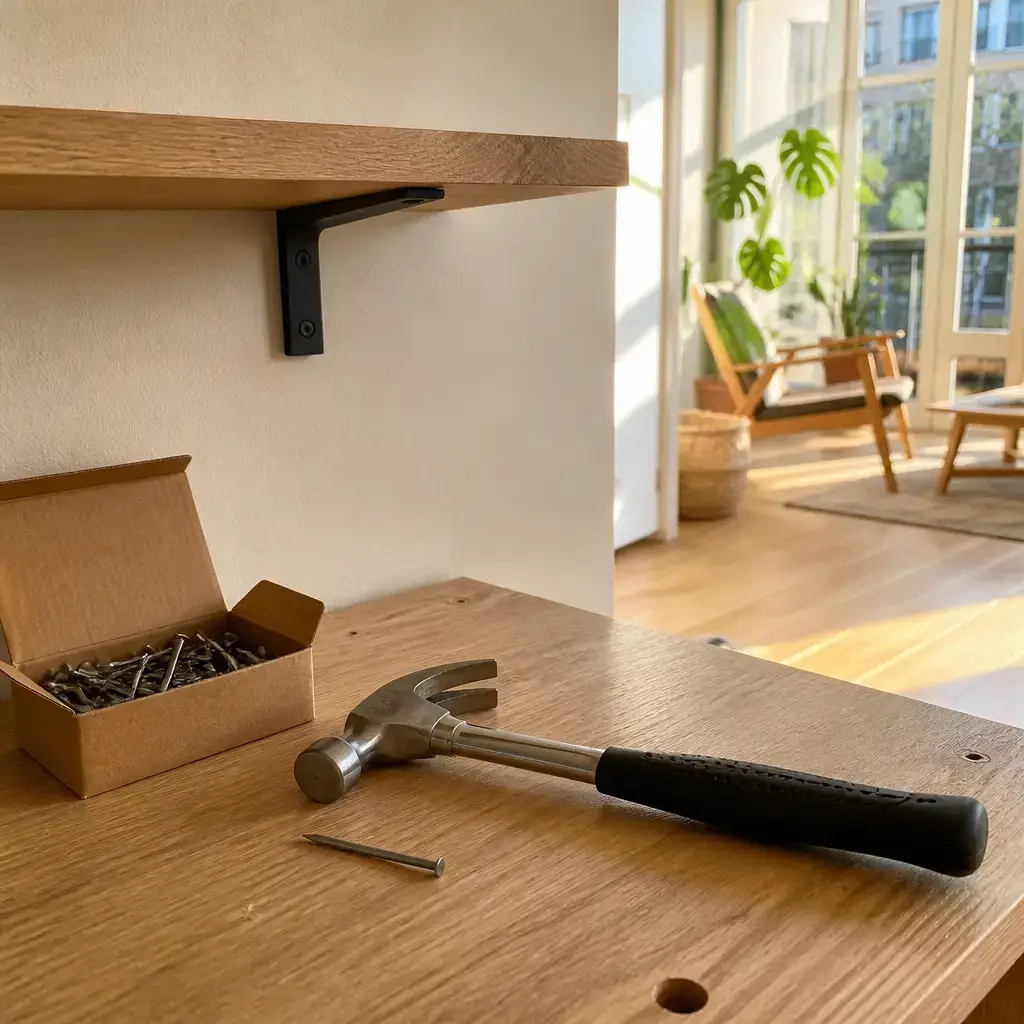
“hammer” means “hammer” in “en hammer.” It names the tool being requested and used to repair the shelf. The specific tool is later referred to as “hammeren”.
jeg
“jeg” means “I,” the person speaking. It appears in “jeg kan bruge” and “Jeg skal bruge” to identify who can use or needs the hammer.
kan
“kan” means “can” or “be able to” in “jeg kan bruge.” It expresses the speaker’s ability to use the hammer and is followed by “bruge.”
bruge
“bruge” means “use” in “jeg kan bruge.” It follows “kan” and names the action the speaker is able to carry out.
Brug
“Brug” means “use” as a direct instruction in “Brug denne.” The lowercase form “brug” also appears in “brug for,” where the whole expression means “need”; “brug” alone does not carry that whole meaning there.
denne
“denne” means “this one” in “Brug denne.” It points to the offered item, understood from the situation. It can follow an instruction when the item is clear from context.
men
“men” means “but” in “Brug denne, men hold godt fast om håndtaget.” It introduces the warning or added instruction about gripping the handle.
hold
“hold” means “hold” or “grip” in “hold godt fast om håndtaget.” It gives the action in the instruction and is followed by details about how and where to grip.
godt
“godt” contributes the meaning “well” or “firmly” in “hold godt fast om håndtaget.” It strengthens the manner of holding, so the grip should be secure.
fast
“fast” means “firmly” or “tight” in “hold godt fast om håndtaget.” Together with “hold godt” it describes a secure grip on the handle.
om
“om” means “around” in “om håndtaget.” It connects the gripping action with the handle; the full instruction is “hold godt fast om håndtaget.”
håndtaget
“håndtaget” means “the handle” in “hold godt fast om håndtaget.” It identifies the part of the hammer that should be gripped and follows “om.”
skal
“skal” expresses necessity in “Jeg skal bruge den til at reparere denne hylde.” Together with “bruge,” “skal bruge” means that the speaker needs the item, and it is followed by the object “den.”
den
“den” means “it” or “that one” in “bruge den til at reparere denne hylde.” Here it refers to the hammer and is the item needed for the repair.
til
“til” marks purpose in “til at reparere denne hylde.” Together with “at reparere,” it means “to repair this shelf” and explains what the hammer is needed for.
at
“at” marks the verb in “at reparere.” Together with “til,” it introduces the purpose “til at reparere denne hylde,” meaning “to repair this shelf.”
reparere
“reparere” means “repair” or “fix” in “at reparere denne hylde.” It names the action for which the hammer is needed and follows “at.”
hylde
“hylde” means “shelf” in “denne hylde.” It names the object that the speaker wants to repair.
også
“også” means “also” in “Har du også brug for søm?” It adds nails as another possible thing the person needs.
for
“for” is part of the expression “brug for,” which means “need.” In “Har du også brug for søm?”, the thing needed comes after this expression.
søm
“søm” means “nail” or “nails” in this dialogue. It appears in “brug for søm” and in “Et søm,” where “Et” specifies one nail.
Et
“Et” means “one” or “an” in “Et søm.” It introduces one nail as the item that would help.
ville
“ville” means “would” in “Et søm ville hjælpe.” It presents the result as a conditional possibility: one nail would help.
hjælpe
“hjælpe” means “help” in “Et søm ville hjælpe.” It follows “ville” and describes the benefit that one nail would provide.
De
“De” means “they” in “De ligger i kassen ved siden af dig.” Here it refers to the nails and functions as the subject of “ligger.”
ligger
“ligger” means “are located” or “are lying” in “De ligger i kassen ved siden af dig.” It tells where the nails are, followed by the location “i kassen.”
i
“i” means “in” in “i kassen.” It introduces the container where the nails are located.
kassen
“kassen” means “the box” in “i kassen.” It names the container and follows “i” to give the location of the nails.
ved
“ved” is part of the location expression “ved siden af dig,” meaning “beside you.” It contributes the relation of being near the person addressed.
siden
“siden” is part of “ved siden af dig,” the expression meaning “beside you.” It supplies the “side” component of this location phrase.
af
“af” is part of “ved siden af dig,” meaning “beside you.” It connects “siden” with the person named by “dig,” so it should be learned as part of the full expression.
dig
“dig” means “you” in “ved siden af dig.” It identifies the person beside whom the box is located.
lægger
“lægger” means “put” or “place” in “Jeg lægger hammeren tilbage.” It describes placing the hammer back and is used with the object “hammeren” and the direction “tilbage.”
hammeren
“hammeren” means “the hammer” in “Jeg lægger hammeren tilbage.” It refers to the specific hammer that was borrowed and is the object being returned.
tilbage
“tilbage” means “back” in “lægger hammeren tilbage.” It shows that the hammer is being placed in its previous or proper location again.
når
“når” means “when” in “når jeg er færdig.” It introduces the time condition for returning the hammer.
er
“er” means “am,” “are,” or “is” in “jeg er færdig” and “du er færdig.” It links the person to the state described by “færdig.”
færdig
“færdig” means “finished” or “done” in “jeg er færdig” and “du er færdig.” Together with “er,” it says that the person has finished the task.
Læg
“Læg” means “put” or “place” as a direct instruction in “Læg den her sammen med de andre værktøjer.” It tells the listener where to leave the hammer after use.
her
“her” means “here” in “Læg den her.” It identifies the place where the hammer should be left.
sammen
“sammen” means “together” in “sammen med de andre værktøjer.” Together with “med,” it shows that the hammer should be placed with the other tools.
med
“med” means “with” in “sammen med de andre værktøjer.” It connects the hammer with the group of other tools.
andre
“andre” means “other” in “de andre værktøjer.” It distinguishes these tools from the hammer being returned.
værktøjer
“værktøjer” means “tools” in “de andre værktøjer.” It names the group with which the hammer should be left.