Må
“Må” asks for permission here: “Må jeg bruge saksen?” means “May I use the scissors?” It is useful when asking whether an action is allowed, especially with “Må jeg” followed by an action.
jeg
“jeg” means “I” and identifies the person asking to use or borrow something. In “Må jeg bruge saksen?” it comes after “Må” and before the action.
bruge
“bruge” means “use” in “Må jeg bruge saksen?” It names the action the speaker wants permission to do; after “Må jeg,” it introduces the action being requested.
saksen
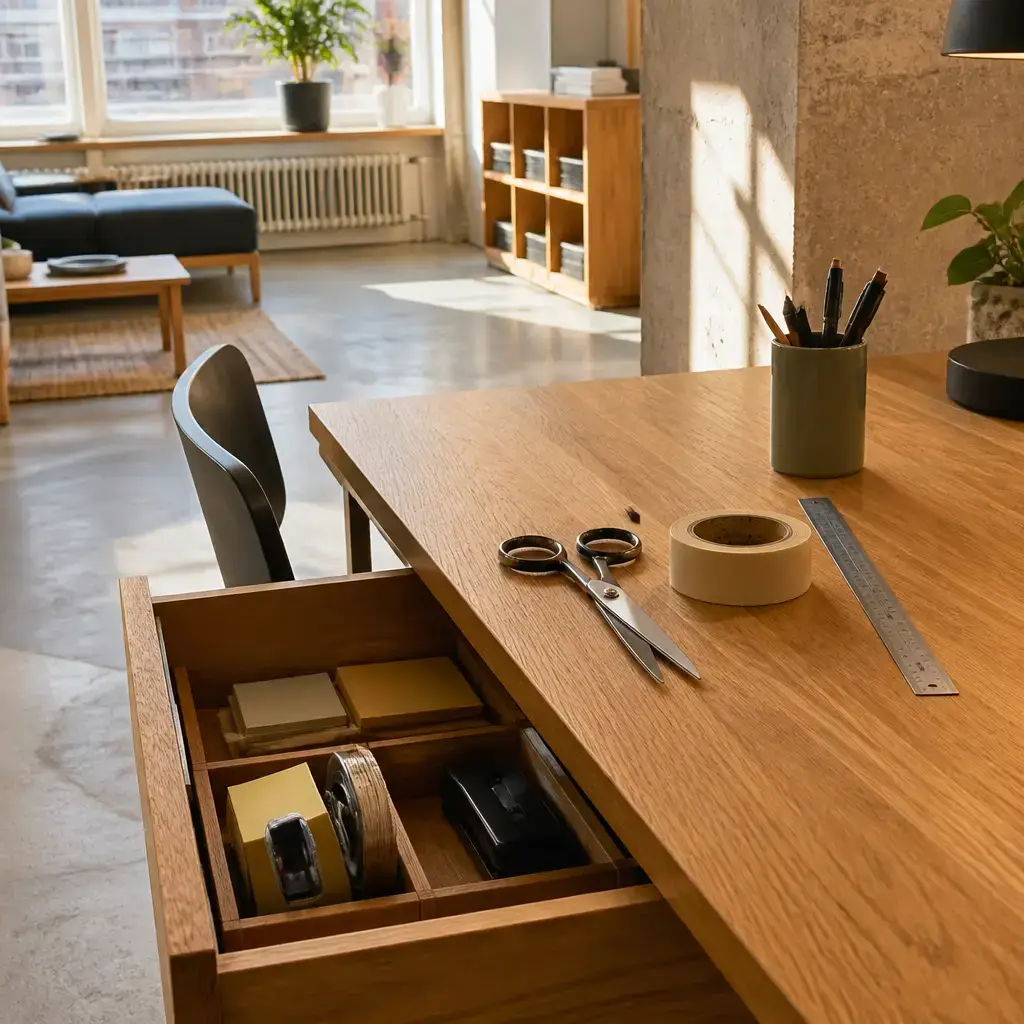
“saksen” means “the scissors,” the tool the speaker wants to use. The form refers to a specific pair of scissors, and “bruge saksen” is a useful pattern for saying that you want to use a particular tool.
Tag
“Tag” tells someone to take something: “Tag dem her” means “Take these here.” It is a direct instruction placed before the object being taken.
dem
“dem” means “them” and refers here to the scissors. In “Tag dem her,” it is the object of “Tag,” so the listener is told to take them.
her
“her” means “here” and points to the items being offered nearby in “Tag dem her.” It commonly follows an object when indicating something close to the speaker.
og
“og” means “and” and joins the two instructions in “Tag dem her, og hold bladene nedad.” It is used to connect coordinated actions or statements.
hold
“hold” means “keep” or “hold” in the instruction “hold bladene nedad.” It tells the listener to maintain the blades in a particular position.
bladene
“bladene” means “the blades,” referring to the sharp parts of the scissors. In “hold bladene nedad,” it is the object whose position the listener must control.
nedad
“nedad” means “downward” and describes the direction of the blades in “hold bladene nedad.” It is useful after an action of holding or pointing when the direction should be kept downward.
skal
“skal” expresses necessity or intended action in “Jeg skal også bruge noget tape,” which means “I also need some tape.” The pattern “skal bruge” is used when saying that you need something for an activity.
også
“også” means “also” here and adds tape to the scissors the speaker already needs. It commonly appears before the item or action being added, as in “skal også bruge noget tape.”
noget
“noget” means “some” in “noget tape,” referring to an unspecified amount of tape. It is useful before an uncounted amount of something that is needed or wanted.
tape
“tape” means “tape” in “noget tape.” The same noun appears as “Tapen” when the dialogue refers to the specific tape in the drawer.
er
“er” means “is” in “Tapen er i skuffen” and “den er på mit skrivebord.” It links an item with its location or state, commonly in patterns such as “X er i …” or “X er på …”.
i
“i” means “in” and places the tape inside the drawer in “Tapen er i skuffen.” It is used before the container or place where something is located.
skuffen
“skuffen” means “the drawer,” the specific place where the tape is located. The phrase “i skuffen” is useful when identifying an item’s location inside a drawer.
Har
“Har” means “have” in the question “Har du også en lineal?” It begins a question about whether someone possesses or has a particular item.
du
“du” means “you” and identifies the person being asked about the ruler. In “Har du også en lineal?” it follows “Har” in the question.
en
“en” means “a” in “en lineal,” introducing one nonspecific ruler. It comes directly before the noun when asking about or mentioning one item.
lineal
“lineal” means “ruler,” the tool being requested in “Har du også en lineal?” It can follow “en” when referring to one ruler that has not yet been made specific.
Ja
“Ja” means “yes” and confirms that the speaker has the ruler. It is used as a short affirmative reply before giving additional information.
den
“den” refers to the ruler in “den er på mit skrivebord” and “tage den derfra.” It lets the speaker refer back to the specific item instead of repeating “linealen.”
på
“på” means “on” in “på mit skrivebord,” locating the ruler on the speaker’s desk. It commonly comes before a surface or place in a location statement.
mit
“mit” means “my” in “mit skrivebord,” showing that the desk belongs to the speaker. It comes directly before the owned noun in this expression.
skrivebord
“skrivebord” means “desk” in “mit skrivebord.” Together with “på,” the phrase identifies the surface where the ruler is located.
kan
“kan” means “can” in “Du kan tage den derfra,” expressing that the listener is able or permitted to take the ruler from that place. It is followed by the action in “kan tage.”
tage
“tage” means “take” in “kan tage den derfra.” After “kan,” it names the action and is followed by the object and its starting place.
derfra
“derfra” means “from there” and identifies the place from which the ruler can be taken. The pattern “tage den derfra” combines the object with its starting point.
giver
“giver” means “give” or “return” in “Jeg giver det hele tilbage.” Together with “tilbage,” it describes returning all the borrowed items, and “giver … tilbage” is a useful pattern for returning something.
det
“det” contributes the definite “the” sense in “det hele,” referring to the complete set of borrowed items. The expression “det hele” means “everything” or “the whole lot,” rather than naming one particular tool.
hele
“hele” means “whole” in “det hele,” referring to the complete group of items. “Det hele” is a reusable expression for the whole thing or everything in a situation.
tilbage
“tilbage” means “back” in “giver det hele tilbage,” adding the idea that the items return to their original place or owner. It commonly follows an action of giving when something is being returned.
når
“når” means “when” and introduces the time condition in “når jeg er færdig.” It connects an action with the point at which another event or state occurs.
færdig
“færdig” means “finished” or “done” in “jeg er færdig.” Here it describes the speaker’s state after finishing the activity, and “er færdig” is a common pattern for saying that something is complete.
Læg
“Læg” tells someone to place or leave something in a particular position: “Læg linealen øverst.” It is used as a direct instruction before the object and its location.
linealen
“linealen” means “the ruler,” referring to the specific ruler already mentioned. It is the object of “Læg” in “Læg linealen øverst,” where the speaker gives instructions about where to leave it.
øverst
“øverst” means “on top” or “at the top” and specifies the ruler’s position in “Læg linealen øverst.” The pattern “læg … øverst” is useful when telling someone to place an item on the top of a group.
så
“så” means “so that” in “så jeg kan finde den senere,” introducing the intended result of leaving the ruler on top. It commonly connects an action with the purpose or result that follows.
finde
“finde” means “find” in “kan finde den senere.” After “kan,” it names the action the speaker wants to be able to do, with “den” as the object.
senere
“senere” means “later” and indicates a later time in “finde den senere.” It is useful when saying that an action will happen after the current moment.