Hvor
Hvor means “where” in Hvor kan jeg finde denne bog? It asks for the location of the book. A common pattern is Hvor + verb for a location question.
kan
Kan expresses ability or possibility in Hvor kan jeg finde denne bog? It is followed by the infinitive finde. Use kan + an infinitive when asking what someone can do.
jeg
Jeg means “I” in Hvor kan jeg finde denne bog? It is the person asking the question. A common pattern is jeg + verb when talking about your own action.
finde
Finde means “find” in Hvor kan jeg finde denne bog? It follows kan and names the action the speaker wants to perform. Use kan + finde when asking where you can find something.
denne
Denne means “this” before bog in denne bog, identifying one specific book near the conversation. It helps distinguish this book from other books. A common pattern is denne + a noun for one specifically identified thing.
bog
Bog means “book” in denne bog. It is the item the speaker is looking for. You can reuse bog after a word that identifies a particular book, such as denne bog.
Den
Den refers back to the book in Den burde stå på en af disse hylder. It is the item expected to be located on one of the shelves. A common use is Den + verb when referring back to a known common-gender item.
burde
Burde expresses that the book is expected to be on one of the shelves in Den burde stå på en af disse hylder. It gives a cautious expectation rather than certainty. Use burde + an infinitive when saying what should or is expected to happen.
stå
Stå literally means “stand,” but here it means be located on a shelf in burde stå på en af disse hylder. It follows burde. This use describes where an item is positioned.
på
På means “on” in på en af disse hylder and describes the book’s location on a shelf. It connects the location with the shelves. A common pattern is på + a place or surface.
en
En means “one” in en af disse hylder, selecting one shelf from the group. Together with af, it introduces one member of a group. Use en af + a plural group when referring to one of several things.
af
Af means “of” in en af disse hylder and links one shelf to the group of shelves. It is part of the pattern en af disse hylder. This pattern is used to select one item from a group.
disse
Disse means “these” before hylder in disse hylder, referring to the shelves nearby or already identified. It specifies the relevant group. A common pattern is disse + a plural noun.
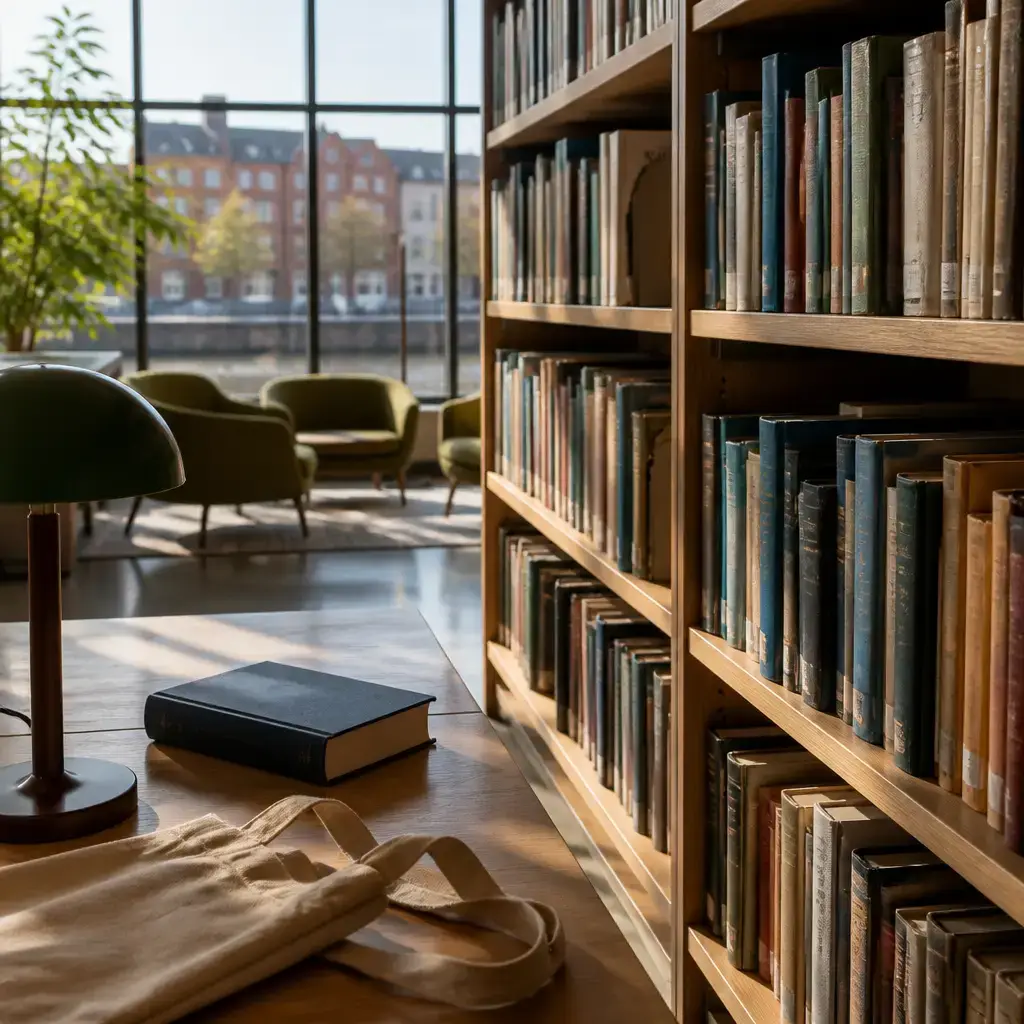
hylder
Hylder means “shelves” in disse hylder. It is the plural form referring to the group of shelves where the book is expected to be. The singular form is hylde, while hylder is the plural form used here.
Hvilken
Hvilken means “which” before hylde in Hvilken hylde skal jeg se på først? It asks the listener to choose one shelf. A common pattern is Hvilken + a singular noun when asking which one.
hylde
Hylde means “shelf” in Hvilken hylde. It names the particular shelf the speaker should check. It can be used after Hvilken when asking someone to identify one shelf.
skal
Skal expresses what the speaker should do in Hvilken hylde skal jeg se på først? It is followed by the subject jeg and the infinitive se. Use skal + an infinitive when asking or stating what someone is to do.
se
Se means “see” or “look” in se på, where the expression means look at or check a shelf. Here it is followed by på and identifies the act of checking. The reusable pattern is se på + the thing being inspected.
først
Først means “first” in skal jeg se på først, showing the order in which the shelves should be checked. It asks which shelf to inspect before the others. A common use is først when describing the first action in a sequence.
Prøv
Prøv means “try” as an instruction in Prøv den nederste hylde nær enden. It tells the listener to check the suggested shelf. Use Prøv + a noun phrase when suggesting that someone try a particular option.
nederste
Nederste identifies the lowest shelf in den nederste hylde. It helps the listener choose the shelf by its position. A common pattern is nederste + a noun when identifying the lowest item in a set.
nær
Nær means “near” in nær enden, locating the shelf close to the end. It introduces the landmark used to describe the location. A common pattern is nær + a place or point.
enden
Enden means “the end” in nær enden. It names the point that the lower shelf is near. The definite form enden is used here for a specific end.
omslaget
Omslaget means “the cover” in Jeg kan se omslaget nu. It is the part of the book that the speaker can see. The form omslaget refers to a specific cover already connected with the book.
nu
Nu means “now” in Jeg kan se omslaget nu. It shows that the cover has become visible at this moment. Use nu to mark the current time or a change occurring at the present moment.
Træk
Træk means “pull” as an instruction in Træk den forsigtigt ud. It tells the listener to move the book outward. A common use is Træk + an object + ud when instructing someone to pull something out.
forsigtigt
Forsigtigt means “carefully” in Træk den forsigtigt ud. It describes how the book should be pulled so the other books remain in place. It can be used to describe the careful manner of an action.
ud
Ud means “out” in Træk den forsigtigt ud and marks movement away from the shelf. Together with Træk, it describes pulling the book outward. A common pattern is a movement verb + ud when something moves out.
så
Så means “so that” in så de andre bliver på plads. It introduces the purpose or intended result of pulling the book carefully. A common pattern is så + a clause explaining the result of an action.
de
De means “they” in de andre and refers to the other books on the shelf. It identifies the items that should remain in place. It is commonly used before andre to mean the others.
andre
Andre means “others” in de andre, referring to the books other than the one being pulled out. It contrasts the selected book with the remaining books. A common pattern is de andre when referring to the rest of a known group.
bliver
Bliver means “stay” or “remain” in bliver på plads. It describes the other books continuing to occupy their positions. A common use is bliver + a location phrase when something remains somewhere.
plads
Plads means “place” or “position” in på plads. In this dialogue, på plads means that the other books remain in their positions. Plads can be used in this expression when talking about something staying where it belongs.
Det
Det points to the book in Det er den rigtige bog, meaning “this” or “it” in the identification. It introduces the item the speaker has recognized. A common pattern is Det er + a noun phrase when identifying something.
er
Er means “is” in Det er den rigtige bog. It links the identifying subject Det with the description den rigtige bog. Use Det er + a noun phrase to say what something is.
rigtige
Rigtige means “right” or “correct” in den rigtige bog, identifying the book that matches the one being sought. It appears inside the noun phrase for the specific book. A common pattern is den rigtige + a noun when confirming the correct item.
Du
Du means “you” in Du kan læse den ved det bord. It identifies the person being given permission or advice. A common pattern is Du kan + an infinitive when telling someone what they can do.
læse
Læse means “read” in Du kan læse den ved det bord. It follows kan and names the activity allowed at the table. Use kan + læse when saying that someone can read something.
ved
Ved means “at” in ved det bord and locates the reading activity beside or at the table. It introduces the place where the person can read. A common pattern is ved + a specific place or object, such as ved det bord.