Må
“Må” asks for permission here: “Må jeg låne din oplader til telefonen?” means “May I borrow your phone charger?” It is used before the person and action in a permission question, as in the new example “Må jeg åbne vinduet?”
jeg
“jeg” means “I” and is the person asking to borrow the charger in “Må jeg låne din oplader til telefonen?” It is used as the subject before the verb, as in the new example “Jeg kommer senere.”
låne
“låne” means “borrow” in “Må jeg låne din oplader til telefonen?” It follows “Må jeg” in a permission question and can be reused with an object, as in the new example “Må jeg låne din pen?”
din
“din” means “your” and identifies the charger as belonging to the person being addressed in “din oplader til telefonen”. It comes before the noun it describes, as in the new example “din taske.”
oplader
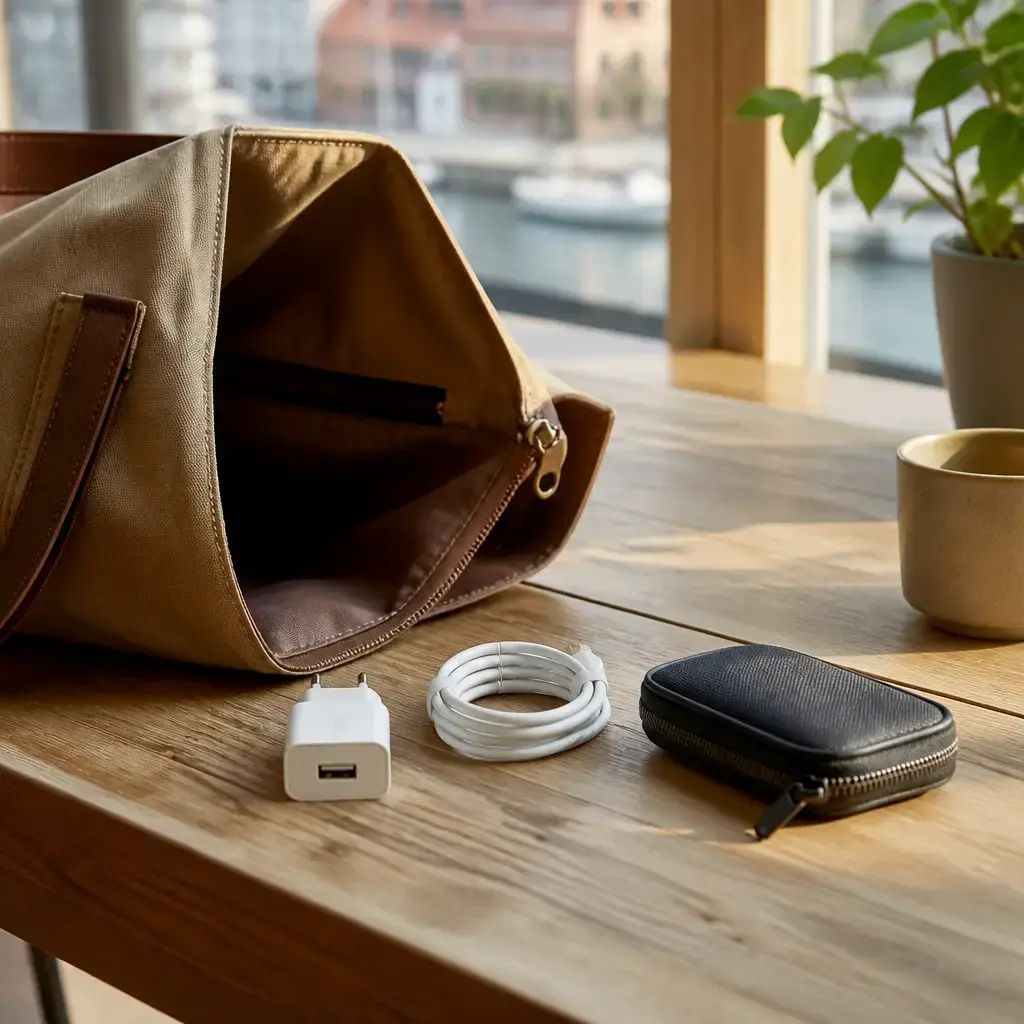
“oplader” means “charger” in “din oplader til telefonen”. It is the item the speaker wants to borrow and can be used with “til telefonen” to specify what it is for.
til
“til” links “oplader” with “telefonen” in “oplader til telefonen”, meaning a charger for the phone. It introduces the thing the charger is intended for, as in the new example “en taske til computeren.”
telefonen
“telefonen” means “the phone” in “oplader til telefonen”. The ending “-en” is part of this exact definite form, and the noun follows “til” to identify what the charger is for.
Den
“Den” means “it” here and refers back to the charger in “Den ligger i inderlommen på min taske.” It is used as the subject when describing where that item is located.
ligger
“ligger” says that something is located or lying somewhere; in “Den ligger i inderlommen på min taske”, the charger is in the inside pocket. It is commonly used with a place introduced by “i”, as in the new example “Bogen ligger i tasken.”
i
“i” means “in” and introduces the location “i inderlommen på min taske”. It is used before the container or place where something is located, as in the new example “i etuiet.”
inderlommen
“inderlommen” means “the inside pocket” in “i inderlommen på min taske”. It names the specific pocket where the charger is located and is used after “i” for the location.
på
“på” links “inderlommen” with “min taske” in “inderlommen på min taske”, meaning the inside pocket of my bag. Here it shows the relationship between a part and the whole bag.
min
“min” means “my” and identifies the bag as belonging to the speaker in “min taske”. It comes directly before the noun it describes.
taske
“taske” means “bag” in “min taske”. It is the object of the possessive phrase and names the bag containing the inside pocket.
Er
“Er” means “is” in the question “Er kablet sammen med opladeren?” It comes first because this is a question about whether the cable is together with the charger.
kablet
“kablet” means “the cable” in “Er kablet sammen med opladeren?” The ending “-et” is part of this exact definite form, and the cable is the subject of the question.
sammen
“sammen” means “together” in “sammen med opladeren”. Together with “med”, it asks whether the cable is with the charger; the reusable pattern is “sammen med” followed by the person or thing accompanying it.
med
“med” means “with” in “sammen med opladeren”. In the expression “sammen med”, it identifies what the cable is together with.
opladeren
“opladeren” means “the charger” in “sammen med opladeren”. The ending “-en” is part of this exact definite form, and the charger is the item accompanying the cable.
det
The lowercase “det” means “the” in “det lille etui”, identifying the case as a specific neuter noun. The capitalized “Det” in “Det er fint for mig” refers to the proposed arrangement and means “that” or “it” in that sentence.
lille
“lille” means “small” in “det lille etui”. It describes the case and appears between “det” and the noun, as in the new example “det lille rum.”
etui
“etui” means “case” in “det lille etui”. It is the container holding the cable and is used after the description “det lille”.
fandt
“fandt” means “found” in “Jeg fandt begge dele.” It describes discovering the two requested items, and it can be reused with the thing found, as in the new example “Jeg fandt min nøgle.”
begge
“begge” means “both” in “begge dele”, referring to the charger and the cable together. It is used before “dele” to indicate two items as a pair.
dele
“dele” means “things” or “parts” in “begge dele”, which means both items in this dialogue. The expression “begge dele” is a reusable way to refer to two things already understood from the conversation.
Læg
“Læg” tells someone to put or place something in “Læg kablet tilbage i etuiet, tak.” It is used at the beginning of this polite request, followed by the object and its destination.
tilbage
“tilbage” means “back” in “Læg kablet tilbage i etuiet”. It shows that the cable should be returned to its previous place, and it commonly follows an action verb when something is put or given back.
etuiet
“etuiet” means “the case” in “tilbage i etuiet”. The ending “-et” is part of this exact definite form, and it identifies the destination where the cable should be placed.
tak
“tak” means “please” at the end of “Læg kablet tilbage i etuiet, tak.” Here it makes the request polite; in other contexts, “tak” can also mean “thanks.”
giver
“giver” means “give” in the phrase “giver det hele tilbage”, where the meaning is “return”. It is used with the object “det hele” and the direction word “tilbage” to describe returning everything.
hele
“hele” means “whole” in “det hele”, an expression meaning “everything” in this dialogue. It comes after “det” and refers to the complete set of borrowed items.
før
“før” means “before” in “før jeg går”. It introduces the time condition for returning everything, and it is followed here by a clause with “jeg” and “går.”
går
“går” means “goes” literally, but in “før jeg går” it means “leave”. It is used after “før jeg” to say that the speaker will return everything before departing.
fint
“fint” means “fine” in “Det er fint for mig”, expressing that the proposed arrangement is acceptable. The common pattern “Det er fint” can be used to agree to a plan.
for
“for” means “for” in “fint for mig”, identifying the person for whom the arrangement is acceptable. It is followed by the object form “mig” in this expression.
mig
“mig” means “me” in “Det er fint for mig”. It identifies the speaker as the person who accepts the arrangement and follows “for” in this phrase.