Jeg
“Jeg” means “I” and is the speaker’s subject in “Jeg kan ikke finde min pung.” Use it at the beginning of a sentence when talking about yourself.
kan
“kan” means “can” or “am able to” in “Jeg kan ikke finde min pung.” It is followed by the infinitive “finde”; a reusable pattern is “Jeg kan ...” followed by an action.
ikke
“ikke” makes the statement negative in “Jeg kan ikke finde min pung.” It comes after “kan” and before “finde” in this sentence, and it can be used to say that an action does not happen or is not possible.
finde
“finde” means “find” in “Jeg kan ikke finde min pung.” It is the action that the speaker cannot do; after “kan” it names the action directly.
min
“min” means “my” in “min pung” and shows that the wallet belongs to the speaker. Use it before the thing that belongs to you, as in “min pung.”
pung
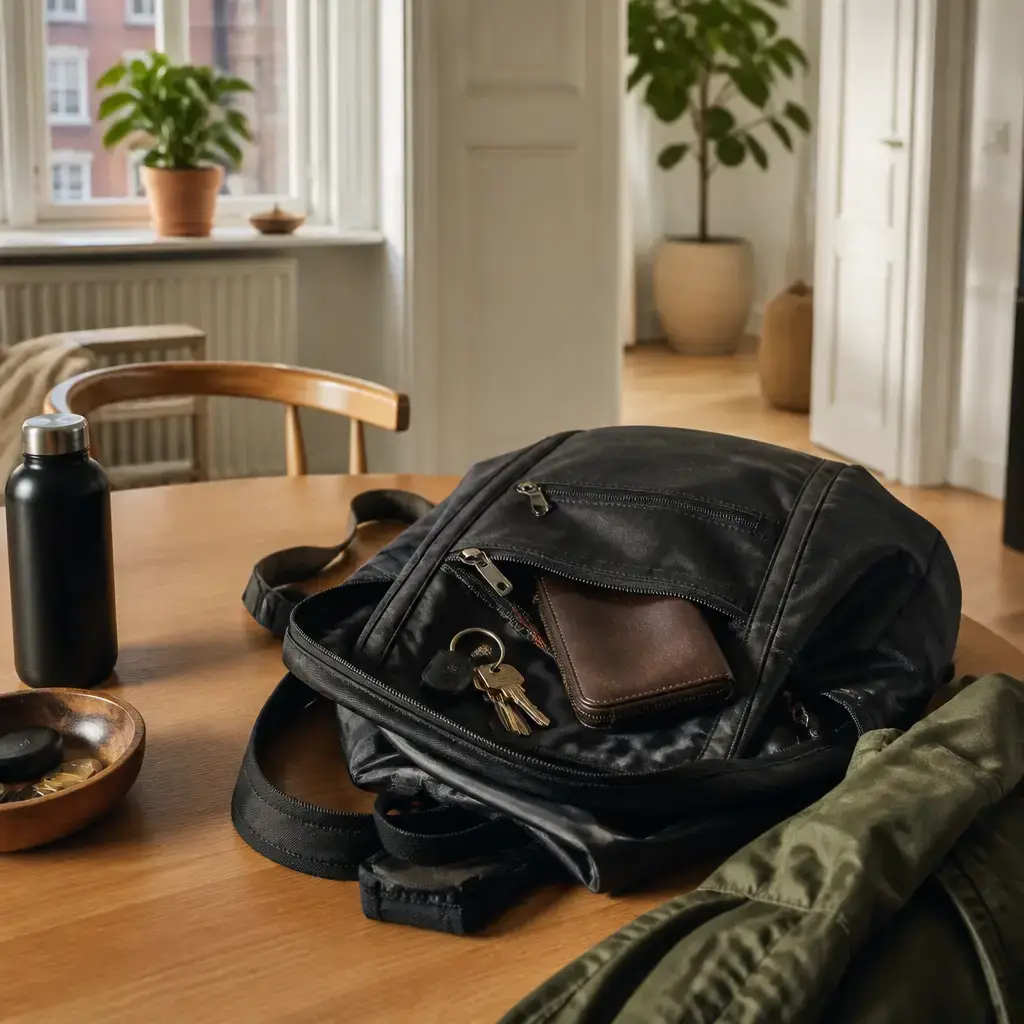
“pung” means “wallet” in “Jeg kan ikke finde min pung.” It is the missing item the speaker is looking for; use it when talking about a wallet or purse for money and cards.
Har
“Har” is the helping verb in the question “Har du tjekket inde i din rygsæk?” asking whether the checking has happened. The same word appears as “har” in “Jeg har allerede tjekket den forreste lomme”; use it with a subject and “tjekket” for this completed-checking construction.
du
“du” means “you” and is the person being asked in “Har du tjekket inde i din rygsæk?” It comes after “Har” in this question; use “du” when addressing one person directly.
tjekket
“tjekket” means “checked” in “Har du tjekket inde i din rygsæk?” and “Jeg har allerede tjekket den forreste lomme.” It follows “har” to describe checking that has already happened, and it can be used with the thing or place being checked.
inde
“inde” means “inside” in “inde i din rygsæk.” It specifies an interior location and is used here together with “i” before the backpack.
i
“i” means “in” in “inde i din rygsæk” and “i sidelommen.” It introduces the place containing something, so use it before a location such as “sidelommen.”
din
“din” means “your” in “din rygsæk” and identifies the backpack as belonging to the person being addressed. Use it before a thing belonging to that person.
rygsæk
“rygsæk” means “backpack” in “din rygsæk.” It is the place where the wallet may be, and it can be used after a possessive such as “din.”
allerede
“allerede” means “already” in “Jeg har allerede tjekket den forreste lomme.” It shows that the checking happened before this moment; use it with an action that has been completed.
den
“den” means “the” in “den forreste lomme” and “it” in “Jeg fandt den der.” In the first phrase it identifies the pocket, while in the second it refers back to the wallet; the surrounding words show which function it has.
forreste
“forreste” means “front” or “frontmost” in “den forreste lomme.” It describes which pocket is meant and comes before “lomme”; use it in a noun phrase when identifying the front one.
lomme
“lomme” means “pocket” in “den forreste lomme.” It names the part of the backpack that was checked, and it can be combined with a description such as “forreste” or “lille.”
Prøv
“Prøv” gives the direct instruction “try” in “Prøv den lille lomme ved lynlåsen.” It tells the other person to check the suggested pocket; use it before the thing or action you want someone to try.
lille
“lille” means “small” in “den lille lomme.” It describes the pocket and comes before “lomme”; use it in a noun phrase to identify something small.
ved
“ved” means “near” or “by” in “ved lynlåsen.” It shows the pocket’s position in relation to the zipper and is followed here by the landmark used for orientation.
lynlåsen
“lynlåsen” means “the zipper” in “den lille lomme ved lynlåsen” and “Luk lynlåsen.” It identifies the zipper near the pocket and the zipper that should be closed; use it when referring to that specific zipper.
fandt
“fandt” means “found” in “Jeg fandt den der.” It reports that the wallet was located there and is the completed form of the finding action; the related form “finde” appears after “kan ikke” in “Jeg kan ikke finde min pung.”
der
“der” means “there” in “Jeg fandt den der.” It points to the place where the wallet was found; use it after an action when indicating a location already understood from the situation.
Luk
“Luk” gives the instruction “close” in “Luk lynlåsen, før du går.” It tells the other person what to do with the zipper; use it before the object that should be closed.
før
“før” means “before” in “før du går.” It introduces the action that must happen later in the sequence, and a reusable pattern is “før” followed by a subject and an action.
går
“går” means “go” in “før du går.” Here it refers to the other person leaving after closing the zipper; use it in a time clause introduced by “før” when ordering two actions.
mangler
“mangler” expresses “am missing” or “need” in “Jeg mangler stadig mine nøgler.” It presents the keys as still absent or needed, and the missing item follows it in this sentence.
stadig
“stadig” means “still” in “Jeg mangler stadig mine nøgler.” It shows that the need or absence continues; use it with an ongoing situation that has not changed.
mine
“mine” means “my” in “mine nøgler” and shows that the keys belong to the speaker. Use it before the things belonging to you in this expression.
nøgler
“nøgler” means “keys” in “Jeg mangler stadig mine nøgler.” The speaker still needs these keys, and the word is also what “De” refers to in “De er i sidelommen.”
De
“De” means “they” in “De er i sidelommen” and refers to the keys. Use it as the subject when stating where those keys are.
er
“er” means “are” in “De er i sidelommen.” It links the keys to their location, and a reusable pattern is a subject followed by “er” and “i” plus a place.
sidelommen
“sidelommen” means “the side pocket” in “De er i sidelommen.” It names the location of the keys; use it after “i” when saying that something is in the side pocket.