Jeg
“Jeg” means “I” and identifies the speaker in “Jeg kan se”. It is used as the subject before the verb, for example in a statement about what the speaker can see.
kan
“kan” means “can” here and expresses the speaker’s ability to see the sign. It is followed by the verb “se” in “Jeg kan se”; this is a useful pattern for saying that someone can do something.
se
“se” means “see” in “Jeg kan se skiltet”. It follows “kan” without an extra ending, and it can be used for noticing a person, object, or sign.
skiltet
“skiltet” means “the sign”, specifically the event sign being seen. The form is the definite form related to “skilt”, and it is the object after “se” in “kan se skiltet”.
til
“til” connects the sign with the event in “skiltet til arrangementet”, meaning the sign for the event. A useful pattern is a noun followed by “til” and another noun to show what something is connected with.
arrangementet
“arrangementet” means “the event” in “skiltet til arrangementet”. It refers to a specific event, and the form is the definite form related to “arrangement”.
på
“på” means “on” in “på væggen” and shows the sign’s location. It is commonly used before a place or surface when saying where something is.
væggen
“væggen” means “the wall”, specifically the wall where the sign is located. The form is the definite form related to “væg”, and it follows “på” in “på væggen”.
Der
“Der” begins “Der står, at skranken er ovenpå” and introduces what the sign says. In this expression it is not the word for a physical place; the useful pattern is “Der står, at ...” for information written on a sign.
står
“står” is the verb in “Der står” and means that something is written or says something on the sign. The expression “Der står, at ...” is useful when reporting the information shown in a written notice.
at
“at” introduces the content of what is written: “at skranken er ovenpå”. It connects “Der står” with a complete clause, so the useful pattern is “Der står, at ...”.
skranken
“skranken” means “the desk” or “the counter”, specifically the desk mentioned on the sign. The form is the definite form related to “skranke”, and it is the subject of “skranken er ovenpå”.
er
“er” means “is” in “skranken er ovenpå” and links the desk with its location. It is used with the subject before a location or description.
ovenpå
“ovenpå” means “upstairs” in “er ovenpå”, describing where the desk is. It also appears in “Vejen ovenpå” to identify the way leading upstairs, so it is useful when giving directions inside a building.
Vejen
“Vejen” means “the way” or “the route” in “Vejen ovenpå er nem at følge”. The form is the definite form related to “vej”, and it names the specific route the speakers are following.
nem
“nem” means “easy” in “Vejen ovenpå er nem at følge”. The construction “nem at følge” describes something that is easy to follow, and “nem” describes the route here.
følge
“følge” means “follow” in “nem at følge”. It follows “at” in this construction, and it is useful for describing following a route, direction, or sign.
hjælper
“hjælper” means “helps” in “Skiltet hjælper meget”. It says that the sign is useful to the speakers, and the pattern “hjælper meget” expresses that something helps a lot.
meget
“meget” means “a lot” or “very much” in “hjælper meget”. It intensifies the amount of help, and it can follow a verb when describing that an action has a strong effect.
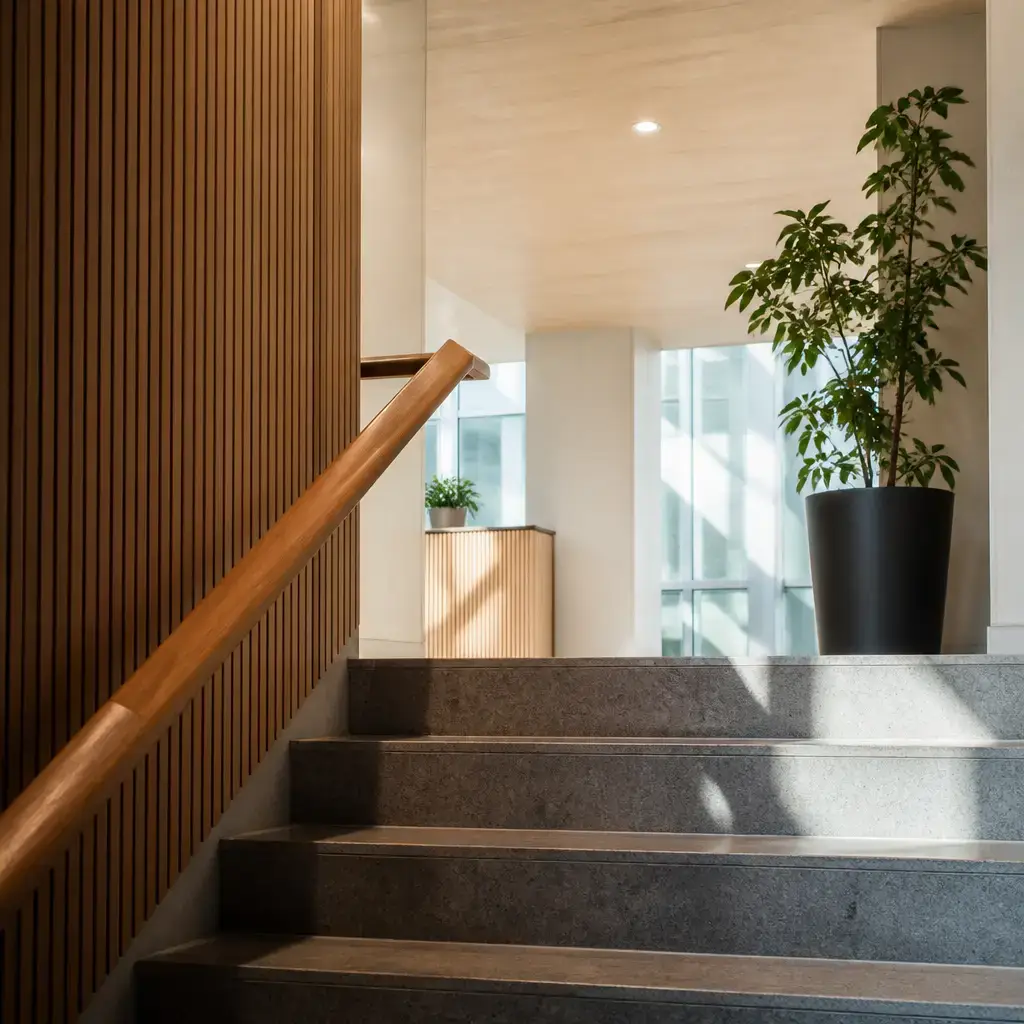
Reposen
“Reposen” means “the landing”, the level area on the stairs that is just ahead. The form is the definite form related to “repos”, and it is the subject in “Reposen er lige fremme”.
lige
“lige” means “just” in the direction phrase “lige fremme”. Together with “fremme”, it makes the location sound immediately ahead rather than far away.
fremme
“fremme” means “ahead” in “lige fremme”. The phrase “lige fremme” is useful when telling someone that a place or object is directly ahead.
Så
“Så” means “then” here and introduces the speakers’ conclusion: “Så burde registreringsskranken være tæt på”. It is useful at the beginning of a sentence when one situation leads to a conclusion.
burde
“burde” means “should” in “burde registreringsskranken være tæt på” and expresses an expected result rather than complete certainty. It is useful when making a reasonable prediction about where something is or what condition it is in.
registreringsskranken
“registreringsskranken” means “the registration desk”, the specific desk the speakers are trying to reach. It is a compound definite form related to “registreringsskranke” and names a service desk for registration.
være
“være” means “be” in the phrase about where the registration desk should be. It follows “burde” to state the expected location or condition.
tæt
“tæt” means “close” in “tæt på”, describing a short distance to the registration desk. The complete phrase “tæt på” is useful when saying that a person or place is nearby.
Lad
“Lad” begins the suggestion “Lad os gå”, meaning “let us”. Together with “os” and the verb “gå”, it invites the group to take an action, and the pattern is “Lad os + verb”.
os
“os” means “us” in “Lad os gå” and identifies the group that includes the speaker. It follows “Lad” in the suggestion pattern “Lad os + verb”.
gå
“gå” means “go” in “Lad os gå”. It names the proposed action and follows “Lad os”; this pattern is useful for making a suggestion to go or do something together.
før
“før” means “before” and introduces the event that should not happen first: “før køen bliver længere”. It is useful before a complete clause when one action should happen earlier than another event.
køen
“køen” means “the line” or “the queue”, specifically the line at the registration desk. The form is the definite form related to “kø”, and it is the subject of “køen bliver længere”.
bliver
“bliver” means “gets” or “becomes” in “bliver længere” and describes a change in the queue’s length. It is useful before an adjective when describing a change of state.
længere
“længere” means “longer” in “køen bliver længere”. It describes the queue becoming longer and follows “bliver” in this change-of-state construction.
holder
“holder” means “keep” in “Jeg holder formularen klar”, describing maintaining the form in a ready state. In this pattern, the object comes before the describing word: “holder formularen klar”.
formularen
“formularen” means “the form”, specifically the document being kept ready for registration. The form is the definite form related to “formular”, and it is the object of “holder”.
klar
“klar” means “ready” in “holder formularen klar”. It describes the form’s state while it is being kept available for immediate use.