Denne
Denne means “this” in Denne bygning and points to the building being described. It is used before the singular noun bygning in this phrase. The pattern Denne + noun identifies one nearby or relevant thing.
bygning
Bygning means “building” in Denne bygning føles meget ren indvendigt. It names the building whose interior is being described. It can be used as the noun after Denne, as in Denne bygning.
føles
Føles means “feels” in Denne bygning føles meget ren indvendigt. It describes the speaker’s impression of the building rather than a physical action. The pattern noget føles + adjective describes how something seems or feels.
meget
Meget means “very” in meget ren and strengthens the description ren. It is placed before the adjective it intensifies. The pattern meget + adjective is used to express a high degree.
ren
Ren means “clean” in Denne bygning føles meget ren indvendigt. It describes the building’s condition as experienced inside. After føles, an adjective such as ren describes how something feels.
indvendigt
Indvendigt means “inside” or “on the inside” in meget ren indvendigt. It specifies that the building is clean in its interior. It is placed after the description to show where that impression applies.
Det
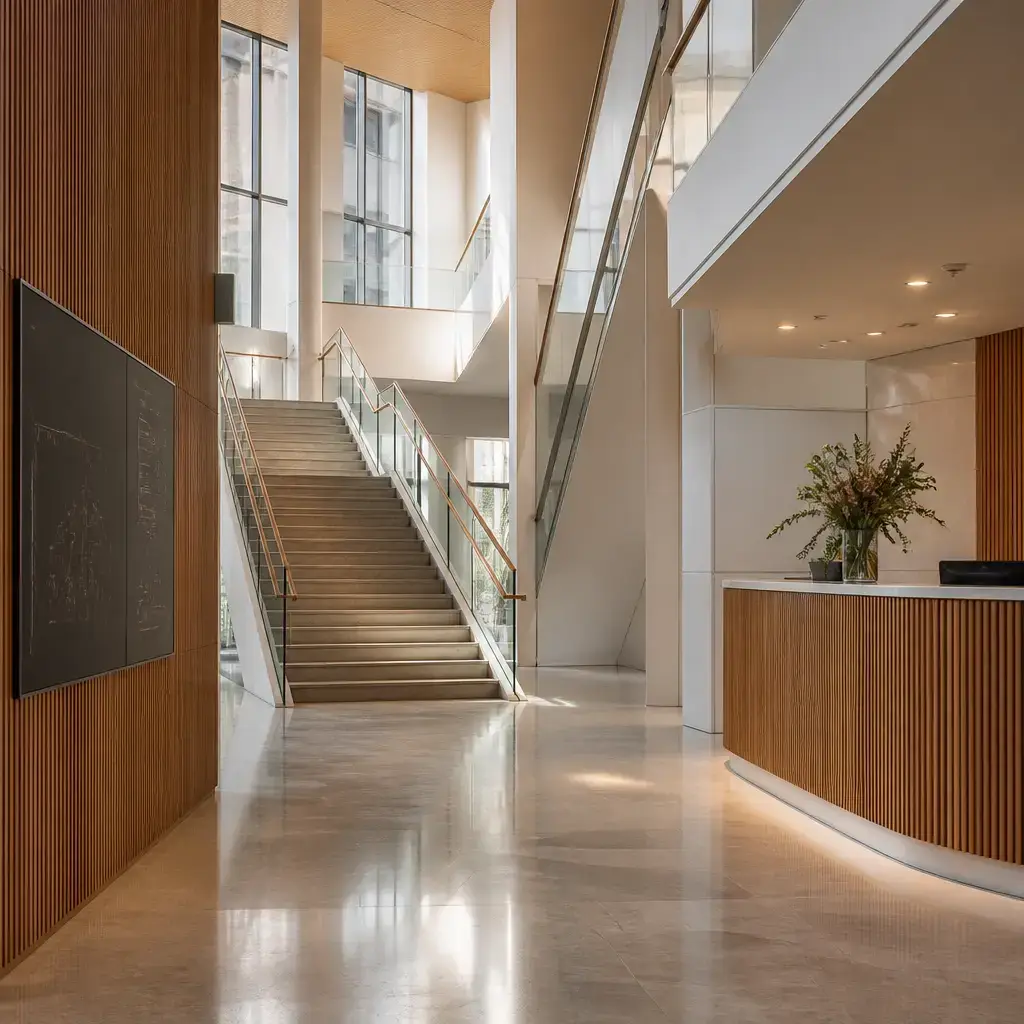
Det means “the” in Det høje loft, where it introduces the definite noun phrase “the high ceiling.” Here it is not the pronoun “it”; it comes before høje loft. The pattern Det + adjective + noun is used in this type of noun phrase.
høje
Høje means “high” in Det høje loft and describes the ceiling. It appears between Det and loft in the definite noun phrase. The pattern Det høje + noun describes a specific high thing.
loft
Loft means “ceiling” in Det høje loft. It names the part of the lobby that makes the space feel open. It can follow an adjective such as høje in a noun phrase.
får
Får means “makes” or “causes” in får lobbyen til at føles åben and får stedet til at virke varmt. It introduces a result caused by something. A reusable pattern is får + thing + til at + verb, as in får lobbyen til at føles.
lobbyen
Lobbyen means “the lobby” in Det høje loft får lobbyen til at føles åben. It is the place whose impression is changed by the high ceiling. In får lobbyen til at føles, it names the thing that comes to have the resulting feeling.
til
Til is part of the causative construction får lobbyen til at føles åben. Together with får ... at føles, it links the lobby to the result “feel open.” A reusable pattern is får + noun + til at + verb.
at
At marks the infinitive in til at føles and til at virke. It follows til and introduces the action or state that results from the cause. The reusable pattern here is til at + verb, as in til at føles.
åben
Åben means “open” in lobbyen til at føles åben. It describes the impression the lobby gives because of the high ceiling. After føles, åben expresses how the lobby feels.
Lad
Lad means “let” in Lad os finde tilmeldingsskranken til arrangementet. With os, it begins a suggestion for a shared action. The reusable pattern Lad os + infinitive proposes that “let’s” do something.
os
Os means “us” in Lad os finde. It identifies the people included in the suggestion. The pattern Lad os + infinitive is used when the speaker proposes a joint action.
finde
Finde means “find” in Lad os finde tilmeldingsskranken til arrangementet. It is the action proposed for the two people. It follows Lad os in the reusable pattern Lad os + infinitive.
tilmeldingsskranken
Tilmeldingsskranken means “the registration desk” in tilmeldingsskranken til arrangementet. It refers to the specific desk the speakers need to locate. It is the object after finde in finde tilmeldingsskranken.
arrangementet
Arrangementet means “the event” in tilmeldingsskranken til arrangementet. It specifies which event the registration desk is for. The pattern til + event identifies the purpose or connection, as in til arrangementet.
Jeg
Jeg means “I” in Jeg tjekker bygningens oversigt ved væggen. It identifies the speaker as the person who will check the directory. It is placed before tjekker as the subject of the sentence.
tjekker
Tjekker means “check” in Jeg tjekker bygningens oversigt ved væggen. It describes looking at the building directory to get information. The pattern Jeg tjekker + object states what the speaker is checking.
bygningens
Bygningens means “the building’s” in bygningens oversigt. It links the oversigt to the building, showing whose directory or guide it is. The pattern noun + s, as in bygningens oversigt, expresses this relationship.
oversigt
Oversigt means “directory” or “guide” in bygningens oversigt. It is the information display the speaker checks for directions. It follows the possessive form bygningens in this noun phrase.
ved
Ved means “by” or “at” in ved væggen. It places the directory near the wall. The pattern ved + place identifies where something is located.
væggen
Væggen means “the wall” in ved væggen. It identifies the location beside which the building directory is found. It follows ved in the location phrase ved væggen.
Der
Der is part of Der står, meaning “it says” or “it is written” in this context. It introduces the information shown in the directory rather than pointing to a physical object. The reusable pattern Der står, at + statement reports written information.
står
Står means “says” or “is written” in Der står, at tilmeldingsskranken er ovenpå. With Der, it describes what the directory indicates. The pattern Der står, at + statement is useful for reporting information from a sign or guide.
er
Er means “is” in tilmeldingsskranken er ovenpå and “are” in de er lige her. Its English meaning depends on the subject in each sentence. It connects a subject with a location or description, as in er ovenpå.
ovenpå
Ovenpå means “upstairs” in tilmeldingsskranken er ovenpå. It gives the location of the registration desk. It can follow er to state where someone or something is.
Skal
Skal means “shall” or “should” in Skal vi tage rulletrappen eller trapperne? It turns the sentence into a question about a proposed action. The pattern Skal vi + infinitive asks whether the group should do something.
vi
Vi means “we” in Skal vi tage rulletrappen eller trapperne? It refers to the speaker and the other person together. It comes after Skal in the question pattern Skal vi + infinitive.
tage
Tage means “take” in Skal vi tage rulletrappen eller trapperne? It names the action being considered. It follows Skal as the infinitive in Skal vi tage.
rulletrappen
Rulletrappen means “the escalator” in tage rulletrappen. It is one of the two possible ways the speakers can go upstairs. It is the object after tage in the choice rulletrappen eller trapperne.
eller
Eller means “or” in rulletrappen eller trapperne. It joins the two alternatives being considered. The pattern option A eller option B presents a choice between two possibilities.
trapperne
Trapperne means “the stairs” in Skal vi tage rulletrappen eller trapperne? It is the second route being considered for going upstairs. It also appears in Lad os tage trapperne, where it is the object after tage.
de
De means “they” in de er lige her, referring to trapperne. At the start of De trætrapper, the same written form means “the” before the plural noun phrase. Context and position distinguish the pronoun de from the article De.
lige
Lige means “right” in lige her and emphasizes the exact location. Together with her, it means “right here.” The reusable expression lige her points out that something is very close to the speaker.
her
Her means “here” in de er lige her. It identifies the place where the stairs are located. The expression lige her means “right here” and is useful when pointing out a nearby place.
trætrapper
Trætrapper means “wooden stairs” in De trætrapper får stedet til at virke varmt. It identifies the stairs by their material and connects them with the warm impression of the place. It is the subject of får in this sentence.
stedet
Stedet means “the place” in får stedet til at virke varmt. It refers to the lobby or building area being discussed. In får stedet til at virke varmt, it is the thing that seems warm as a result of the wooden stairs.
virke
Virke means “seem” or “appear” in får stedet til at virke varmt. It describes the impression the place gives, rather than saying that its temperature changes. The pattern får + thing + til at virke + adjective describes something causing an impression.
varmt
Varmt means “warm” in stedet til at virke varmt. It describes the impression created by the wooden stairs. It follows virke as the adjective expressing how the place seems.