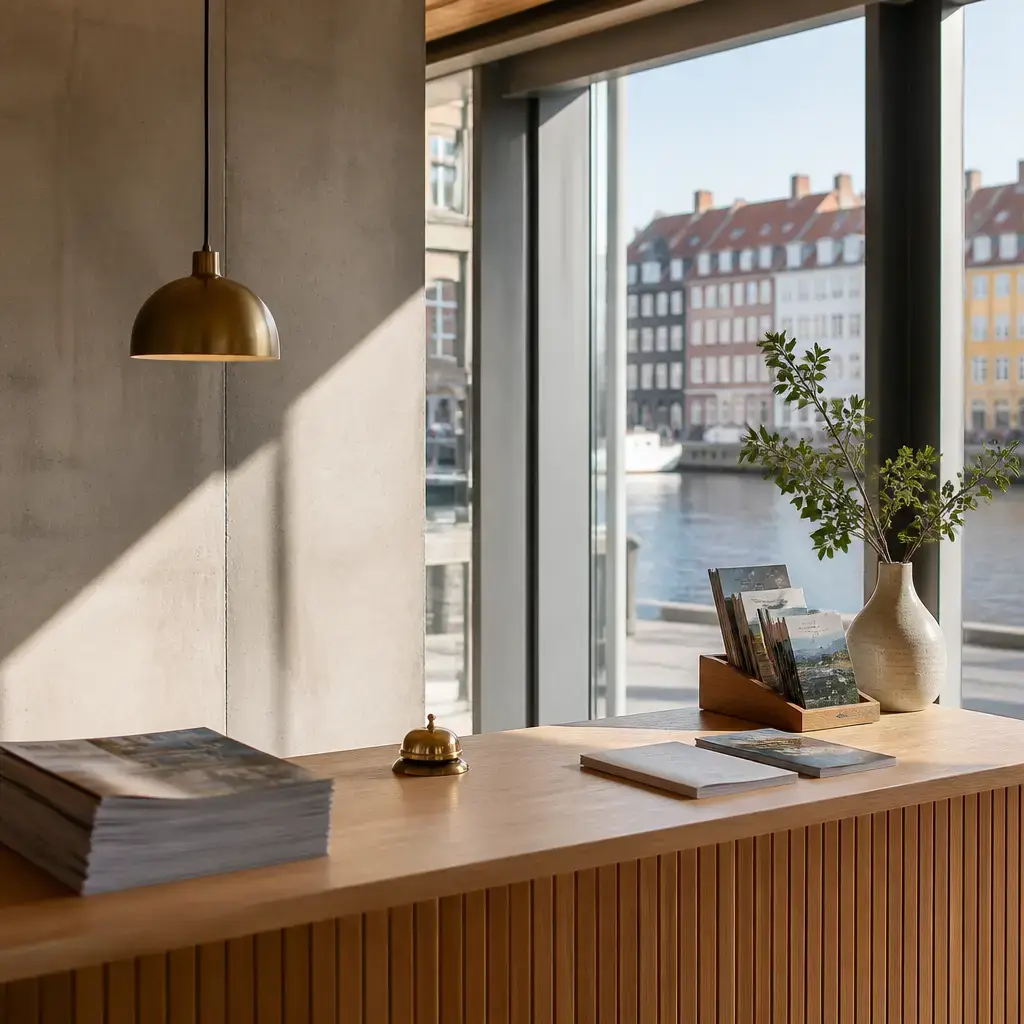
Undskyld
“Undskyld” politely gets someone’s attention here and means “Excuse me.” It is placed at the beginning of the question before asking for information, so it is useful at a reception or service desk.
hvilke
“Hvilke” asks which ones when choosing among the events in “hvilke arrangementer”. It comes directly before the noun “arrangementer”, and you can use this pattern when asking someone to identify one or more options.
arrangementer
“Arrangementer” means events or organized activities here. It is the activity being joined after “deltage i”, so this word is useful when asking about available events at a venue.
kan
“Kan” expresses what is possible here: what the visitors can join. It is followed by the subject and an infinitive in “kan vi deltage”, a useful pattern for asking about available actions.
vi
“Vi” means “we” and refers to the people asking the question. It appears after “kan” in “kan vi deltage”, so it is useful when a group asks what they can do.
deltage
“Deltage” means participate or join in this dialogue. It follows “kan” and is used with “i” in “deltage i”, a pattern for joining an event or activity.
i
The lowercase “i” means “in” in “deltage i”, where it introduces the event being joined. The uppercase “I” in “I kan vælge” and “I danser” means plural “you”; notice that capitalization changes the word’s function.
nu
“Nu” means “now” and asks about the current time in “kan vi deltage i nu?”. It is placed at the end of the question and is useful when checking what is available at this moment.
vælge
“Vælge” means choose here. It follows “kan” in “I kan vælge” and appears with “mellem” in “vælge mellem”, a useful pattern for selecting among alternatives.
mellem
“Mellem” means “between” in “vælge mellem en guidet gåtur og en dansetime”. It introduces the two alternatives, and the pattern “mellem ... og ...” is useful when presenting a choice.
en
“En” is the indefinite article meaning “a” in “en guidet gåtur” and “En guide”. It comes before a singular noun and is useful when introducing one activity or one person.
guidet
“Guidet” means guided in “en guidet gåtur”. It comes before “gåtur” and describes the walk as one led by a guide, which is useful when identifying an organized activity.
gåtur
“Gåtur” means walk in “en guidet gåtur”. It is the activity being compared with a dance session, and the phrase is useful when choosing or describing a walk.
og
“Og” means “and” and connects the two choices in “en guidet gåtur og en dansetime”. It is useful for joining two activities or other items in the same statement.
dansetime
“Dansetime” means a dance session or class here. It follows “en” in “en dansetime” and is the second activity in the choice introduced with “mellem ... og ...”.
Hvordan
“Hvordan” asks “how” or “what ... like” in “Hvordan er den guidede gåtur?”. It opens a question about the character or experience of an activity, useful when asking someone to describe it.
er
“Er” links a subject with a description in “Hvordan er den guidede gåtur?” and “er den nem at følge?”. It is useful for asking or stating what something is like.
den
“Den” means “the” in “den guidede gåtur” and refers to the walk as “it” in “Så er den nem at følge”. The surrounding words show whether it introduces the noun or refers back to the activity.
guidede
“Guidede” means guided in the definite phrase “den guidede gåtur”. It comes after “den” and before “gåtur”, identifying the particular guided walk being discussed.
guide
“Guide” means guide, the person who leads the walk in “En guide leder gåturen”. It is introduced with “En” and is useful when identifying the person responsible for an activity.
leder
“Leder” means leads in “En guide leder gåturen”. It connects the guide with the walk being led, and this subject–verb–object pattern is useful for describing who leads an activity.
gåturen
“Gåturen” means “the walk” and is the particular walk that the guide leads. It is the definite form related to “gåtur”, and “leder gåturen” is useful for saying who leads a specific walk.
et
“Et” is the indefinite article meaning “a” in “et roligt tempo”. It introduces the pace being described and is useful before a singular noun in a phrase about an activity.
roligt
“Roligt” describes the pace as calm or slow in “i et roligt tempo”. It comes before “tempo” and is useful when characterizing how quickly or calmly an activity proceeds.
tempo
“Tempo” means pace in “i et roligt tempo”. Together with “i et roligt tempo”, it explains how the guide leads the walk, so it is useful when describing the speed of an activity.
Så
“Så” means “so” and introduces the conclusion in “Så er den nem at følge”. It connects the calm pace with the result, and it is useful when explaining a consequence.
nem
“Nem” means easy in “nem at følge”. It describes the walk as easy to follow, and the pattern “nem at” is useful when saying that an action is easy to do.
at
“At” marks the infinitive in “at følge”. It connects the description “nem” with the action being evaluated, and this pattern is useful after an adjective when describing how easy an action is.
følge
“Følge” means follow in “nem at følge”. It names the action that is easy for participants, and the pattern “nem at følge” is useful for describing an instruction, route, or activity that is easy to follow.
Det
“Det” means “it” in “Det lyder nemt nok til første gang” and refers to the guided walk just described. It is useful as the subject when giving an overall reaction to an activity.
lyder
“Lyder” means “sounds” in “Det lyder nemt nok”. It presents the speaker’s impression based on the description, and this pattern is useful when reacting to information.
nemt
“Nemt” means easy or manageable in “lyder nemt nok”. It evaluates the activity as suitable for a beginner, and it is useful with “lyder” when something seems manageable.
nok
“Nok” means “enough” in “nemt nok til første gang”. It softens the evaluation by saying the activity is easy enough for the stated occasion, and the pattern “adjective + nok til” is useful for expressing sufficiency.
til
“Til” means “for” in “til første gang”. It connects the level of difficulty with the occasion, and it is useful in phrases that say something is suitable for a particular time or purpose.
første
“Første” means “first” in “første gang”. It specifies that this is the initial occasion, and the phrase is useful when talking about doing an activity for the first time.
gang
“Gang” means “time” or “occasion” in “første gang”. Together with “første”, it identifies the first occasion of trying the activity, which is useful when discussing a new experience.
Hvor
“Hvor” means “how” in “Hvor aktiv er dansetimen?”. It asks about the degree of the adjective “aktiv”, and the pattern “Hvor + adjective” is useful for asking how much of a quality something has.
aktiv
“Aktiv” means active in “Hvor aktiv er dansetimen?”. It describes the level of physical activity in the dance session, so it is useful when comparing how demanding activities are.
dansetimen
“Dansetimen” means “the dance session” or “the dance class”. It is the specific activity being evaluated in “Hvor aktiv er dansetimen?”, and it is the definite form related to “dansetime”.
går
“Går” means “goes” or “moves” in “Det går hurtigere”, where it describes how quickly the activity proceeds. This expression is useful when explaining the pace of an activity or process.
hurtigere
“Hurtigere” means faster in “Det går hurtigere”. It compares the pace of the dance session with the slower guided walk described earlier, and it is useful with “går” when describing increased speed.
danser
“Danser” means dance in “I danser i en gruppe”. It describes what the plural “I” do during the session, and the pattern is useful for saying what participants do in an activity.
gruppe
“Gruppe” means group in “i en gruppe”. It describes the people dancing together, and the phrase is useful when explaining that an activity is done collectively.
med
“Med” means “with” in “med enkle trin”. It introduces the simple steps used in the dance session, and “med + noun” is useful for adding an accompanying feature or element.
enkle
“Enkle” means simple in “enkle trin”. It describes the steps as uncomplicated and comes directly before “trin”, which is useful when characterizing the difficulty of an activity.
trin
“Trin” means steps in “med enkle trin”. Here it refers to the movements used in the dance session, and the phrase is useful when describing the movements or instructions in an activity.
passer
“Passer” means suits or is a good fit in “passer bedre til os”. It expresses that the guided walk is more suitable for the speakers, and the pattern “passer til + person” is useful when choosing something appropriate.
bedre
“Bedre” means better in “passer bedre til os”. It shows a preference between the guided walk and the dance session, and it is useful when saying that one option fits someone more than another.
os
“Os” means “us” in “til os”. It identifies the people for whom the guided walk is more suitable, and the phrase “passer bedre til os” is useful when expressing a group’s preference.