Jeg
Jeg means “I” here and is the person who has not been inside the city hall. It is used as the subject before Jeg har. A reusable pattern is Jeg har ... when talking about your own experience.
har
har means “have” here and helps form the statement Jeg har aldrig været inde på dette rådhus før. It comes before the past form været in this experience statement. A reusable pattern is Jeg har ... før for saying that you have done something before or have not done it before.
aldrig
aldrig means “never” in Jeg har aldrig været inde på dette rådhus før. It makes the experience negative and is placed after har. Use it when saying that something has not happened at any time.
været
været means “been” here, referring to being inside the city hall. It follows har in Jeg har aldrig været inde på dette rådhus før. A reusable pattern is har været ... when describing where someone has been.
inde
inde means “inside” in Jeg har aldrig været inde på dette rådhus før. Together with på, it describes being inside or at the city hall. Use inde when the location is within a building or another enclosed place.
på
på is the preposition in inde på dette rådhus, meaning being at or inside this city hall. Its meaning here comes from the whole location phrase, not from på alone. A reusable pattern is inde på + a place.
dette
dette means “this” and points to the particular city hall being discussed in dette rådhus. It comes directly before rådhus. Use it to identify one specific nearby or currently discussed thing.
rådhus
rådhus means “city hall” in dette rådhus. It names the public building where the speakers are arriving. A reusable pattern is på rådhuset when referring to being at the city hall in its definite form.
før
før means “before” in Jeg har aldrig været inde på dette rådhus før, referring to any earlier time. It appears at the end of the sentence. Use it to say that an experience has or has not happened previously.
Bygningen
Bygningen means “the building” and is the subject of Bygningen er pænere, end jeg havde forventet. The ending shows the particular building already known in the conversation. Use it when referring back to a specific building.
er
er means “is” in Bygningen er pænere, end jeg havde forventet. It links the building with the description pænere. A reusable pattern is [thing] er + a description.
pænere
pænere means “nicer” here and compares the building with the speaker’s expectation. It is followed by end in Bygningen er pænere, end jeg havde forventet. Use pænere when saying that one thing is nicer than another or than expected.
end
end means “than” in the comparison Bygningen er pænere, end jeg havde forventet. It introduces the expectation used as the comparison point. A reusable pattern is [thing] er [comparative], end ... .
havde
havde means “had” in jeg havde forventet, referring to the expectation that existed before the speaker saw the building. It comes before forventet. Use havde ... when describing an earlier expectation or state.
forventet
forventet means “expected” in jeg havde forventet. Together, havde forventet refers to what the speaker expected earlier. A reusable pattern is jeg havde forventet ... when explaining an earlier expectation.
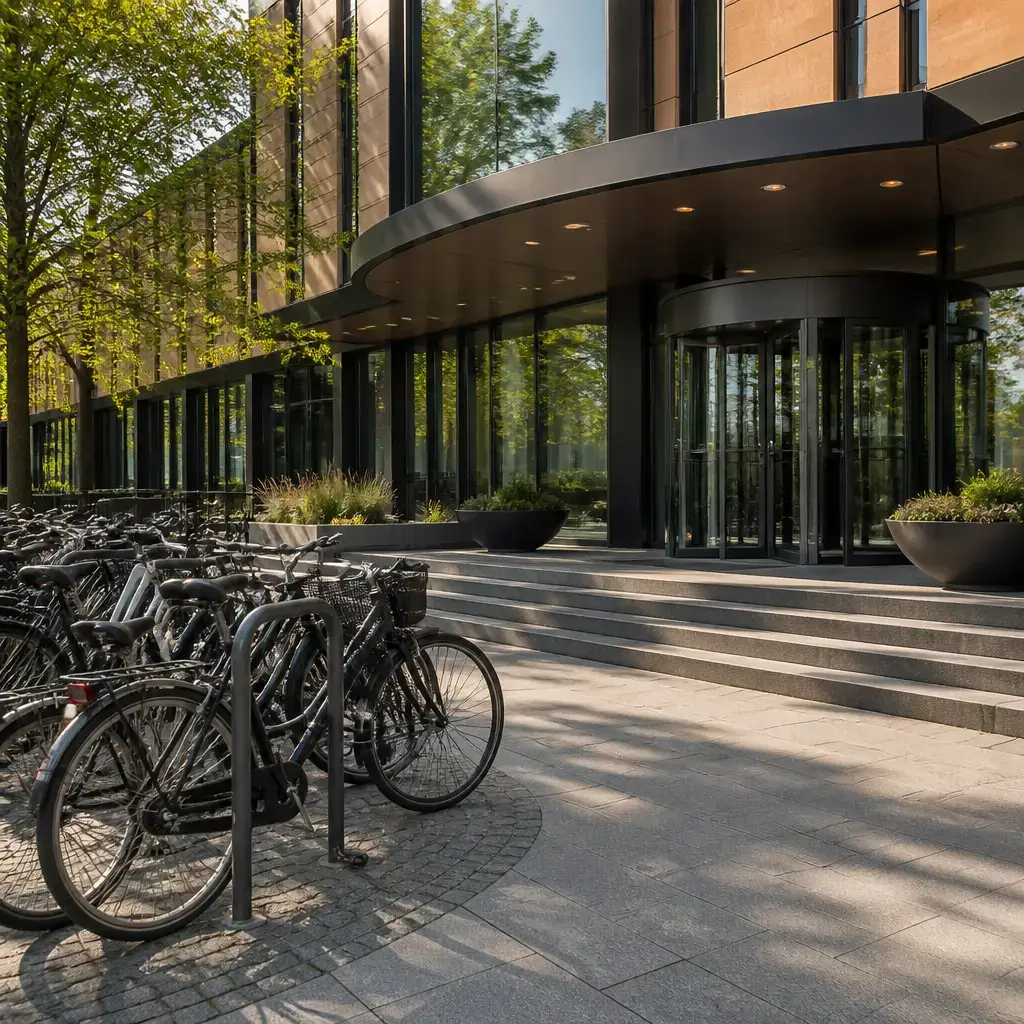
Indgangen
Indgangen means “the entrance” in Indgangen ligger ved siden af cykelparkeringen. It identifies the specific entrance being described. Use it as the subject when giving the location of an entrance.
ligger
ligger means “is located” in Indgangen ligger ved siden af cykelparkeringen. It describes the entrance’s position rather than an action. A reusable pattern is [place] ligger + a location phrase.
ved
ved is part of the location expression ved siden af, meaning “beside” in this sentence. The complete expression ved siden af cykelparkeringen gives the position of the entrance. Use ved siden af + a place or object to describe something next to it.
siden
siden is part of ved siden af, the expression meaning “beside” in ved siden af cykelparkeringen. It does not give the full location meaning by itself here. Keep the complete pattern ved siden af + a place or object.
af
af completes the expression ved siden af, which means “beside” in the dialogue. The phrase ved siden af cykelparkeringen tells where the entrance is. Use af as part of this fixed location pattern rather than translating it separately.
cykelparkeringen
cykelparkeringen means “the bicycle parking area” in ved siden af cykelparkeringen. It is the place used as the reference point for the entrance’s location. Use it after a location expression when identifying the bicycle parking area.
Mange
Mange means “many” or “a lot of” in Mange mennesker kom på cykel. It comes before mennesker and describes the number of people. Use mange + a plural noun to talk about a large number of things or people.
mennesker
mennesker means “people” in Mange mennesker kom på cykel. It is the group that came by bike. A reusable pattern is mange mennesker + a verb when talking about many people doing something.
kom
kom means “came” in Mange mennesker kom på cykel, describing movement to the place where the speakers are. It is followed by på cykel to show how they travelled. Use kom when reporting that someone arrived or came.
cykel
cykel means “bike” in på cykel. The expression på cykel means travelling by bike, so cykel names the means of transport. A reusable pattern is på + a means of transport.
Det
Det refers to the situation just mentioned in Det giver mening and means “that” or “it” in the expression “that makes sense.” The whole expression responds to the idea that many people came by bike. Use Det giver mening to say that something is understandable or logical.
giver
giver is part of Det giver mening, the expression meaning “that makes sense.” In this construction, giver connects the situation with mening, “sense.” Keep the complete pattern Det giver mening when agreeing that an explanation or idea is logical.
mening
mening means “sense” or “meaning” in Det giver mening. Together, Det giver mening means that the situation is understandable or logical. Use mening in this expression when reacting positively to someone’s explanation.
nemmere
nemmere means “easier” in Det er nemmere end at vente på bussen. It compares cycling with waiting for the bus. Use nemmere end + an activity or option when saying that one choice is easier than another.
at
at introduces the activity at vente på bussen in the comparison Det er nemmere end at vente på bussen. It marks vente as an infinitive after end. A reusable pattern is nemmere end at + an activity.
vente
vente means “wait” in at vente på bussen. It describes the activity being compared with cycling. The reusable pattern is vente på + a person, vehicle, or thing that you are waiting for.
bussen
bussen means “the bus” in vente på bussen. It is the specific bus or bus service the speakers would otherwise wait for. Use it after vente på when naming the bus being awaited.
Næste
Næste means “next” in Næste gang, referring to the following occasion. It comes before gang in this time expression. Use næste + a time word to refer to a later occurrence.
gang
gang means “time” or “occasion” in Næste gang. Together, Næste gang means “next time,” referring to a future occasion. Use gang in time expressions such as Næste gang when discussing a later visit or activity.
kunne
kunne means “could” in Næste gang kunne vi også cykle hertil. It presents cycling here as a possible plan for next time. It is followed by the infinitive cykle. Use kunne + an infinitive to suggest a possible action.
vi
vi means “we” in kunne vi også cykle hertil. It identifies the speaker and the other person as the people who could cycle here. It appears after the modal kunne in this sentence. Use vi as the subject when referring to yourself together with others.
også
også means “also” or “too” in kunne vi også cykle hertil. It adds cycling here as another possible way to arrive. It is placed before the main verb cykle in this sentence. Use også to add an activity or option to something already discussed.
cykle
cykle means “cycle” or “ride a bike” in kunne vi også cykle hertil. It is the action suggested for next time and follows kunne. A reusable pattern is kunne + cykle when suggesting that someone could travel by bike.
hertil
hertil means “to here,” referring to the city hall or the place where the speakers are now. It completes the movement idea in cykle hertil. Use hertil when describing movement toward the current place.
Så
Så means “then” in Så kan vi stille cyklerne tæt på indgangen. It connects a possible cycling trip with the practical result that follows. Use Så at the beginning of a sentence to introduce a consequence or next step.
kan
kan means “can” in Så kan vi stille cyklerne tæt på indgangen. It expresses what the speakers will be able to do after arriving. It is followed by the infinitive stille. Use kan + an infinitive to describe ability or a possible action.
stille
stille means “place” or “leave” in stille cyklerne tæt på indgangen. It describes putting the bikes somewhere rather than simply leaving them anywhere. A reusable pattern is stille + an object + a location.
cyklerne
cyklerne means “the bikes” in stille cyklerne tæt på indgangen. It refers to the specific bikes belonging to the speakers. It is the object of stille. Use it when talking about known bikes in the definite plural.
tæt
tæt means “close” in tæt på indgangen. Together with på, it describes the bikes’ short distance from the entrance. Use tæt på + a place or object to say that something is nearby.
Lige
Lige means “right” or “just” in the time expression Lige nu. Together, Lige nu means “right now” or “for now.” Use Lige nu to focus on the present moment.
nu
nu means “now” in Lige nu. It identifies the present time, while lige makes the focus more immediate. Use nu in time expressions when referring to what is happening at the current moment.
går
går means “go” in går ind and describes the speakers moving inside. The direction is completed by ind. A reusable pattern is gå ind when entering a building or another interior place.
ind
ind means “in” or “inside” in går ind. It marks movement from outside to inside the city hall. Use gå ind when saying that someone enters a place.
og
og means “and” in går ind og finder den rigtige skranke. It joins the actions of going inside and finding the counter. Use og to connect two actions performed by the same subject.
finder
finder means “find” in går ind og finder den rigtige skranke. It describes locating the correct counter after going inside. A reusable pattern is finde + an object, such as a place or thing that needs to be located.
den
den is the definite word meaning “the” in den rigtige skranke. It identifies one specific counter, and it comes before the adjective rigtige. Use den before a definite noun phrase of this type.
rigtige
rigtige means “right” or “correct” in den rigtige skranke. It describes which counter the speakers need to find. It comes between den and skranke. Use den rigtige + a noun when selecting the correct one.
skranke
skranke means “counter” in den rigtige skranke. It refers to the service counter inside the city hall that the speakers need to locate. Use it after a description such as den rigtige when identifying a particular counter.