Det
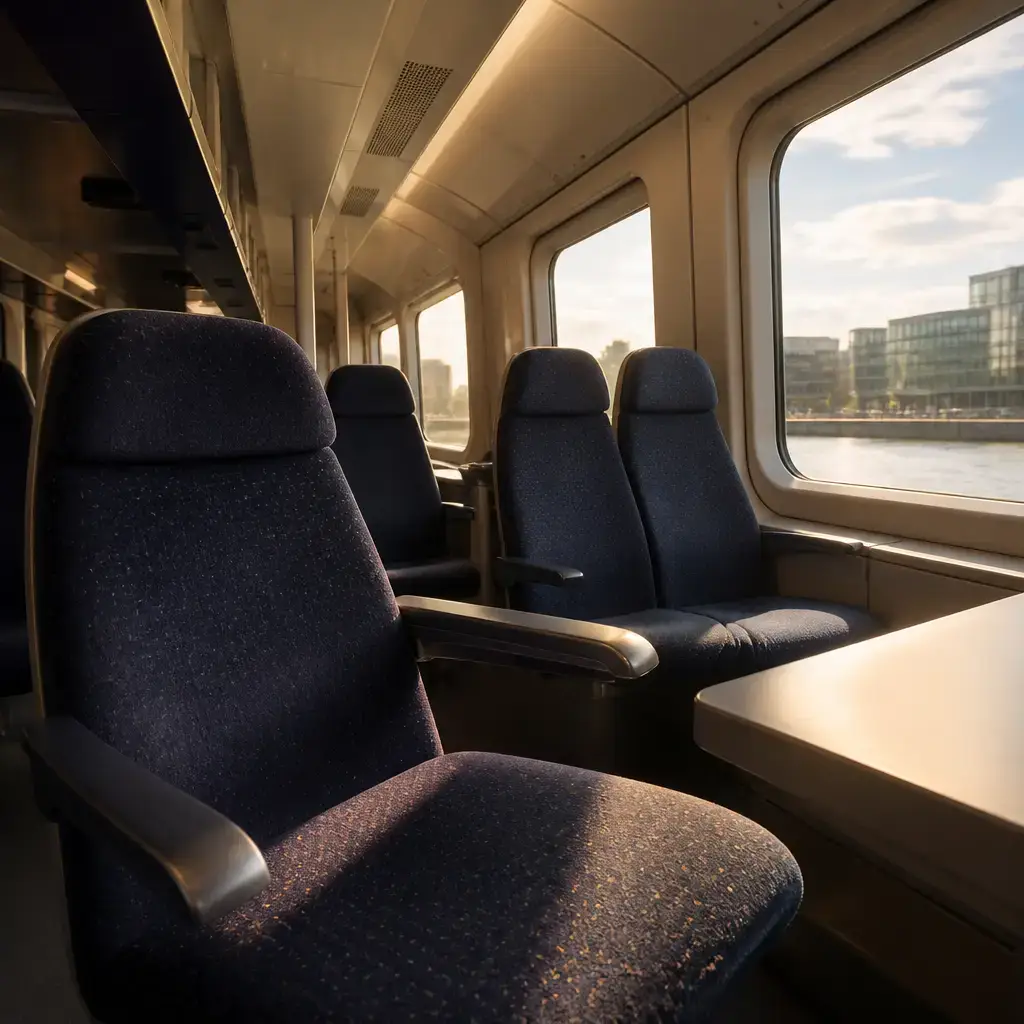
In "Det føles køligt", "Det" is the sentence subject for the statement that the inside of the train feels cool. Here it does not refer to a person; it introduces the situation being described.
føles
In "Det føles køligt", "føles" means feels and describes how something is experienced. It is used here before the adjective "køligt" to describe a perceived quality.
køligt
"Køligt" means cool in "Det føles køligt" and describes the temperature inside the train. It follows "føles" as the quality being experienced.
inde
"Inde" means inside and locates the situation within the train in "inde i toget". This pattern is useful for saying that something is inside a place.
i
In "inde i toget", "i" means in and connects the location "inde" with the train. It introduces the place where something is located.
toget
"Toget" means the train referred to in "inde i toget". It is the noun used after "i" to name the place where the speakers are.
Der
In "Der er ledige pladser", "Der" introduces the statement that open seats exist. It is part of this existence pattern rather than a reference to a particular place.
er
In "Der er ledige pladser", "er" states that the seats are available or present. Together with "Der", it forms the expression used to say that something exists or is available.
ledige
"Ledige" means available or unoccupied in "ledige pladser". It describes the seats and comes directly before the noun "pladser".
pladser
"Pladser" means seats in "Der er ledige pladser". It names the available places that the speakers can use on the train.
længere
"Længere" means farther in "længere inde" and shows that the seats are located farther into the train. It is used here with "inde" to describe position.
Jeg
"Jeg" means I and is the person who wants to sit in "Jeg vil gerne sidde". It is placed at the beginning as the sentence subject.
vil
In "Jeg vil gerne sidde", "vil" expresses wanting to do the action that follows. It is used before "gerne" and the action word "sidde".
gerne
In "vil gerne sidde", "gerne" helps express that the speaker would like to sit. The reusable pattern is "vil gerne" followed by an action.
sidde
"Sidde" means sit in "Jeg vil gerne sidde". It follows "vil gerne" as the action the speaker wants to do.
efter
"Efter" means after and introduces the time relation in "efter at have gået så meget". It connects the earlier walking with the later wish to sit.
at
In "at have gået", "at" introduces the verb phrase describing the earlier walking. It appears directly before "have" in this construction.
have
In "at have gået", "have" helps form the expression for having walked before the main action. It comes before the dialogue form "gået".
gået
"Gået" refers to the walking that happened before the speaker wants to sit in "efter at have gået så meget". It is used after "have" in this phrase.
så
In lowercase "så meget", "så" means so and emphasizes the large amount of walking. In the sentence-initial "Så kan vi hvile os lidt", capitalized "Så" means then and introduces the next action.
meget
"Meget" means much or a lot in "så meget" and describes the amount of walking. Together with "så", it expresses that the walking was a lot.
De
In "De her sæder", "De" means these and points to the seats nearby. Together with "her", it forms the expression for these particular seats.
her
In "De her sæder", "her" contributes the meaning here, making "De her" mean these. It is placed after "De" in this demonstrative expression.
sæder
"Sæder" means seats in "De her sæder er behagelige". It is the noun being described as comfortable.
behagelige
"Behagelige" means comfortable in "sæder er behagelige" and describes the seats. It follows "er" as the quality assigned to them.
Togturen
"Togturen" means the train ride in "Togturen føles også rolig". It is the subject whose character is being described.
også
"Også" means also or too in "Togturen føles også rolig". It adds this description of the ride to what has already been said.
rolig
"Rolig" means quiet or calm in "Togturen føles også rolig". It describes how the train ride feels.
Kan
At the beginning of "Kan du se stationsskærmen derfra?", "Kan" asks whether the listener is able to see something. It comes before the subject "du" in this question.
du
"Du" means you and refers to the person being asked in "Kan du se stationsskærmen derfra?". It follows "Kan" in the question.
se
"Se" means see in "Kan du se stationsskærmen derfra?". It follows "kan" as the action the listener may be able to do.
stationsskærmen
"Stationsskærmen" means the station display and is the object of "se" in the question. It names the display that shows station information.
derfra
"Derfra" means from there and indicates the place from which the listener should try to see the display. It appears at the end of the question.
Vi
"Vi" means we and refers to both speakers in "Vi har tre stop mere". It is the subject of the statement about the remaining journey.
har
In "Vi har tre stop mere", "har" means have and is used to state how many stops remain for the speakers. It comes before the number phrase "tre stop mere".
stop
"Stop" means stops in "tre stop mere". It names the train stops that remain before the speakers get off.
mere
"Mere" means more or additional in "tre stop mere". It comes after the number and noun to show that three additional stops remain.
hvile
"Hvile" means rest in "hvile os lidt". It names the action that the speakers can do before getting off.
os
In "hvile os", "os" refers back to the speakers and makes the resting action apply to themselves. It follows "hvile" in this expression.
lidt
"Lidt" means a little in "hvile os lidt" and limits the amount of resting. It is placed after the resting expression.
før
"Før" means before and introduces the event that must happen later in "før vi står af". It connects resting with getting off the train.
står af
The whole expression "står af" means get off the train in "før vi står af". "Står" contributes the standing action and "af" adds the movement away or off; together they form the action of getting off.