Jeg
“Jeg” means “I” here and identifies the speaker in “Jeg glemte min indkøbspose.” It is used as the subject before the verb, as in the reusable pattern “Jeg kan …” for stating what you can do. You would use it when talking about yourself in everyday conversation.
glemte
“glemte” means “forgot” in this dialogue: the speaker forgot the shopping bag. This exact form describes a completed past event; the reusable pattern is “Jeg glemte …” followed by the thing forgotten. You would use it when explaining that you left something behind or failed to remember it.
min
“min” means “my” before “indkøbspose” in “min indkøbspose.” It shows that the shopping bag belongs to or is associated with the speaker. Use it before a singular common-gender noun when identifying something as yours.
indkøbspose
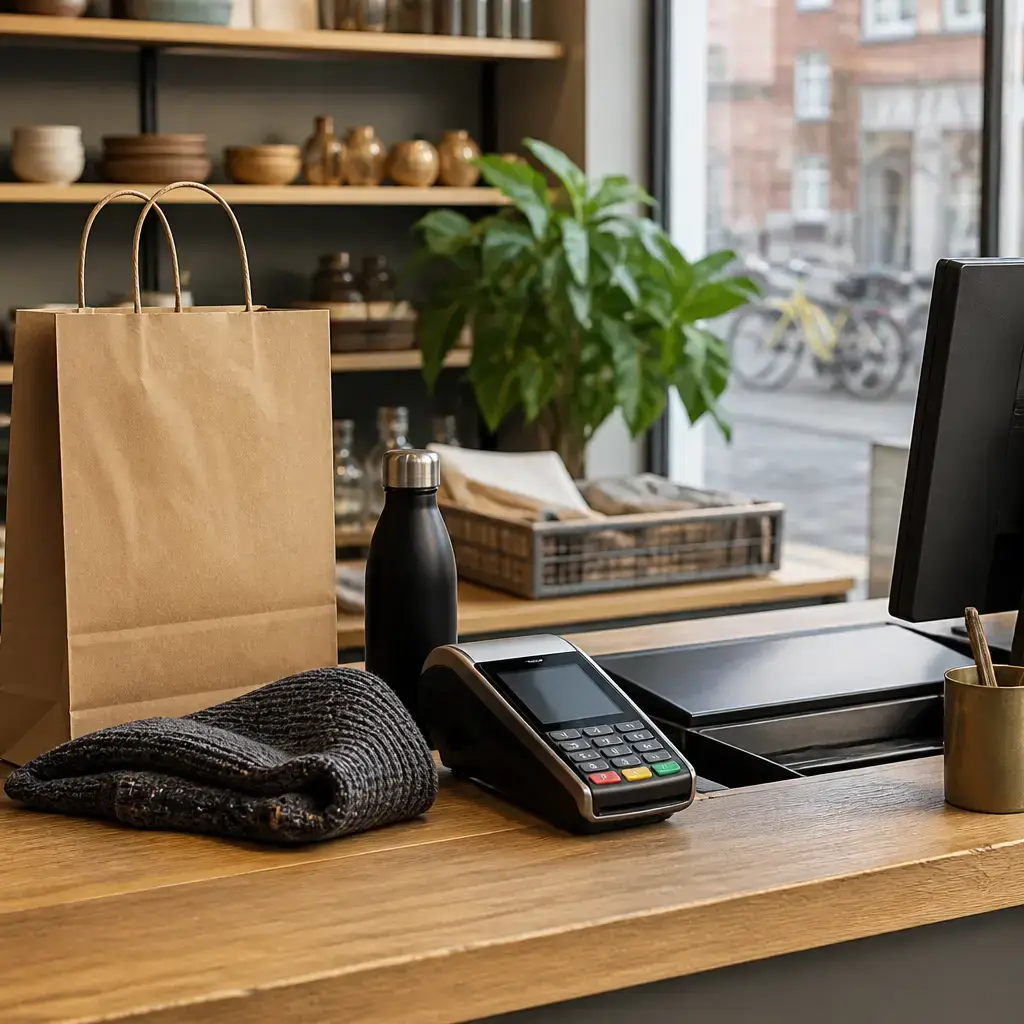
“indkøbspose” means “shopping bag” in this dialogue. It names the bag the speaker forgot and the kind of bag that would help at the shop. You would use it when asking for or discussing a bag for carrying shopping.
Du
“Du” means “you” here and addresses the customer in “Du kan købe en pose her.” It is the subject placed before “kan” in this sentence. You would use it when speaking directly to one person in an ordinary conversation.
kan
“kan” means “can” and expresses ability or possibility in “Du kan købe en pose her.” It is followed by the verb form “købe,” giving the reusable pattern “kan + verb” for saying that someone can do something. You would use it to offer an option or say what is possible.
købe
“købe” means “buy” in “Du kan købe en pose her.” It follows “kan,” so the action is presented as something the person can do; the reusable pattern is “kan købe …” with the object after the verb. You would use it when discussing purchasing something.
en
“en” means “a” in “en pose,” introducing one unspecified bag. It comes directly before the singular noun “pose.” You would use it when mentioning one non-specific item for the first time.
pose
“pose” means “bag” in “en pose her.” Here it refers to a bag that the customer can buy at the shop. You would use it when asking for or referring to a bag without specifying that it is already known.
her
“her” means “here” and locates the available bag at the shop in “Du kan købe en pose her.” It appears at the end of the sentence to identify the place where the purchase can happen. You would use it when pointing out a nearby place or option.
ville
“ville” means “would” in “En indkøbspose ville hjælpe,” presenting the shopping bag as something that would be helpful. It connects the subject “En indkøbspose” with the possible result “hjælpe.” You would use it to describe a helpful or desired result in a situation.
hjælpe
“hjælpe” means “help” in “En indkøbspose ville hjælpe.” It follows “ville,” giving the reusable pattern “ville hjælpe” for saying that something would help. You would use it when explaining what would make a situation easier.
Vil
“Vil” asks whether the customer will pay in “Vil du betale med kort eller kontant?” It comes before the subject “du” in this question and is followed by “betale.” You would use it when asking about someone’s intended choice or action.
betale
“betale” means “pay” in “Vil du betale med kort eller kontant?” It follows “Vil du” in a question about the payment method; the reusable pattern is “Vil du betale med …?” You would use it at a checkout when asking or answering about payment.
med
“med” means “with” or “by” in “betale med kort,” introducing the method of payment. The reusable pattern is “betale med + payment method,” as in the dialogue’s “betale med kort eller kontant.” You would use it to state how you will pay.
kort
“kort” means “card” in “betale med kort.” It is the payment method offered as one choice at the checkout. You would use it when saying that you will pay by card.
eller
“eller” means “or” and links the two payment choices in “med kort eller kontant.” It introduces an alternative rather than adding another choice. You would use it when asking someone to choose between options.
kontant
“kontant” means “cash” in “betale med kort eller kontant.” It is the alternative payment method contrasted with paying by card in the checkout question. You would use it when choosing or asking about cash payment.
betaler
“betaler” means “pay” in “Jeg betaler med kort.” Here it states the speaker’s payment choice: paying by card. The reusable pattern is “Jeg betaler med + payment method.” You would use it when telling a cashier how you are paying.
Har
“Har” begins the question “Har du brug for en kvittering?” and contributes the meaning “do you have” in the expression asking whether someone needs a receipt. It comes before “du” because this is a question. You would use it to ask whether someone has a need for something.
brug
“brug” contributes the idea of “need” in the expression “har brug for en kvittering.” The whole expression means “need a receipt,” while “brug” is used with “for” to identify what is needed. You would reuse the pattern “har brug for + thing” when asking whether someone needs something.
for
“for” is part of “har brug for,” the expression used here for needing a receipt. It introduces the thing that is needed, “en kvittering.” You would reuse “brug for + noun” when naming what someone needs.
kvittering
“kvittering” means “receipt” in “en kvittering.” It refers to a receipt that the customer may need after paying. You would use it at a shop or in another situation where payment is recorded.
Læg
“Læg” tells the listener to put something in “Læg kvitteringen i posen, tak.” The sentence places the object “kvitteringen” after it and the destination “i posen” afterward. You would use it when politely directing someone to place an item somewhere.
kvitteringen
“kvitteringen” means “the receipt” in “Læg kvitteringen i posen, tak.” Compared with “kvittering” in “en kvittering,” this exact form refers to the specific receipt already being discussed. You would use it when the listener knows which receipt you mean.
i
“i” means “in” and introduces the bag as the place where the receipt should be put in “i posen.” The reusable pattern is “i + place or container.” You would use it when describing something located inside or being placed inside something else.
posen
“posen” means “the bag” in “i posen.” It refers to the specific bag available in the checkout situation, not an unspecified bag. You would use this form when the bag is already identifiable to the speakers.
tak
“tak” means “please” at the end of “Læg kvitteringen i posen, tak.” Here it makes the request polite; the same word can also express thanks in other contexts. You would use it when making a polite request or thanking someone.
er
“er” means “are” in “Her er dine varer,” presenting the groceries as being here. With “Her” at the beginning, the sentence introduces or hands over the items. You would use it when showing someone that something is present or ready.
dine
“dine” means “your” in “dine varer.” It shows that the groceries belong to or are intended for the person being addressed. Use it before the plural noun “varer” when identifying several things as belonging to or being for someone.
varer
“varer” means “groceries” or “goods” in “Her er dine varer.” Here it refers to the customer’s purchased items at the checkout. You would use it when talking generally about goods or shopping items.
bære
“bære” means “carry” in “Jeg kan bære dem nu.” It follows “kan,” giving the reusable pattern “kan bære + object” for saying that someone can carry something. You would use it when offering or stating that you can carry items.
dem
“dem” means “them” in “Jeg kan bære dem nu.” It refers back to the groceries, “dine varer,” and is the object of “bære.” You would use it when referring to several already-mentioned things without repeating their names.
nu
“nu” means “now” in “Jeg kan bære dem nu.” It specifies that the carrying can happen at the present time. You would use it to distinguish an action happening now from one happening later.