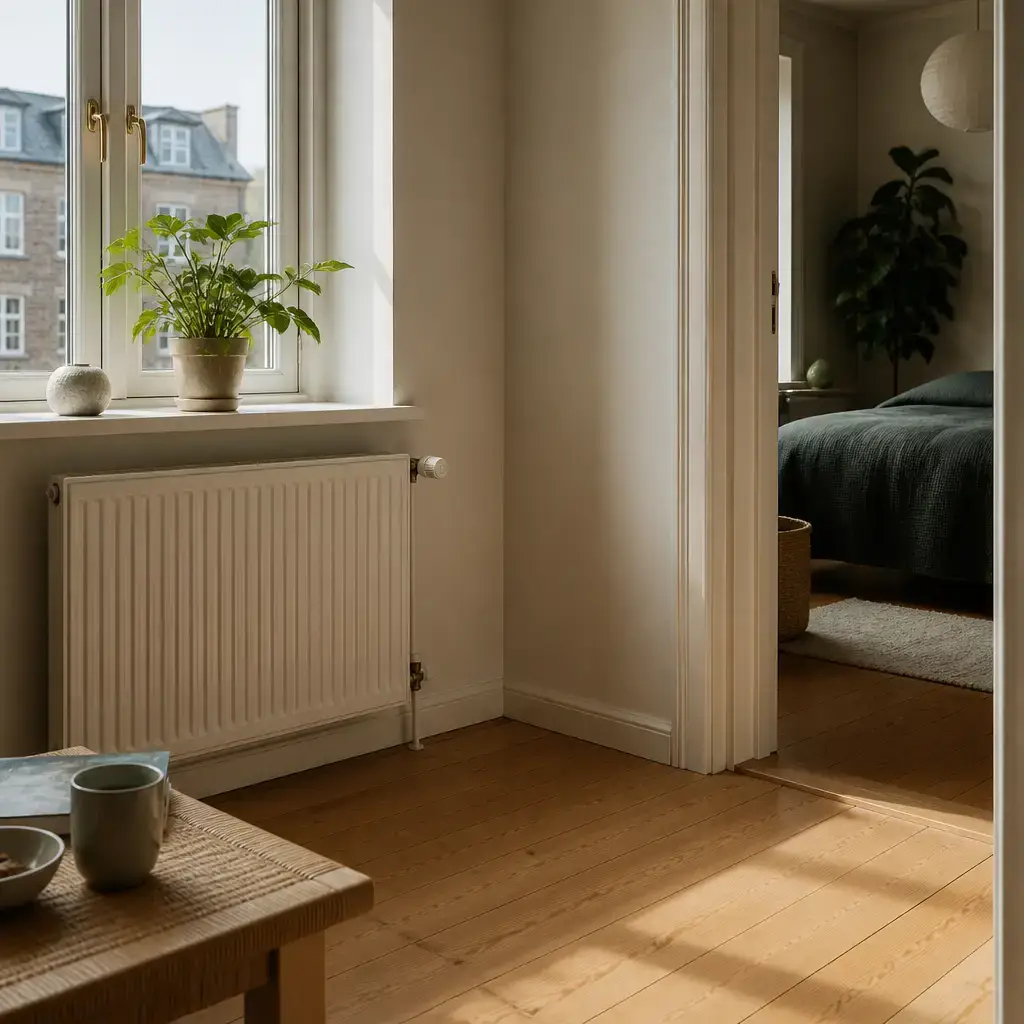
Die
At the start of “Die Heizung”, “Die” means “the” and identifies the heating system being discussed. It is the article used with “Heizung” here. Reuse it before this noun when referring to that specific heating system.
Heizung
“Heizung” means the heating system that switches on but does not make the room comfortable. In “Die Heizung”, it is the thing being described as switching on. Use it when discussing a building’s heating system.
schaltet
In “schaltet sich ein”, “schaltet” contributes the meaning “switches”. Together with “sich” and “ein”, it describes the heating turning on. Use this expression for a device or system switching on.
sich
In “schaltet sich ein”, “sich” is the reflexive component showing that the heating switches on itself. The complete meaning comes from the whole expression, not from “sich” alone. Use it with this verb when describing a device or system turning on.
ein
In “schaltet sich ein”, “ein” is the separable particle that completes the meaning “on”; here it is not the article meaning “a” or “an”. It is used with the verb when describing a device or system switching on.
aber
“aber” means “but” and introduces the problem that contrasts with the heating switching on. It connects “Die Heizung schaltet sich ein” with “der Raum wird nie wirklich angenehm”. Use it to contrast an expected result with an actual one.
der
In “der Raum”, “der” means “the” and identifies the particular room being discussed. It is the article used with “Raum” here. Use it before this noun when referring to that specific room.
Raum
“Raum” means “room”, the space whose temperature or comfort is being discussed. In “der Raum wird nie wirklich angenehm”, it is the subject that does not become comfortable. Use it when referring to an individual room.
wird
In “wird nie wirklich angenehm”, “wird” says that the room becomes or changes into a state. Together with “angenehm”, it describes a change in how comfortable the room is. Use this form when describing the room becoming a certain way.
nie
“nie” means “never” and says that the room does not become comfortable at any time. It strengthens the negative result in “wird nie wirklich angenehm”. Use it to describe something that does not happen at all.
wirklich
In “nie wirklich angenehm”, “wirklich” means “really” and emphasizes that the room never becomes genuinely comfortable. It modifies “angenehm” rather than describing the heating directly. Use it to stress whether a quality is fully present.
angenehm
“angenehm” means comfortable or pleasant in “der Raum wird nie wirklich angenehm”. It describes the state the room is expected to reach. Use it for a comfortable feeling, atmosphere, or condition.
Das
“Das” appears in “Das Thermostat” as “the” and in “Das habe ich mich gefragt” as “that” or “it”, referring back to the issue just mentioned. Its meaning depends on which of these two exact dialogue contexts it is in. Use the second pattern to refer back to a point or situation you are considering.
Thermostat
“Thermostat” means thermostat, the device that may be functioning in the heating system. In “Das Thermostat funktioniert vielleicht”, it is the subject of the statement. Use it when discussing the control device that regulates heating.
funktioniert
In “Das Thermostat funktioniert vielleicht”, “funktioniert” means works or functions. It describes the thermostat as possibly operating correctly. Use it to say whether a device or system is working.
vielleicht
“vielleicht” means “maybe” or “perhaps” and makes the statement about the thermostat uncertain. In “funktioniert vielleicht”, it signals a possibility rather than a confirmed fact. Use it when offering a tentative explanation.
während
“während” means “while” and introduces the situation that the radiator valve remains stuck as the thermostat may be working. In the subordinate clause beginning with “während”, the verb comes at the end. Use it to connect simultaneous or contrasting situations.
Heizkörperventil
“Heizkörperventil” means radiator valve, the component that remains stuck in the dialogue. In “das Heizkörperventil weiterhin klemmt”, it is the subject of the subordinate clause. Use it when discussing the valve controlling a radiator.
weiterhin
“weiterhin” means “still” or “continuing” and shows that the radiator valve remains in the same stuck condition. It adds continuation to “klemmt”. Use it when a situation has not changed.
klemmt
In “Heizkörperventil weiterhin klemmt”, “klemmt” says that the radiator valve sticks or is stuck. Together with “weiterhin”, it shows that this condition continues. Use it for a physical part that does not move as it should.
habe
In “habe ich mich gefragt”, “habe” is the form of “have” used to build the expression about a past thought. It works together with “mich” and “gefragt”, not as a standalone meaning of possession here. Use this pattern when reporting something you wondered about.
ich
“ich” means “I” in “habe ich mich gefragt”, while “Ich” is the same pronoun capitalized at the beginning of “Ich kann das organisieren”. It identifies the speaker as the person thinking or organizing. Use it as the subject when talking about yourself.
mich
In “habe ich mich gefragt”, “mich” refers back to the speaker and forms part of the expression meaning “I wondered”. Its meaning comes from the reflexive construction with “gefragt”. Use this pattern when describing a question or thought you had yourself.
gefragt
In “habe ich mich gefragt”, “gefragt” is the verb form used with “habe” to express that the speaker wondered about something. The complete meaning comes from “habe”, “mich”, and “gefragt” together. Use it when reporting a question you considered.
weil
“weil” means “because” and introduces the reason for the speaker’s question. In “weil sich das Rohr in der Nähe der Wand warm anfühlt”, it introduces a subordinate clause with the verb at the end. Use it to give a reason or explanation.
Rohr
“Rohr” means “pipe”, the object that feels warm near the wall. In “das Rohr ... warm anfühlt”, it is the thing whose temperature is being perceived. Use it when discussing a pipe in a heating or plumbing system.
in
In “in der Nähe der Wand”, “in” means “in” or “within” and introduces the location of the pipe. Together with “der Nähe”, it forms a phrase meaning near or in the vicinity of something. Use this construction to describe where something is located.
Nähe
“Nähe” means “vicinity” or “nearby area” in “in der Nähe der Wand”. The phrase locates the pipe close to the wall rather than directly on it. Use it with a location to describe something being nearby.
Wand
“Wand” means “wall” in “in der Nähe der Wand”. It is the reference point for locating the pipe. Use it when describing the position of something inside a room or building.
warm
“warm” means “warm” in “warm anfühlt” and describes the temperature perceived from the pipe. It is the quality that the pipe is said to have by touch. Use it to describe the temperature of an object or surface.
anfühlt
In “warm anfühlt”, “anfühlt” means “feels” and describes the pipe’s perceived temperature. It appears at the end of the subordinate clause after “warm”. Use this pattern to describe how an object feels when touched.
Dann
“Dann” means “then” and introduces the conclusion drawn from the warm pipe. It links the observation to the proposed explanation about circulation. Use it to present a result or next step in reasoning.
liegt
In “liegt das Problem”, “liegt” presents the problem as being located in or attributable to something. With “an der Zirkulation”, the whole expression says that the problem is probably due to circulation rather than power. Use this construction when identifying the likely cause of a problem.
Problem
“Problem” means “problem”, here referring to the heating fault being diagnosed. In “liegt das Problem ... an der Zirkulation”, it is the issue whose cause is being considered. Use it when naming a difficulty or fault.
wahrscheinlich
“wahrscheinlich” means “probably” and marks the explanation as likely rather than certain. It modifies the claim about what the problem is due to. Use it when making a reasoned but unconfirmed assessment.
eher
In “eher an der Zirkulation als an der Stromversorgung”, “eher” means “rather” and indicates that one explanation is more likely than the other. It works with “als” to compare circulation with the power supply. Use it when choosing the more likely of two explanations.
an
In “an der Zirkulation”, “an” identifies what the problem is attributed to. Its meaning comes from the whole construction with “liegt ... an”, which says what a problem is due to. Use this construction when naming the cause or source of a problem.
Zirkulation
“Zirkulation” means “circulation”, here referring to the movement of heat through the heating system. In “an der Zirkulation”, it is presented as the likely cause of the problem. Use it when discussing circulation within a technical system.
als
In “eher an der Zirkulation als an der Stromversorgung”, “als” means “than” or “rather than” and marks the second side of the comparison. It contrasts circulation with the power supply. Use it after a comparative choice to identify the alternative.
Stromversorgung
“Stromversorgung” means “power supply”, the alternative possible cause considered in the dialogue. In “als an der Stromversorgung”, it is the cause judged less likely than circulation. Use it when discussing the electrical supply to a device or system.
Könnte
“Könnte” means “could” and introduces a polite question about whether a technician might check the heating. In “Könnte ein Techniker das überprüfen?”, it makes the request less direct. Use it to ask politely about a possible action.
Techniker
“Techniker” means “technician”, the person who may inspect the heating system. In “ein Techniker”, it is the person being asked about. Use it for someone who carries out technical inspection or repair work.
überprüfen
“überprüfen” means “check” or “inspect” in “das überprüfen”. It is the action the technician might carry out on the heating problem. Use it when asking someone to examine whether something is working correctly.
ohne
“ohne” means “without” and introduces an action that would not be necessary: “ohne jeden Raum zu betreten”. It is followed here by an infinitive construction. Use it to describe an action carried out without another action.
jeden
In “jeden Raum”, “jeden” means “every” or “each” and applies to all individual rooms considered one by one. It specifies that the technician might not need to enter every room. Use it before a singular noun when referring to each member of a group.
zu
In “zu betreten”, “zu” marks the infinitive construction after “ohne”; it does not mean a destination here. Together with “betreten”, it expresses the action of entering. Use it in similar infinitive constructions after expressions such as “ohne”.
betreten
“betreten” means “enter” in “jeden Raum zu betreten”. It describes the technician going into each room. Use it when referring to entering a room, building, or other defined area.
Er
“Er” in “Er braucht möglicherweise” and “er” in “wenn er mir rechtzeitig Bescheid gibt” refer to the technician. The capitalization changes because the first form begins a sentence. Use this pronoun to refer back to a male person already mentioned.
braucht
In “Er braucht möglicherweise Zugang”, “braucht” means “needs”. It describes access as something the technician may require. Use it with the thing or condition that someone requires.
möglicherweise
“möglicherweise” means “possibly” and expresses uncertainty about whether the technician needs access. In “braucht möglicherweise Zugang”, it presents the need as a possibility. Use it when discussing an option that may or may not apply.
Zugang
“Zugang” means “access”, here permission or ability to reach several rooms. In “Zugang zu mehreren Räumen”, it is the thing the technician may need. Use it with “zu” when specifying the place or area someone needs access to.
mehreren
In “zu mehreren Räumen”, “mehreren” means “several” and indicates more than one room without specifying the exact number. It describes the rooms to which access may be needed. Use it before a plural noun when referring to an unspecified number greater than one.
Räumen
“Räumen” means “rooms” in “zu mehreren Räumen”. It identifies the different rooms whose temperatures may need to be compared. Use it when referring to multiple rooms in an apartment or building.
um
In “um die Temperaturen ... zu vergleichen”, “um” introduces the purpose of needing access. The complete construction explains that the technician needs access in order to compare temperatures. Use it to state the purpose of an action.
Temperaturen
“Temperaturen” means “temperatures”, here the temperatures measured in different parts of the apartment. In “die Temperaturen ... zu vergleichen”, they are the things being compared. Use it when discussing temperature readings or conditions in multiple places.
ganzen
In “in der ganzen Wohnung”, “ganzen” means “whole” or “entire” and emphasizes that the comparison covers the complete apartment. It modifies “Wohnung” in this location phrase. Use it to stress that something applies throughout a place.
Wohnung
“Wohnung” means “apartment”, the entire living space in which the heating problem occurs. In “in der ganzen Wohnung”, it is the area covered by the temperature comparison. Use it when referring to an apartment or flat.
vergleichen
“vergleichen” means “compare” in “zu vergleichen”. It describes checking the temperatures against one another across the apartment. Use it when examining two or more things to identify similarities or differences.
kann
In “Ich kann das organisieren”, “kann” means “can” and expresses the speaker’s ability or readiness to arrange access. It is followed by the infinitive “organisieren”. Use it to say that someone is able or willing to do something.
organisieren
“organisieren” means “arrange” or “organize” in “das organisieren”. Here it refers to arranging the technician’s access. Use it for coordinating a visit, appointment, or practical arrangement.
wenn
“wenn” means “if” here and introduces the condition for organizing access. In “wenn er mir rechtzeitig Bescheid gibt”, the arrangement depends on receiving notice in good time. Use it to state a condition that must be met.
mir
In “mir rechtzeitig Bescheid gibt”, “mir” means “to me” and identifies the person who should receive the notice. It marks the speaker as the recipient of the information. Use it when saying that someone informs or gives something to you.
rechtzeitig
“rechtzeitig” means “in good time” or “promptly” and says that the notice must arrive early enough for the speaker to arrange access. It modifies the act of giving notice. Use it when timing matters and something must happen before it is too late.
Bescheid gibt
The exact expression “Bescheid gibt” means “lets someone know” or “gives notice”. Here “Bescheid” is the information or notice, while “gibt” contributes the idea of giving; in “mir Bescheid gibt”, “mir” is the recipient. Use this expression when someone informs another person about a plan or timing.
Wir
“Wir” means “we” in “Wir sollten um ein konkretes Zeitfenster bitten”. It includes the people discussing and planning the request. Use it when referring to yourself together with one or more other people.
sollten
“sollten” means “should” and presents requesting a clear time window as the recommended next step. It is followed by the infinitive “bitten”. Use it to give or discuss practical advice.
konkretes
In “ein konkretes Zeitfenster”, “konkretes” means “specific” or “concrete”. It emphasizes that the requested time window should be clearly defined rather than vague. Use it to describe information or arrangements with precise details.
Zeitfenster
“Zeitfenster” means “time window”, a defined period during which the technician could visit. In “um ein konkretes Zeitfenster bitten”, it is the information being requested. Use it when arranging a visit or appointment within a particular period.
bitten
In “um ein konkretes Zeitfenster bitten”, “bitten” means “ask” or “request” something. The requested thing follows “um”, here a specific time window. Use it when making a polite request for information or an arrangement.
bevor
“bevor” means “before” and places the act of confirming after the request for a clear time window. In “bevor wir bestätigen”, it introduces the action that must happen first. Use it to order two actions in time.
bestätigen
“bestätigen” means “confirm” in “bevor wir bestätigen”. It refers to formally agreeing to the arrangement after receiving a clear time window. Use it when accepting or verifying an appointment, plan, or decision.