Ich
“Ich” means I and identifies the speaker in the dialogue. It is used as the subject before the finite verb in statements such as “Ich habe bemerkt”.
habe
“habe” means have here as the first-person form of haben used with “Ich”. Together with “bemerkt”, “aufgestellt”, and “freigeräumt”, it helps describe completed observations and actions. It is commonly followed by a past participle in this kind of statement.
bemerkt
“bemerkt” means noticed in “Ich habe bemerkt”. It is the past participle of bemerken and describes recognizing the damp patch. The pattern “Ich habe bemerkt, dass …” introduces something the speaker observed.
dass
“dass” introduces the content of what was noticed: “dass sich unter der Küchenspüle ein feuchter Fleck bildet”. It sends the finite verb to the end of the subordinate clause here. It is useful for reporting an observation or statement.
sich
“sich” is the reflexive pronoun used in “dass sich unter der Küchenspüle ein feuchter Fleck bildet” and “der Boden sich zu verziehen beginnt”. It shows that the change is described as happening to the subject itself. It commonly appears with reflexive expressions describing a change or development.
unter
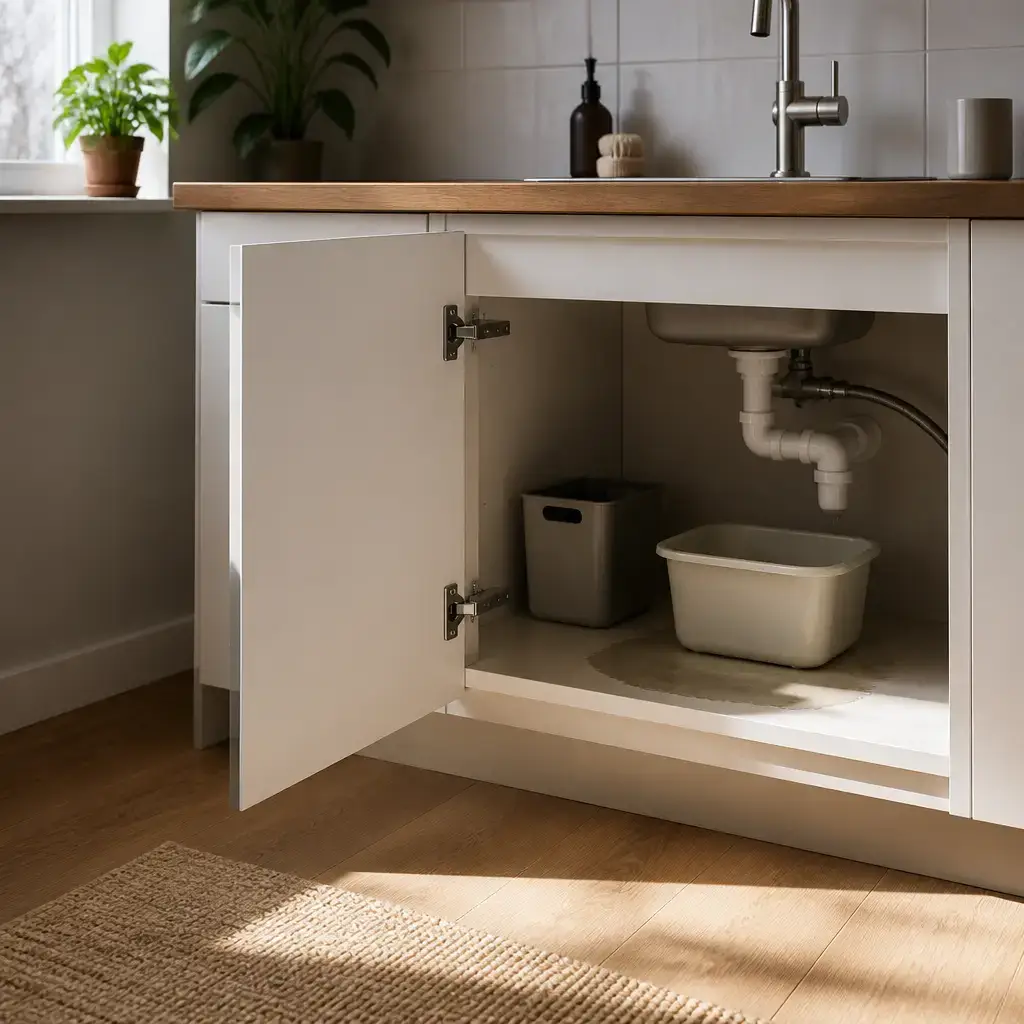
“unter” means under in “unter der Küchenspüle” and locates the damp patch below the kitchen sink. For a fixed location, it is used with the phrase that identifies what something is beneath. It is useful when reporting where a problem or object is located.
der
In “unter der Küchenspüle”, “der” means the and introduces the sink in this location phrase. In “der Schrank”, it introduces the cabinet as the subject of the subordinate clause. Its exact function depends on the noun phrase in which it appears.
Küchenspüle
“Küchenspüle” means kitchen sink and identifies the place under which the damp patch is forming. It is a compound noun naming the sink in a kitchen. It can be used to specify the location of a household maintenance problem.
ein
“ein” means a in “ein feuchter Fleck”. It introduces one unspecified damp patch that is forming under the sink. It is used before a singular noun when the particular item has not been previously identified.
feuchter
“feuchter” means damp and describes the Fleck in “ein feuchter Fleck”. Its ending matches the form of the surrounding noun phrase. It can be used before a noun to describe a damp condition or surface.
Fleck
“Fleck” means patch or spot, referring here to the visible damp area. In “ein feuchter Fleck”, it names the problem the speaker has noticed. It is useful for describing a localized mark or affected area.
bildet
“bildet” means is forming in “ein feuchter Fleck bildet”. It is the third-person singular form of bilden and describes the patch coming into existence or becoming visible. The pattern can describe something that gradually forms in a particular place.
Das
The capitalized form “Das” means that and refers to the reported leak or problem. In “Das muss behoben werden”, it is the subject of the statement about what needs to be done. It is useful for referring back to a previously mentioned situation.
muss
“muss” means must or needs to and expresses necessity in “Das muss behoben werden”. It is the form of müssen used with “Das”. It commonly appears before an infinitive or passive construction to state that action is required.
behoben
“behoben” means fixed or remedied in “muss behoben werden”. It is the past participle of beheben and describes correcting the problem. It is used here in a passive construction because the problem, rather than the person fixing it, is the focus.
werden
“werden” functions as the passive auxiliary in “muss behoben werden”. It helps express that the problem needs to be fixed without naming who will fix it. In this construction, it follows the participle and completes the passive infinitive.
bevor
“bevor” means before and introduces the condition that must be met before the cabinet is damaged: “bevor der Schrank beschädigt wird”. It connects two events in time. It is useful when warning that one action should happen before a consequence.
Schrank
“Schrank” means cabinet in “der Schrank”. It identifies the household item that could be damaged by the leak. It can be used to name a cabinet or cupboard affected by a maintenance problem.
beschädigt
“beschädigt” means damaged in “der Schrank beschädigt wird”. It is the participle of beschädigen used in the passive, describing the possible condition of the cabinet. It is useful when reporting damage or a risk of damage.
wird
“wird” is the form of werden used with “der Schrank” in the passive phrase “beschädigt wird”. It helps express that the cabinet may be damaged by something. In a subordinate clause introduced by “bevor”, it appears at the end.
dort
“dort” means there and points to the place under the sink. It is used both for where the container was placed and for where something might be stored. It is useful for referring back to a location already understood from the conversation.
einen
“einen” means a in “einen Behälter”. It introduces the container as the object that was placed there. It is the form used before this masculine noun in the object phrase.
Behälter
“Behälter” means container and refers to the object placed under the sink to catch water. It is useful for describing a vessel used to collect or hold something. In the dialogue, it is the object of the placement action.
aufgestellt
“aufgestellt” means placed or set up in “Ich habe dort einen Behälter aufgestellt”. It is the past participle of aufstellen and describes putting the container in position. The pattern can describe setting an object somewhere for a practical purpose.
aber
“aber” means but and contrasts the container being placed with the leak continuing. It connects two statements where the second limits or changes the effect of the first. It is useful for reporting an action that has not solved the problem.
Leck
“Leck” means leak and names the source of the dripping water. In “das Leck tropft weiterhin langsam”, it is the subject described as continuing to drip. It is useful when reporting a fault in a pipe, sink, or other container.
tropft
“tropft” means drips in “das Leck tropft”. It is the third-person singular form of tropfen and describes the slow release of drops. It can be used to report ongoing water leakage.
weiterhin
“weiterhin” means still or continuing and shows that the dripping has not stopped. It modifies “tropft” in “das Leck tropft weiterhin langsam”. It is useful when describing a situation that remains unchanged over time.
langsam
“langsam” means slowly and describes the manner of the dripping. In the dialogue, it makes clear that the leak is not rapid but is still ongoing. It can be used to give a practical detail about the speed of an action.
Ist
“Ist” means is and begins the question “Ist dort etwas gelagert …?”. It is the form of sein used to ask about the situation in that location. In a yes-or-no question, the finite verb comes before the subject or thing being asked about.
etwas
“etwas” means anything or something in “Ist dort etwas gelagert …?”. It asks whether any object is stored there without naming a specific object. It is useful in questions about the presence of an unspecified thing.
gelagert
“gelagert” means stored in “Ist dort etwas gelagert?”. It describes something that has been kept in that location. It commonly appears with sein when asking or stating whether items are stored somewhere.
den
“den” introduces the masculine noun in object phrases such as “den Zugang”, “den Bereich”, and “den Bericht”. It marks the thing that is blocked, cleared, or included. It is useful for identifying a specific masculine object involved in an action.
Zugang
“Zugang” means access, referring here to the way into the area under the sink. In “den Zugang versperren”, it is the thing that could be blocked. This phrase is useful when stored objects may prevent a technician from reaching a problem.
versperren
“versperren” means block or obstruct in “den Zugang versperren könnte”. It is the infinitive used with “könnte” to describe a possible obstruction. It is useful with an object such as access, a passage, or an entrance.
könnte
“könnte” means could and expresses a possible risk in “das den Zugang versperren könnte”. It is a form of können used to present the obstruction as possible rather than certain. It commonly appears with an infinitive at the end of the clause.
Bereich
“Bereich” means area and refers to the space around the leak. In “Ich habe den Bereich freigeräumt”, it is the area the speaker has made accessible. It is useful for referring to a defined part of a room or work area.
freigeräumt
“freigeräumt” means cleared in “Ich habe den Bereich freigeräumt”. It is the past participle of freiräumen and describes removing objects from the area. It is useful when preparing a place so someone can reach or inspect it.
damit
“damit” means so that and introduces the purpose of clearing the area: “damit der Techniker ihn problemlos untersuchen kann”. It connects an action with the result the speaker wants to make possible. It is useful for explaining the purpose of a practical preparation.
Techniker
“Techniker” means technician and identifies the person who can inspect the area. In the dialogue, it is the subject of the purpose clause after “damit”. It is useful when arranging a repair or inspection by a skilled worker.
ihn
“ihn” means it here and refers back to the masculine noun “Bereich”, not to a person. In “der Techniker ihn problemlos untersuchen kann”, it is the object being inspected. It is useful for avoiding repetition of a previously mentioned masculine noun.
problemlos
“problemlos” means easily or without problems in “ihn problemlos untersuchen”. It describes the conditions under which the technician can inspect the area. It is useful for stating that an action can be carried out without obstruction or difficulty.
untersuchen
“untersuchen” means inspect or examine and describes what the technician can do to the area. It is the infinitive after “kann”. It is useful for reporting a careful examination of a problem, object, or location.
kann
“kann” means can and expresses the technician’s ability to inspect the area. It is the form of können used with “der Techniker”. It is followed by the infinitive “untersuchen” in the subordinate clause.
es
In “Ich kann es als dringend kennzeichnen”, “es” means it and refers to the item being marked urgent. In “Es wirkt sich auf die Sicherheit und den Reparaturplan aus”, it refers back to the reported detail or problem. The pronoun avoids repeating the relevant thing or situation.
als
“als” means as in “es als dringend kennzeichnen”. It introduces the status or label assigned to the item. This pattern is useful when marking, describing, or classifying something as a particular category.
dringend
“dringend” means urgent and describes the priority assigned to the maintenance request. In “als dringend kennzeichnen”, it is the label given to the request. It is useful when asking that a problem receive prompt attention.
kennzeichnen
“kennzeichnen” means mark or label in “es als dringend kennzeichnen”. It is the infinitive after “kann” and describes assigning a clear status to the request. It is useful with “als” when something is identified as a particular priority or type.
auch
In “auch wenn”, “auch” adds the sense of even to the subordinate clause. The complete expression “auch wenn die Terminvergabe trotzdem etwas dauern kann” presents a concession: the request may be urgent although scheduling can still take time. This pattern is useful when acknowledging an exception or limitation.
wenn
In “auch wenn”, “wenn” introduces the clause describing the possible limitation of scheduling. Together with “auch”, it means although or even if in this context. It is useful for linking an expected action with a condition that does not prevent the main statement.
die
“die” means the and introduces “Terminvergabe”, the subject of the scheduling statement. It identifies the specific scheduling process being discussed. It is used before this feminine noun phrase.
Terminvergabe
“Terminvergabe” means scheduling or the assignment of an appointment. In the dialogue, it is the process that may take some time even after the request is marked urgent. It is useful when discussing how an appointment or service time is allocated.
trotzdem
“trotzdem” means nevertheless or still and emphasizes that scheduling may take time despite the request being urgent. It connects the limitation with the earlier statement about priority. It is useful for acknowledging that a result remains possible despite another circumstance.
dauern
“dauern” means take time in “die Terminvergabe … dauern kann”. It is the infinitive after “kann” and describes the duration of the scheduling process. It is useful when stating how long an arrangement or process may continue.
Bitte
“Bitte” means please and makes “Bitte erwähnen Sie …” a polite request. It signals that the speaker wants a specific detail added to the report. It is commonly placed at the beginning of a polite request.
erwähnen
“erwähnen” means mention in “Bitte erwähnen Sie”. It is the infinitive used in a polite request with the formal pronoun “Sie”. It is useful when asking someone to include a particular fact in a conversation or report.
Sie
“Sie” means you in the formal request “Bitte erwähnen Sie”. Its capitalization marks the formal form of address. It is used when speaking politely to a service representative, technician, or other person who is not addressed informally.
Boden
“Boden” means floor and identifies the surface that is beginning to warp. In “der Boden sich zu verziehen beginnt”, it is the thing undergoing the change. It is useful when reporting damage to a room’s floor.
zu
“zu” is the infinitive marker in “sich zu verziehen beginnt”. It links the beginning of the change with the infinitive “verziehen”, rather than meaning a direction here. It is used in the pattern “beginnen, etwas zu tun” to describe an action that is starting.
verziehen
“verziehen” means warp or bend in “der Boden sich zu verziehen beginnt”. It describes the floor changing shape because of the moisture. It is useful for reporting a gradual physical deformation of a surface or material.
beginnt
“beginnt” means begins in “der Boden sich zu verziehen beginnt”. It is the third-person singular form of beginnen and shows that the warping is just starting. It is useful for reporting the initial stage of a developing problem.
Dieses
“Dieses” means this and points to the specific detail just mentioned about the floor. In “Dieses Detail sollte in den Bericht aufgenommen werden”, it identifies that information as the item to include. It is used before the neuter noun “Detail”.
Detail
“Detail” means detail and refers to the floor beginning to warp. In the dialogue, it is important information for the maintenance report. It is useful when identifying one specific fact that affects how a problem is assessed.
sollte
“sollte” means should and expresses a recommendation or expectation in “Dieses Detail sollte … aufgenommen werden”. It is a form of sollen used to say that the detail belongs in the report. It commonly introduces advice about what ought to be done.
in
“in” connects the detail with the report in “in den Bericht aufgenommen werden”. It presents the report as the place or record where the information should be included. It is useful when describing information being put into a document or record.
Bericht
“Bericht” means report and identifies the document that should contain the floor-related detail. In “in den Bericht aufgenommen werden”, it is the destination for the information. It is useful when documenting a problem for maintenance or follow-up.
aufgenommen
“aufgenommen” means included or recorded in “in den Bericht aufgenommen werden”. It is the past participle of aufnehmen and appears in a passive construction because the detail is the information being added. It is useful when stating that information should be entered into a report.
wirkt
“wirkt” is the finite verb part of the expression “wirkt sich auf die Sicherheit und den Reparaturplan aus”. Together with the reflexive pronoun and “aus”, it means has an effect on. It is useful for explaining how a problem influences a particular area or plan.
auf
In “wirkt sich auf die Sicherheit und den Reparaturplan aus”, “auf” introduces the things affected by the problem. It belongs to the reusable expression “sich auf etwas auswirken”. It is useful when describing an effect on safety, plans, decisions, or other areas.
Sicherheit
“Sicherheit” means safety and is one of the areas affected by the reported leak. In “wirkt sich auf die Sicherheit … aus”, it identifies the safety consequences being considered. It is useful when explaining why a maintenance issue needs attention.
und
“und” means and and joins “die Sicherheit” with “den Reparaturplan”. It shows that the leak affects both areas. It is useful for connecting two equivalent objects or consequences in one statement.
Reparaturplan
“Reparaturplan” means repair plan and identifies the plan that may need to account for the leak and floor damage. It is the second object of “wirkt sich auf … aus”. It is useful when discussing how reported details influence the organization of repair work.
aus
“aus” is the separable particle that completes “sich auswirken” in “wirkt sich auf die Sicherheit und den Reparaturplan aus”. It appears at the end of the finite clause while “wirkt” remains near the subject. The complete expression means that something has an effect on a specified area.