Ich
“Ich” means “I” and identifies the speaker as the person making the statement. It is used as the subject, as in “Ich habe”, when talking about your own situation or action.
habe
“habe” is the first-person form of “haben” used in “Ich habe ... liegen lassen” to describe something the speaker left somewhere. With “Ich” as the subject, this form helps present the completed situation; reuse it with a past participle or infinitive construction when reporting what you have done.
mein
“mein” means “my” and identifies the charger as belonging to the speaker in “mein Ladegerät”. It is placed directly before the possessed noun and can be reused with another item that belongs to the speaker.
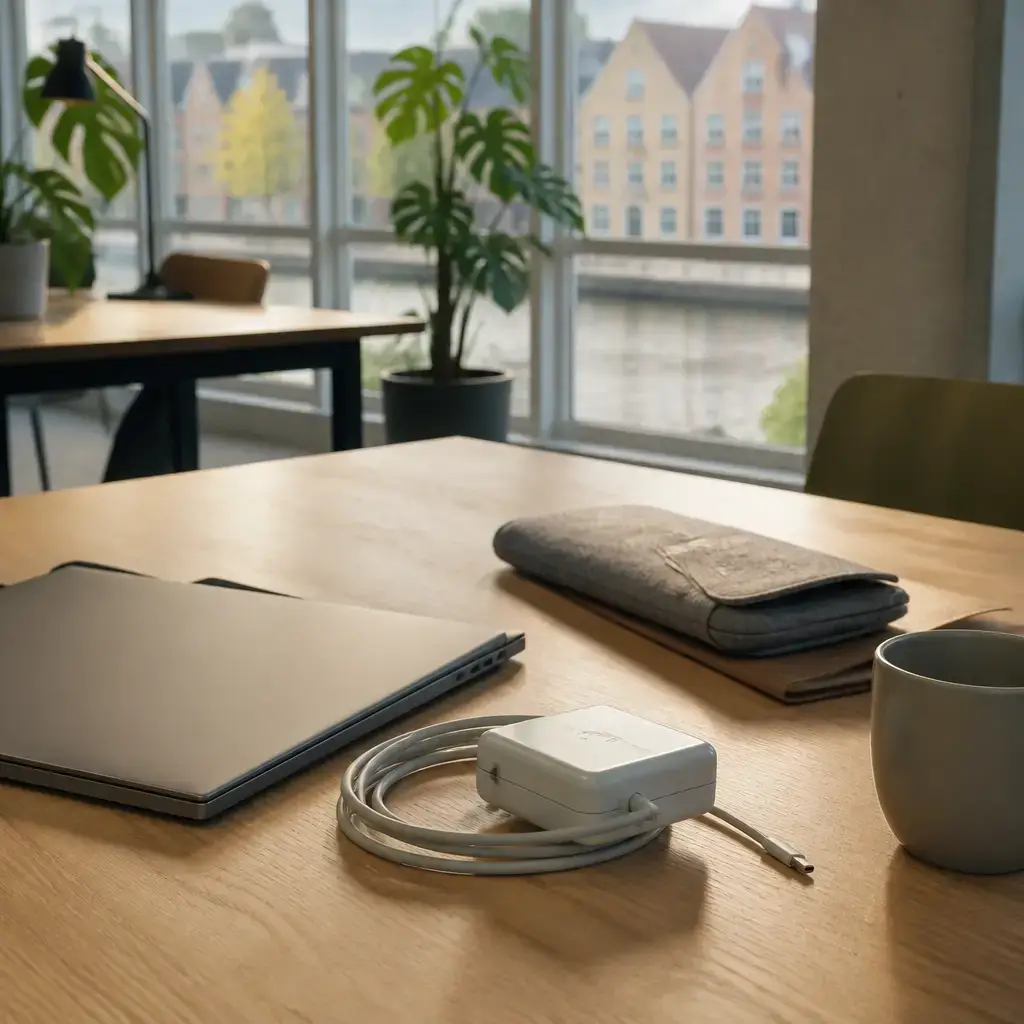
Ladegerät
“Ladegerät” means “charger”, specifically the device being borrowed and returned in this dialogue. It is the object that is left elsewhere, needed for the upload, and later returned; use it when referring to a charger as an object.
woanders
“woanders” means “somewhere else” and gives the location where the charger was left. It is a useful way to describe an unspecified different place when explaining where something is.
liegen
In “liegen lassen”, “liegen” contributes the idea that the charger is left lying somewhere. Together with “lassen”, the phrase describes leaving an object in a place; reuse “liegen lassen” when saying that you left something behind.
lassen
In “liegen lassen”, “lassen” means to leave something in its position rather than take it with you. The construction is useful for reporting that an object was left somewhere, as with the charger here.
und
“und” means “and” and connects the statement about the charger with the statement about the laptop battery. Use it to join related information or two coordinated clauses.
der
“der” is the definite article introducing “der Akku”, meaning “the battery”. It identifies the specific battery being discussed; use a definite article when the listener can identify the noun from the context.
Akku
“Akku” means “battery”, here the battery of the speaker’s laptop. In this situation it refers to the rechargeable power source whose charge is nearly gone; use it when discussing a device’s battery.
meines
“meines” means “of my” in “meines Laptops” and shows that the battery belongs to the speaker’s laptop. The phrase “meines Laptops” identifies whose battery is meant; reuse this possessive pattern to link an object to the speaker’s possession.
Laptops
“Laptops” means “laptop” in the possessive phrase “meines Laptops”. It specifies the device whose battery is being described; use the noun when referring to a laptop in a work or study setting.
ist
“ist” is the form of “sein” used to say that the laptop battery has a particular condition in “ist fast leer”. It links the battery with its state and is reused when describing what something is like or what condition it is in.
fast
“fast” means “nearly” and shows that the battery is close to being empty but not necessarily completely empty. It modifies the following description, as in “fast leer”, and can be used to express an almost-reached condition.
leer
“leer” means “empty”; with a battery, it describes having almost no charge in “fast leer”. It is useful for reporting a device’s remaining power or another container’s lack of contents.
Meins
“Meins” means “mine” and refers back to the other person’s charger without repeating the noun. A standalone possessive such as “Meins” is useful when the owned object is already clear from the conversation.
sollte
“sollte” expresses the speaker’s expectation that the charger will fit, rather than making a firm guarantee. In “sollte passen”, it is followed by the infinitive “passen”; reuse this combination when something is expected to work.
passen
“passen” means “fit” here, referring to whether the charger and the port are compatible. It follows “sollte” in “sollte passen”; use it with an item when checking whether it fits or is compatible.
vorausgesetzt
“vorausgesetzt” means “provided” and introduces the condition under which the charger should fit. It is useful for stating a requirement before accepting that something will work, as in “vorausgesetzt, ...”.
dein
“dein” means “your” and identifies the port as belonging to the person being addressed. It is placed before the possessed noun in “dein Anschluss”; reuse it when referring to something belonging to the informal “du” addressee.
Anschluss
“Anschluss” means “port” in this technical context, referring to the laptop connection used by the charger. It can also refer more generally to a connection, but here the relevant meaning is the device port.
hat
“hat” is the form of “haben” used with “dein Anschluss” to say that the port has a particular connector. It introduces the feature that determines compatibility; reuse it when describing what a device or object has.
den
“den” is the definite article introducing “den neueren Stecker”, the specific connector under discussion. It marks the noun phrase as the connector being checked; use a definite article when the object is identifiable in context.
neueren
“neueren” means “newer” and describes the connector as the more recent of the relevant options. It modifies “Stecker” in “den neueren Stecker”; use this form when comparing a specific item with another known option.
Stecker
“Stecker” means “plug” or “connector” and refers here to the connector required by the port. It is the part whose type must match for the charger to fit; use it when discussing a plug or connector.
Das
“Das” means “that” and refers back to the previous condition about the port and connector. In “Das ist der Fall”, it points to the situation just mentioned; use it to refer to an already stated fact or circumstance.
Fall
In “der Fall”, “Fall” means “case” or “situation”, and “Das ist der Fall” means that the preceding statement is true. This fixed expression is useful when confirming that a previously mentioned condition applies.
obwohl
“obwohl” means “although” and introduces information that contrasts with the confirmation that the port works. It connects a main statement with an unexpected or limiting fact; use it to make that contrast clear.
nur
“nur” means “only” and limits the speaker’s need for the charger to the current upload. It is placed before the relevant time or purpose phrase; reuse it when narrowing a need, action, or quantity.
für
“für” means “for” in “für diesen Upload” and identifies the purpose or occasion for which the charger is needed. It commonly introduces the intended use of an object or action.
diesen
“diesen” means “this” and points to the specific upload currently taking place. It appears directly before “Upload” to identify that particular event; use it when referring to a nearby or currently relevant item.
Upload
“Upload” means “upload”, the file transfer that is currently taking place. In this dialogue it names the task for which the charger is needed; use it when referring to sending files from a device to a service or system.
brauche
“brauche” is the first-person form of “brauchen” meaning “need”, used by the speaker to state that the charger is required for the upload. It normally takes the needed item as its object; use it to explain what you require.
lässt
In “Das lässt sich einrichten”, “lässt” helps express that the proposed arrangement can be made workable. The whole construction means that the arrangement is manageable; reuse “lässt sich ...” with an infinitive when describing something as possible to arrange or do.
sich
In “Das lässt sich einrichten”, “sich” is part of the construction meaning “can be arranged”, rather than a separate literal reference to itself. Keep it with “lässt” and the infinitive when using this pattern to describe what can be done.
einrichten
In “Das lässt sich einrichten”, “einrichten” means “arrange” or “manage”, referring to making the proposed borrowing workable. The reusable pattern “Das lässt sich einrichten” is a practical way to accept a feasible arrangement.
da
“da” means “since” and introduces the reason why the arrangement is manageable. It connects the conclusion with the fact that the computer is already charged; use it to give a reason that supports the preceding statement.
Computer
“Computer” means “computer” and is the device described as already fully charged. It is the subject of the explanation for why the charger is available; use it when referring generally to a computer.
bereits
“bereits” means “already” and shows that the computer reached the charged state before the current moment. It is useful for emphasizing that something has happened or is true by now.
vollständig
“vollständig” means “fully” or “completely” and strengthens “geladen” to show that the computer has reached its full charged state. It modifies the condition being described; use it to emphasize completeness.
geladen
“geladen” means “charged” in “vollständig geladen” and describes the computer’s current power condition. Together with “ist”, it reports the device’s state; use it when explaining that a battery or device has charge.
kann
“kann” means “can” and expresses the speaker’s ability or possibility to return the charger. It is followed by the infinitive “zurückgeben”; reuse “kann” with an infinitive to state what someone is able or permitted to do.
es
“es” means “it” and refers back to the charger in the return arrangement. It stands before “zurückgeben” as the object being returned; use this pronoun when the object is already clear.
zurückgeben
“zurückgeben” means “give back” or “return”, here referring to returning the borrowed charger. It follows “kann” and is used with the returned object; reuse it when promising to return something to its owner.
sobald
“sobald” means “as soon as” and sets the return time at the moment the files have finished synchronizing. It introduces a time clause for an action that will follow immediately after the stated condition.
die
“die” is the definite article introducing “die Dateien”, meaning “the files”. It identifies the particular files involved in the synchronization; use it when the listener knows which files are meant.
Dateien
“Dateien” means “files” and refers to the digital items being synchronized. In this dialogue their completion determines when the charger can be returned; use the plural noun for multiple computer files.
synchronisiert
“synchronisiert” means “synchronized” and describes the files as having finished matching or updating across systems. In “synchronisiert sind”, it names the completed state that triggers the return; use it for files or data brought into sync.
sind
“sind” is the plural form of “sein” used with “die Dateien” to state their condition in “synchronisiert sind”. It completes the time clause after “sobald”; reuse it when describing a plural subject’s state.
Bitte
“Bitte” means “please” and makes the following request polite. It is placed at the beginning of the request “Bitte lass ...”; use it when asking someone to do something.
lass
“lass” is the informal imperative of “lassen” in the request “Bitte lass es in der Nähe”. Here it means “leave it”; use it with an object when asking someone to keep something in a particular place.
in
“in” means “in” and introduces the location phrase “in der Nähe”. It is used with a place expression to say where the charger should remain; reuse it to describe an object’s location.
Nähe
“Nähe” means “vicinity” or “nearby area” in “in der Nähe”. The phrase asks that the charger remain close enough to retrieve later; use “in der Nähe” for a nearby location.
weil
“weil” means “because” and introduces the reason for asking that the charger remain nearby. It connects the request with the possible later need; use it to give a direct reason for a statement or request.
später
“später” means “later” and refers to a time after the current upload and borrowing arrangement. It is useful for referring to a later point without specifying an exact time.
vielleicht
“vielleicht” means “perhaps” and marks the later need for the charger as possible but not certain. It is useful when mentioning a possibility without presenting it as definite.
bleiben
“bleiben” means “stay” or “remain” and describes the speaker remaining nearby. It follows “kann” in “kann in der Nähe bleiben”; reuse it when saying that a person or thing will remain in a place.
damit
“damit” means “so that” and introduces the purpose of staying nearby: making it easy for the other person to get the charger back. It connects an action with the intended result; use it before a purpose clause.
du
“du” means informal singular “you” and identifies the person who can get the charger back. It is the subject of the purpose clause after “damit”; use it when addressing one familiar or informally addressed person.
leicht
“leicht” means “easily” in this context and describes the retrieval as uncomplicated. It modifies the action in “leicht zurückbekommst”; use it to say that something can be done without difficulty.
zurückbekommst
“zurückbekommst” means “get back” and refers to the addressee receiving the charger again. It is the form used with “du” in the purpose clause; use it when someone regains possession of something.
So
“So” means “that way” and refers to the arrangement just proposed. At the beginning of the sentence, it presents the described plan as the way the situation works; use it to refer back to an action or arrangement.
funktioniert
“funktioniert” means “works” and says that the proposed arrangement is effective. It is used with “So” to evaluate the plan; reuse it when confirming that a method, device, or arrangement works.
ohne
“ohne” means “without” and introduces the condition that neither person is interrupted. In “ohne dass”, it connects the arrangement with an event that does not occur; use this construction to describe avoiding an unwanted result.
dass
“dass” means “that” and introduces the clause describing what does not happen. Together with “ohne”, it forms “ohne dass”, meaning “without ...”; use it to attach a full clause to the main statement.
einer
“einer” means “one” in “einer von uns”, referring to one person within the two-person group. The phrase identifies either individual without naming one; reuse “einer von ...” when selecting one member of a group.
von
“von” means “of” in “einer von uns” and introduces the group from which one person is identified. This pattern is useful for expressing “one of” a group.
uns
“uns” means “us” and refers to the two people involved in the arrangement. In “einer von uns”, it identifies the group containing the person who might otherwise be interrupted; use it when referring to yourself together with others.
unterbrochen
“unterbrochen” means “interrupted” and describes the unwanted disruption that the arrangement avoids. In “unterbrochen wird”, it refers to either person’s work being disturbed; use it when an activity or person is stopped or disturbed.
wird
“wird” is the form of “werden” used in “unterbrochen wird” to express that one of the people is interrupted. Together with “unterbrochen”, it forms the passive description of the event; reuse this pattern when focusing on what happens to someone or something rather than who causes it.