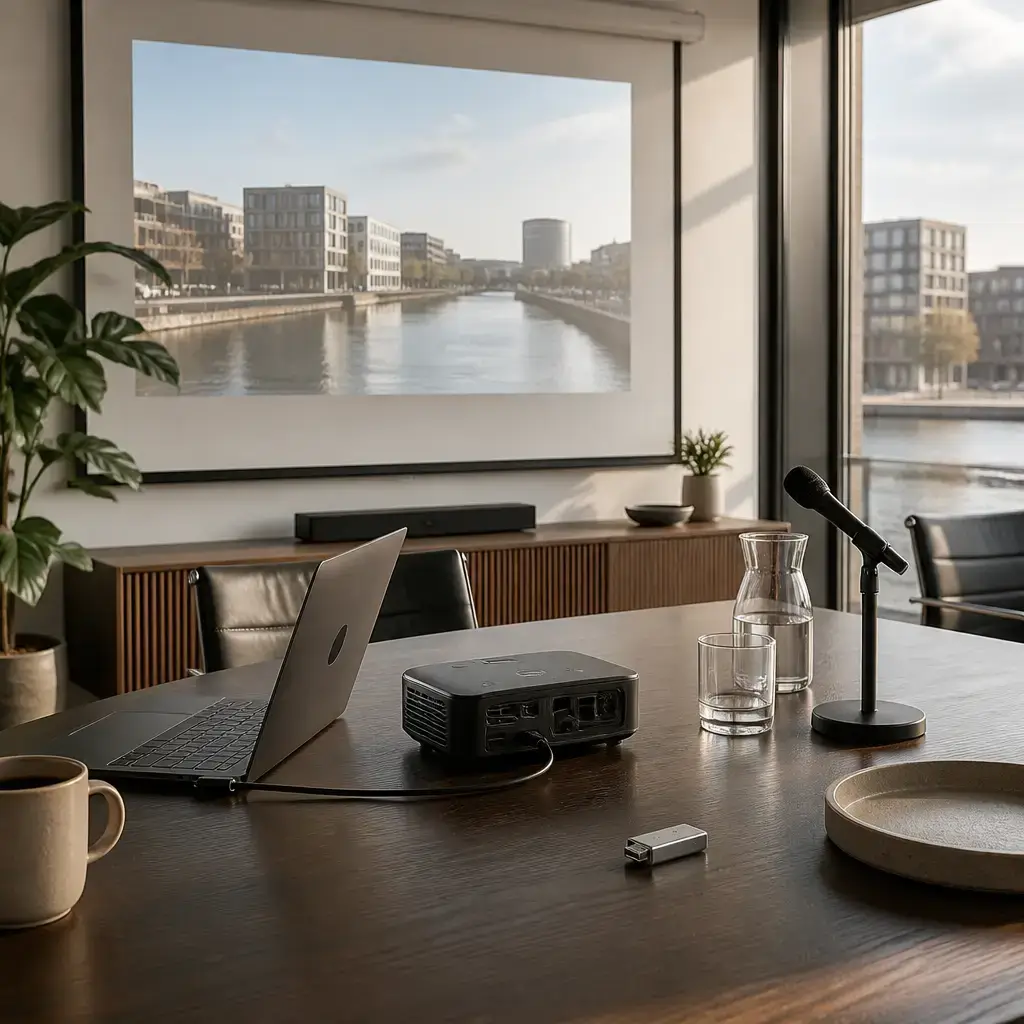
Wir
“Wir” means “we” and refers to the two coworkers together. It is the subject of “Wir sollten ... prüfen”. Use it when describing an action that you and at least one other person will do.
sollten
“sollten” expresses what the coworkers ought to do: check the equipment. Together with “Wir” and the infinitive “prüfen”, it gives a recommendation rather than a direct command. Use this pattern to make a suggestion about a shared action.
die
In “die Präsentationstechnik”, “die” means “the” and identifies specific presentation equipment. It belongs directly with the noun that follows it. Definite articles are used when the listener can identify the thing being discussed.
Präsentationstechnik
“Präsentationstechnik” means the equipment used for a presentation, such as the projector and microphone in this dialogue. It is the object of “prüfen”. Use this compound noun when discussing presentation equipment as a group.
prüfen
“prüfen” means to check or examine something. Here it is the infinitive after “sollten” and refers to checking the presentation equipment. It can be used with an object such as equipment, settings, or a document.
bevor
“bevor” means “before” and introduces the time when the clients arrive. It connects the checking action with a later event. Use it to say that one action happens before another event.
Kunden
“Kunden” refers to the clients who are expected to arrive. In “die Kunden”, it is the subject of “ankommen”. Use it for customers or clients in a business context.
ankommen
“ankommen” means to arrive, here describing the clients reaching the meeting. It appears at the end of the clause introduced by “bevor”. Use it for people or vehicles reaching a destination.
Ich
“Ich” means “I” and identifies the coworker who offers to connect the laptop. It is the subject of “Ich kann ... verbinden”. Use it when speaking about your own action or ability.
kann
“kann” expresses ability or willingness here: the speaker is able to connect the laptop. It is followed by the infinitive “verbinden”. Use “kann” with an infinitive to describe what someone can do.
zuerst
“zuerst” means “first” and shows that connecting the laptop is the initial step. It appears before the object and infinitive in this sentence. Use it to order actions in a process.
den
In “den Laptop”, “den” means “the” and identifies the laptop being connected. Its form belongs to the masculine object phrase here. Use a definite article before a specific noun when its grammatical role requires this form.
Laptop
“Laptop” means laptop and is the device that will be connected to the projector. It is the object of “verbinden” in this sentence. Use it when referring to the portable computer used for the presentation.
mit
“mit” means “with” and marks the projector as the device connected to the laptop. Here it is followed by “dem Beamer”. Use “mit” when describing a connection or association between two things.
dem
In “dem Beamer”, “dem” means “the” and follows the preposition “mit”. It identifies the specific projector involved in the connection. The combination “mit dem” is used before this noun phrase here.
Beamer
“Beamer” means projector in this presentation setting. It is the device that receives the connection from the laptop. Use it when talking about the projector used to display presentation images.
verbinden
“verbinden” means to connect, here linking the laptop with the projector. It is the infinitive after “kann” and is used with “mit” for the connected device. A useful pattern is to connect one device with another device.
Das
“Das” means “the” and identifies the image being displayed. It is the subject of “wird angezeigt”. Use it before a specific neuter noun such as “Bild” in this context.
Bild
“Bild” means image or picture, here the image from the presentation. It is the thing that is displayed and then judged as stretched. Use it for an image shown on a screen or projector.
wird
“wird” helps form the passive expression “wird angezeigt”, meaning that the image is being displayed. It focuses on the image receiving the action rather than on who displays it. Use it with “angezeigt” when describing something appearing on a screen.
angezeigt
“angezeigt” means displayed or shown on the screen. Together with “wird”, it describes the image as currently being shown. Use it for information, images, or other content that appears on a display.
aber
“aber” means “but” and introduces a problem that contrasts with the image being visible. It links the positive observation with the image looking stretched. Use it to connect contrasting statements.
es
“es” means “it” and refers here to the displayed image. It is the subject of “wirkt”. Use it when referring back to something already mentioned without repeating the noun.
wirkt
“wirkt” means “looks” or “seems” here, describing the impression that the image is stretched. It is followed by the adjective “gestreckt”. Use it when describing how something appears rather than stating an absolute fact.
etwas
“etwas” means “a little” or “somewhat” and softens the description of the image. It modifies “gestreckt” in this sentence. Use it before an adjective when expressing a limited degree.
gestreckt
“gestreckt” means stretched, describing the image’s distorted appearance. It completes the description after “wirkt”. Use it for an image or shape that appears extended beyond its intended proportions.
Anzeigeeinstellungen
“Anzeigeeinstellungen” means display settings, the settings that control how the image appears. It is the object of “anpassen”. Use this compound noun when changing screen or display configuration.
anpassen
“anpassen” means to adjust or modify, here referring to the display settings. It is an infinitive after “kann”. Use it with settings or another object that needs to be changed to fit the situation.
und
“und” means “and” and joins two actions: adjusting the settings and testing the slides. It connects “anpassen” with “testen”. Use it to link actions or information of equal importance.
Folien
“Folien” means slides, referring to the presentation pages being tested. It is the object of “testen”. Use it when talking about multiple slides in a presentation.
noch
In “noch einmal”, “noch” contributes to the meaning “again”, showing that the slides will be tested another time. Its meaning depends on the following expression here. Use it with “einmal” in this pattern to refer to repeating an action.
einmal
In “noch einmal”, “einmal” helps express “again” rather than only the number one. Together with “noch”, it indicates another test of the slides. Use this expression when repeating an action.
testen
“testen” means to test, here checking whether the slides work correctly after the adjustment. It is an infinitive after “kann”. Use it with equipment, software, or presentation material that needs to be checked.
Könntest
“Könntest” asks politely whether the other person could perform an action. Here it introduces the request to check the microphone volume. Use it with “du” and an infinitive to make a courteous request.
du
“du” means “you” and addresses one coworker informally. It is the person being asked to check the microphone volume. Use it when speaking directly to one person in an informal relationship.
auch
“auch” means “also” and adds the microphone check to the checks already mentioned. It shows that this is an additional request. Use it to add another action or item to an existing list.
Mikrofonlautstärke
“Mikrofonlautstärke” means microphone volume, the volume level of the microphone. It is the object of “prüfen”. Use this compound noun when checking how loudly a microphone transmits sound.
klingt
“klingt” means “sounds” and describes the quality of the microphone output. Here it is followed by “klar”, meaning that the sound is clear. Use it with an adjective to describe how something sounds.
klar
“klar” means clear and describes the microphone sound as understandable and free from obvious distortion. It completes the expression with “klingt”. Use it to describe clear sound or communication.
hintere
“hintere” means back or rear and identifies the row at the back of the room. It describes “Reihe” in “die hintere Reihe”. Use it to distinguish a rear part or position from one closer to the front.
Reihe
“Reihe” means row, here a row of seats in the meeting room. It is the group that may need more volume. Use it for a line or row of people, seats, or objects.
braucht
“braucht” means “needs” and says that the back row may require more volume. It is followed by the thing needed, “mehr Lautstärke”. Use it to state that a person or place requires something.
vielleicht
“vielleicht” means “perhaps” and makes the statement about the back row less certain. It signals that more volume may be necessary rather than definitely necessary. Use it when presenting a possibility or tentative suggestion.
mehr
“mehr” means “more” and indicates an increase in the required volume. It modifies “Lautstärke”. Use it before an uncountable quantity when comparing a greater amount with the current amount.
Lautstärke
“Lautstärke” means volume, here the loudness of the microphone output. It is what the back row may need more of. Use it when discussing the loudness of sound.
habe
“habe” means “have” and is the auxiliary in “Ich habe ... mitgebracht”. It helps describe the completed action of bringing the slides. Use it with a past participle to talk about a completed action in this pattern.
auf
In “auf einem Sicherungslaufwerk”, “auf” means “on” and indicates where the slides are stored. It is followed here by “einem” and the storage device. Use it to describe files or information located on a drive or similar surface.
einem
In “auf einem Sicherungslaufwerk”, “einem” means “a” or “one” and identifies an unspecified backup drive. Its form follows “auf” in this location expression. Use this article form before a noun in a phrase such as “auf einem ...”.
Sicherungslaufwerk
“Sicherungslaufwerk” means backup drive, the device on which the speaker brought a copy of the slides. It is the object of the storage expression with “auf”. Use it when referring to a drive kept for backup purposes.
mitgebracht
“mitgebracht” means brought along, here saying that the speaker brought the slides to the meeting. Together with “habe”, it describes a completed action. Use it when someone brings something with them to a place or event.
Machen
“Machen” begins the suggestion “Machen wir ...”, meaning “let’s do ...”. It proposes carrying out a rehearsal together. Use this form with “wir” to suggest a shared activity.
eine
In “eine kurze Probe”, “eine” means “a” and introduces one short rehearsal. It belongs with the feminine noun “Probe”. Use it before an unspecified singular feminine noun in this type of phrase.
kurze
“kurze” means short or brief and describes the rehearsal as taking little time. It modifies “Probe”. Use it before a noun when describing a limited duration or length.
Probe
“Probe” means rehearsal, here a practice run of the presentation. It is the activity proposed with “Machen wir”. Use it for a practice performance or test run before the real event.
der
In “der ersten Folie”, “der” means “the” and identifies the specific opening slide used in the rehearsal. It follows “mit” in this phrase. Use this article form in a phrase such as “mit der ...” before the noun.
ersten
“ersten” means first and identifies the opening slide in the rehearsal. It modifies “Folie” in “der ersten Folie”. Use it to specify the first item in an ordered series.
Folie
“Folie” means slide, here one individual presentation slide. In “der ersten Folie”, it is the slide used for the rehearsal. Use it when referring to a single slide in a presentation.
erste
“erste” means first and identifies the opening slide that worked. It modifies “Folie” in “Die erste Folie”. Use it to identify the first item in an ordered sequence.
hat
“hat” means “has” and helps form “hat funktioniert”, describing the completed successful result of the slide test. It is used with “funktioniert” here. Use it with a past participle to describe a completed action or result.
funktioniert
“funktioniert” means worked or functioned successfully here, referring to the opening slide. Together with “hat”, it reports the result of the rehearsal. Use it when equipment, software, or a process operates correctly.
also
“also” means “so” and introduces the conclusion drawn from the opening slide working. It connects the successful test with everything seeming ready. Use it to mark a result or conclusion.
scheint
“scheint” means “seems” and shows that the speaker judges everything to be ready based on the test. It expresses an impression rather than absolute certainty. Use it when something appears to have a particular condition.
jetzt
“jetzt” means “now” and places the conclusion at the present point after the checks. It modifies the statement about everything being ready. Use it to refer to the current time or situation.
alles
“alles” means “everything” and refers to all the presentation equipment and materials checked in the dialogue. It is the subject of “scheint ... bereit zu sein”. Use it for the complete set of relevant things in a situation.
bereit
“bereit” means ready and describes the state that everything appears to be in. It is used with “zu sein” after “scheint”. Use it to say that a person, object, or arrangement is prepared.
zu
In “bereit zu sein”, “zu” marks the infinitive phrase that completes “scheint”. The phrase describes what condition everything appears to have. Use it before an infinitive in this construction.
sein
“sein” means “be” and completes the expression “bereit zu sein”, meaning to be ready. It follows “zu” after “scheint”. Use it to describe a state or condition in an infinitive phrase.
Dieser
“Dieser” means “this” and points to the tech check that has just been completed. It identifies “Technikcheck” as the specific check being discussed. Use it to refer to a nearby or recently mentioned item.
Technikcheck
“Technikcheck” means tech check, the inspection of the presentation equipment. It is the subject of “nimmt ... ab” and refers to the whole checking process. Use it for a technical check before an event or presentation.
nimmt
In “nimmt uns eine Sorge ab”, “nimmt” contributes the meaning of taking something away. With “ab”, it describes removing a worry from someone. Use this construction when an action or solution reduces another person’s concern.
uns
“uns” means “us” and refers to the two coworkers whose worry is reduced. It is the people affected by the tech check in “nimmt uns eine Sorge ab”. Use it when you and at least one other person receive or experience something.
Sorge
“Sorge” means worry or concern, here a concern about whether the presentation equipment will work. It is the thing being taken away in the final sentence. Use it for an emotional concern or problem that someone is thinking about.
ab
In “nimmt uns eine Sorge ab”, “ab” completes the meaning of taking a worry away. The full expression says that the tech check removes one concern from the coworkers. Use this separable-verb element with “nimmt” in this construction.