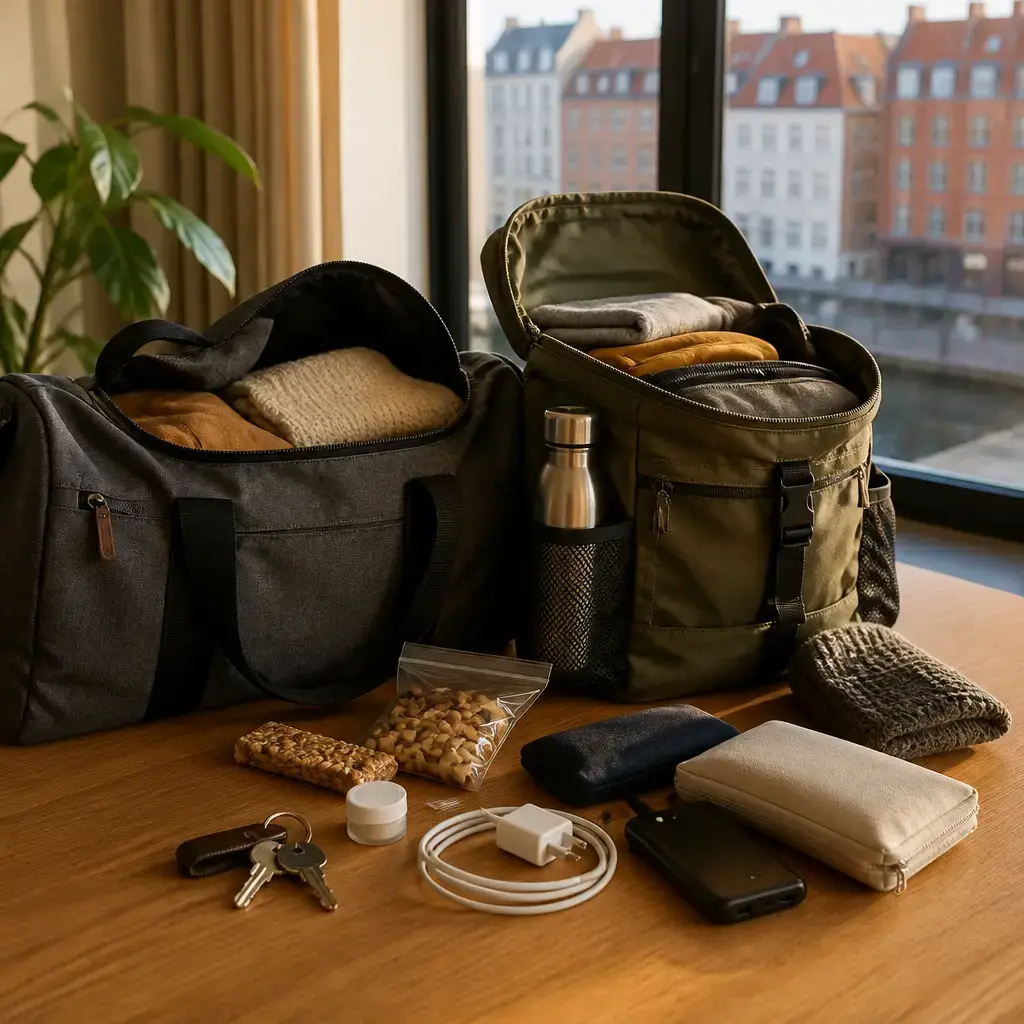
Unsere
'Unsere' means 'our' here and identifies the Reisetaschen as belonging to the speakers. It is used before the plural noun in 'Unsere Reisetaschen'. This is useful when identifying shared belongings before an activity.
Reisetaschen
'Reisetaschen' means travel bags in this dialogue. It names the bags being checked before departure and appears after 'Unsere'. The word is useful when discussing bags prepared for a journey.
müssen
'Müssen' expresses necessity here: the travel bags need to be checked. In 'müssen ... überprüft werden', it combines with the passive construction to express what has to happen. Use it when stating that an action is necessary.
vor
'Vor' means 'before' in 'vor der Abfahrt' and places the checking earlier than the departure. In this time expression, it is followed by 'der Abfahrt'. Use it to mark something that happens before an event.
der
'Der' means 'the' in 'vor der Abfahrt'. It is the article used with 'Abfahrt' in this expression after 'vor'. This form helps build the time phrase for a departure.
Abfahrt
'Abfahrt' means departure here, specifically the time before the travelers leave. It appears in 'vor der Abfahrt'. Use it when referring to the departure of a train, bus, or other journey.
noch
'Noch' contributes the sense of doing something again in 'noch einmal'. Together with 'einmal', it means 'once more'. This expression is useful when an action needs to be repeated before leaving.
einmal
'Einmal' means 'once' in the expression 'noch einmal', which means 'once more' or 'again'. Its meaning here comes from this expression rather than from a separate count. Use 'noch einmal' when asking for or describing a repeat action.
überprüft
'Überprüft' means checked in 'überprüft werden'. It names the checking action that the travel bags must undergo. Together with 'werden', it describes the bags as receiving the check rather than performing it.
werden
'Werden' helps form the passive expression 'überprüft werden', meaning that the bags are to be checked. It follows the participle 'überprüft' in this sentence. This pattern is useful when the action matters more than who performs it.
Beginne
'Beginne' tells one person informally to start. It is the opening instruction in 'Beginne mit den Sachen'. Use this form when directing someone to start with a particular group of items.
mit
'Mit' means 'with' in 'Beginne mit den Sachen' and in 'mit Ladegeräten'. It introduces the items involved in starting or dealing with something. A common pattern here is 'beginnen mit' followed by the starting point.
den
'Den' means 'the' in 'mit den Sachen'. It appears with the plural item group after 'mit'. This form is part of the phrase used to tell someone which things to start with.
Sachen
'Sachen' means things or items in 'den Sachen'. Here it refers to the journey items that are needed. Use it for a general group of physical things when their exact names are not being listed.
die
'Die' introduces the part of the sentence that describes which Sachen are meant in 'die du während der Reise brauchst'. It connects the items with the information that you need them during the journey. This pattern is useful for identifying particular things by what someone needs or does with them.
du
'Du' means informal singular 'you' in 'die du während der Reise brauchst'. It is the person who needs the items. Use it when speaking directly to one familiar person.
während
'Während' means 'during' and marks the time period in 'während der Reise'. It introduces the journey as the period when the items are needed. Use it to connect an action or need with an ongoing event or time span.
Reise
'Reise' means journey or trip in 'während der Reise'. It identifies the travel period during which the items are needed. Use it when talking about the trip itself rather than a specific departure point.
brauchst
'Brauchst' means 'need' for the person addressed as 'du' in 'die du während der Reise brauchst'. It explains why the items belong in the travel bag. Use it with the thing that someone needs, as in this relative-clause pattern.
Ich
'Ich' means 'I' and identifies the speaker who has packed or brought the items. It appears at the beginning of 'Ich habe meine Schlüssel...' and 'Ich habe sie zusammen eingepackt'. Use it to state your own possession or action.
habe
'Habe' means 'have' in 'Ich habe meine Schlüssel ... dabei', showing that the speaker has the items with them. It also works with 'eingepackt' in 'Ich habe sie zusammen eingepackt' to form a completed action. Use 'Ich habe ... dabei' to say that you are carrying something.
meine
'Meine' means 'my' and marks the keys and medications as belonging to the speaker in 'meine Schlüssel' and 'meine Medikamente'. It comes directly before the nouns it identifies. Use it when linking plural belongings to yourself.
Schlüssel
'Schlüssel' means keys here and is one of the items the speaker has with them. It appears in the list 'meine Schlüssel, meine Medikamente und eine warme Schicht'. Use it when referring to keys being carried or checked.
Medikamente
'Medikamente' means medications or medicine in the list of items the speaker has with them. It is coordinated with 'Schlüssel' and 'eine warme Schicht'. Use it for medicine prepared for a journey or another practical situation.
und
'Und' means 'and' and joins items in the lists 'meine Schlüssel, meine Medikamente und eine warme Schicht' and 'Ladegeräten und kleinen Dingen'. Use it to connect items or actions of equal importance.
eine
'Eine' means 'a' in 'eine warme Schicht'. It introduces one warm layer as an item the speaker has brought. Use it before a singular feminine noun when mentioning one unspecified item.
warme
'Warme' means 'warm' and describes the Schicht in 'eine warme Schicht'. It tells the listener that the layer is intended to provide warmth. Use it before the noun when describing a warm item of clothing.
Schicht
'Schicht' means layer here, specifically a warm clothing layer packed for the trip. The surrounding words 'eine warme Schicht' establish this clothing meaning. Use it when describing one layer worn or carried for warmth.
dabei
'Dabei' means 'with me' or 'included' in 'eine warme Schicht dabei'. It shows that the speaker has the item available as part of the travel things. A useful pattern is 'etwas dabei haben' for carrying or having something with you.
Sind
'Sind' means 'are' in the question 'Sind Snacks und Wasser leicht zu erreichen?'. Because it begins the question, it comes before the subject. Use this word order when asking whether plural items have a particular condition.
Snacks
'Snacks' means snacks and names food that the travelers may want to reach easily. It is one of the plural subjects in 'Sind Snacks und Wasser leicht zu erreichen?'. Use it when checking or discussing small foods for a journey.
Wasser
'Wasser' means water and is paired with Snacks as something that should be easy to reach. It is part of the question 'Sind Snacks und Wasser leicht zu erreichen?'. Use it when checking whether drinking water is available.
leicht
'Leicht' means easy in 'leicht zu erreichen'. It describes how easily the snacks and water can be accessed. Use it before a zu-infinitive to describe an action as easy to carry out.
zu
'Zu' marks the infinitive in 'zu erreichen' and 'zu finden'. In 'leicht zu erreichen', it helps express that the items are easy to access. This pattern is useful after an adjective such as 'leicht' when describing an action.
erreichen
'Erreichen' means reach or access in 'leicht zu erreichen'. It refers to getting to the snacks and water without difficulty. Use it with the object that someone can reach.
Sie
'Sie' means 'they' in 'Sie sind in der Seitentasche', referring to the snacks and water. Its capital letter is due to its position at the beginning of the sentence, not because it means formal 'you' here. Use it to refer back to plural items already mentioned.
in
'In' means 'in' and places the snacks and water inside the side pocket in 'in der Seitentasche'. It introduces the location of the items. Use it when saying where something is contained or located.
Seitentasche
'Seitentasche' means side pocket. It identifies the specific pocket where the snacks and water are stored. Use it when describing the location of an item in a bag.
Wie
'Wie' means 'how' at the beginning of 'Wie sieht es mit Ladegeräten und kleinen Dingen für mehr Komfort aus?'. It is part of the question expression that asks about the status or provision of something. Use this expression when asking what the situation is with a particular item or matter.
sieht
'Sieht' contributes the meaning of 'looks' within 'Wie sieht es mit Ladegeräten und kleinen Dingen für mehr Komfort aus?'. In this expression, the question is about how the situation stands, not about literal visual appearance. Use it as part of 'Wie sieht es mit ... aus?' when asking about an item or issue.
es
'Es' is the pronoun used in 'Wie sieht es mit Ladegeräten und kleinen Dingen für mehr Komfort aus?'. Together with the other words, it forms a question about the situation concerning chargers and comfort items. Use it as part of this fixed question pattern rather than translating it separately.
Ladegeräten
'Ladegeräten' means chargers in 'mit Ladegeräten'. It names the chargers being checked as part of the travel equipment. The phrase 'mit Ladegeräten' is useful when discussing what someone has packed or included.
kleinen
'Kleinen' means small and describes the Dinge in 'kleinen Dingen'. It limits the reference to small comfort-related items. Use it before the noun when describing such items in this phrase.
Dingen
'Dingen' means things or items in 'kleinen Dingen für mehr Komfort'. Here it refers to small items intended to make the journey more comfortable. Use it for unspecified practical objects when their purpose is described instead of their exact names.
für
'Für' means 'for' in 'Dingen für mehr Komfort'. It introduces the purpose of the items: providing more comfort. Use it to connect an object with the person, purpose, or result it is intended for.
mehr
'Mehr' means 'more' in 'mehr Komfort'. It indicates an increased amount of comfort provided by the small items. Use it before a noun when referring to an additional or greater amount.
Komfort
'Komfort' means comfort in 'für mehr Komfort'. It states the purpose of the small items packed for the trip. Use it when describing practical additions that make travel or another situation more comfortable.
aus
'Aus' completes the separable verb expression in 'Wie sieht es mit Ladegeräten und kleinen Dingen für mehr Komfort aus?'. Together, the expression asks about the status or availability of the chargers and comfort items. Use the full question pattern when checking what the situation is with something.
zusammen
'Zusammen' means together in 'sie zusammen eingepackt'. It says that the chargers and comfort items were packed in one group. Use it when describing items that are kept or handled as a group.
eingepackt
'Eingepackt' means packed in 'Ich habe sie zusammen eingepackt'. It describes the completed action of putting the items into the bag. With 'habe', it forms a past statement about what the speaker has packed.
damit
'Damit' means 'so that' and introduces the purpose in 'damit sie leicht zu finden sind'. It connects packing the items together with making them easy to find. Use it to introduce a subordinate clause explaining the intended result of an action.
finden
'Finden' means find in 'leicht zu finden'. It refers to locating the chargers and comfort items in the bag. Use it after 'zu' in this pattern when describing how easy it is to locate something.
Das
'Das' means 'that' in 'Das sollte die Reise entspannter machen'. It refers to the preceding arrangement of packing the items together. Use it to point back to an action or situation just mentioned.
sollte
'Sollte' expresses an expectation or likely result in 'Das sollte die Reise entspannter machen'. It presents the calmer trip as something this arrangement is expected to help achieve. Use it when giving a mild prediction about what an action should accomplish.
entspannter
'Entspannter' means more relaxed or calmer in 'die Reise entspannter machen'. It describes the expected effect on the trip if plans change. Use it after 'machen' to describe a change in how something feels or proceeds.
machen
'Machen' means make in 'die Reise entspannter machen'. It connects the arrangement with its expected effect on the trip. A useful pattern is 'etwas ... machen', followed by a description of the resulting condition.
falls
'Falls' means 'if' or 'in case' and introduces the possible condition 'falls sich die Pläne ändern'. It presents changing plans as a situation in which the arrangement would help. Use it to introduce a possible condition rather than a certain event.
sich
'Sich' is the reflexive pronoun used with 'ändern' in 'sich die Pläne ändern'. Together, 'sich ändern' means that the plans change. Use this pronoun as part of that construction when referring to plans or circumstances changing.
Pläne
'Pläne' means plans in 'falls sich die Pläne ändern'. It refers to the travel arrangements that might change. Use it when discussing intended activities or arrangements that may be revised.
ändern
'Ändern' means change in 'sich die Pläne ändern'. With 'sich', the expression says that the plans change. Use this construction when a plan or situation becomes different from what was expected.
außerdem
'Außerdem' means also or in addition in 'Ich habe außerdem noch etwas Platz gelassen'. It adds another preparation to the points already mentioned. Use it to introduce an additional fact or action.
etwas
'Etwas' means some or a certain amount in 'etwas Platz'. It indicates that the speaker has left an unspecified amount of space. Use it before an uncounted amount when the exact quantity is not important.
Platz
'Platz' means space or room in 'etwas Platz ... gelassen'. It refers to empty room in the travel bags for additional items. Use it when discussing available room in a bag, container, or other place.
alles
'Alles' means everything in 'für alles, was wir unterwegs mitnehmen'. It refers broadly to any items covered by the following description. Use it before 'was' when referring to all things that meet a condition.
gelassen
'Gelassen' means left available or kept open in 'noch etwas Platz ... gelassen'. It says that the speaker deliberately did not fill all the space. With 'habe', it describes a completed preparation.
was
'Was' means 'what' or 'that which' in 'alles, was wir unterwegs mitnehmen'. It introduces the clause describing which things are included in 'alles'. Use it after a broad reference such as 'alles' to specify the things meant.
wir
'Wir' means 'we' in 'was wir unterwegs mitnehmen'. It identifies the speakers as the people who may take items along during the journey. Use it when describing an action done by the speaker together with another person.
unterwegs
'Unterwegs' means on the way or during the journey in 'was wir unterwegs mitnehmen'. It places the action of taking items along somewhere during travel. Use it when referring to a situation while traveling from one place to another.
mitnehmen
'Mitnehmen' means take along in 'was wir unterwegs mitnehmen'. It describes carrying or picking up something for the journey. Use it with the object being taken along, especially when the item will accompany someone to another place.
Dann
'Dann' means then in 'Dann sollten wir am Bahnhof losgehen können'. It marks the conclusion that follows from the preparations. Use it to introduce the next action or result in a sequence.
sollten
'Sollten' expresses an expectation in 'Dann sollten wir ... losgehen können'. With the subject 'wir', it says that the speakers are expected to be able to set off. Use it when stating what should be possible under the circumstances.
am
'Am' means 'at the' in 'am Bahnhof'. It is the contracted form used in this location phrase. Use it before a place when saying that an action happens at the station.
Bahnhof
'Bahnhof' means station, specifically the place where the speakers will set off. It appears in the location phrase 'am Bahnhof'. Use it when referring to a train station as a meeting or departure point.
losgehen
'Losgehen' means leave or set off in 'am Bahnhof losgehen können'. It describes beginning the journey from the station. After 'können', it stays in the infinitive and names the action that will be possible.
können
'Können' means can or be able to in 'losgehen können'. It expresses that setting off will be possible. Use it with an infinitive to state that someone is able to perform an action.
ohne
'Ohne' means 'without' in 'ohne noch einmal umzupacken'. It introduces an action that will not be necessary before leaving. Use it with the following infinitive construction to describe leaving without another action.
umzupacken
'Umzupacken' means to repack in 'ohne noch einmal umzupacken'. It describes putting the travel items into the bags again. The form is used after 'ohne' and preserves the separable verb structure of repacking.