Die
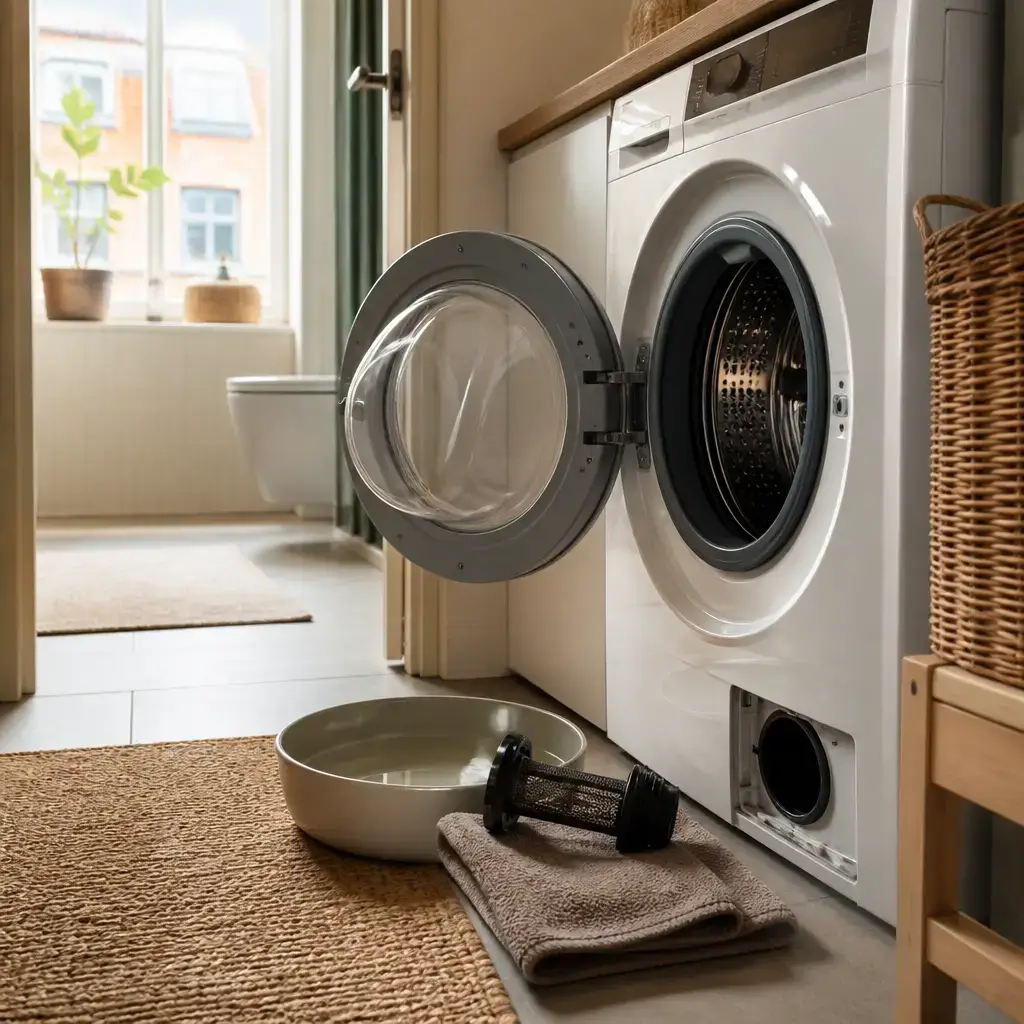
„Die“ means “the” in „Die Waschmaschine“ and identifies a specific washing machine. In German, this article agrees with the noun it accompanies.
Waschmaschine
„Waschmaschine“ means “washing machine,” the appliance being discussed. It is a useful compound noun for talking about washing, cleaning, or checking this appliance.
ist
„Ist“ means “is” and works with „stehen geblieben“ to say that the machine has stopped. It is the helping verb in this past construction.
mitten
„Mitten“ means “in the middle” in „mitten im Waschgang.“ The pattern „mitten im ...“ places an event in the middle of an activity or period.
im
„Im“ means “in the” in „im Waschgang“ and is the contracted form of „in dem.“ It describes something happening during or within a specific process.
Waschgang
„Waschgang“ means “wash cycle,” the cycle in which the machine stopped. The pattern „im Waschgang“ refers to something happening during that cycle.
stehen
In „stehen geblieben,“ „stehen“ contributes the idea of standing or remaining in place, while the whole expression means “stopped.” This expression is useful for saying that a machine or process has stopped.
geblieben
In „stehen geblieben,“ „geblieben“ contributes the meaning “remained,” and the whole expression says that the machine stopped. It appears with „ist“ in this past construction.
Gibt
„Gibt“ means “is there” in the existential question „Gibt es eine Warnung ...?“ Together with „es,“ it asks whether something exists or is present.
es
„Es“ is the placeholder in „Gibt es ...?“ and does not refer to a particular object by itself. The whole pattern „Gibt es ...?“ asks whether something is present.
eine
„Eine“ means “a” or “an” before „Warnung“ in „eine Warnung.“ It introduces one unspecified warning in the question.
Warnung
„Warnung“ means “warning,” here a message shown by the machine. The phrase „eine Warnung auf dem Display“ identifies what may be visible on the screen.
auf
„Auf“ means “on” in „auf dem Display,“ describing the warning’s location. The pattern „auf dem ...“ can identify information shown on a surface or device.
dem
„Dem“ means “the” in „auf dem Display“ and belongs with the masculine noun „Display.“ Together with „auf,“ it forms the phrase meaning “on the display.”
Display
„Display“ means “display” or “screen,” where the warning appears. „Auf dem Display“ is a useful phrase for referring to information shown by a device.
Dort
„Dort“ means “there” and points to the display or the place where the information is shown. In „Dort steht ...,“ it introduces written information that can be read there.
steht
„Steht“ means “says” or “is written” in „Dort steht, dass ...“ It is used here to report information displayed in writing rather than someone speaking it.
dass
„Dass“ means “that” and introduces the content of what is written: „dass der Filter ... sein könnte.“ In the clause after „dass,“ the conjugated verb comes at the end.
der
„Der“ means “the” before „Filter“ in „der Filter.“ It identifies the specific filter as the subject of the possibility being reported.
Filter
„Filter“ means “filter,” the part that may be blocked. It is used here as the subject in „der Filter verstopft sein könnte.“
verstopft
„Verstopft“ means “blocked” or “clogged” and describes the possible condition of the filter. With „sein,“ it forms the description „verstopft sein.“
sein
„Sein“ means “be” in „verstopft sein könnte,“ describing a possible condition of the filter. It remains in the infinitive before the modal form „könnte.“
könnte
„Könnte“ expresses possibility in „verstopft sein könnte,“ meaning that the filter might be blocked. This form is useful when reporting a possible explanation without stating it as certain.
Schau
„Schau“ means “look” or “check” in the informal instruction „Schau in die Anleitung.“ It is a direct instruction to one person.
in
„In“ means “into” in „in die Anleitung schauen,“ directing attention to the manual. This pattern is used when checking information in a document or guide.
Anleitung
„Anleitung“ means “manual” or “instructions,” the document used to troubleshoot the machine. The phrase „in die Anleitung schauen“ means to check the manual.
bevor
„Bevor“ means “before” and introduces the action that should happen later: „bevor du irgendwelche Tasten drückst.“ It connects the instruction to a prior safety step.
du
„Du“ means informal singular “you” and is the subject of „drückst.“ It addresses one person directly in the conversation.
irgendwelche
„Irgendwelche“ means “any” or “random” in „irgendwelche Tasten.“ It shows that the buttons should not be pressed indiscriminately.
Tasten
„Tasten“ means “buttons” or “keys,” specifically the controls that someone might press. In „irgendwelche Tasten drücken,“ it is the object of the action.
drückst
„Drückst“ means “press” in „du irgendwelche Tasten drückst.“ It describes pressing buttons, and it appears at the end of the clause introduced by „bevor.“
ich
„Ich“ means “I” and identifies the speaker as the person who should clean the filter. In „dass ich ... reinigen soll,“ it is the subject of the reported instruction.
den
„Den“ means “the” before „Filter“ in „den Filter reinigen.“ It identifies the specific filter as the object being cleaned.
vorsichtig
„Vorsichtig“ means “carefully” or “cautiously” and describes how the filter should be cleaned. It is placed before „reinigen“ to describe the manner of that action.
reinigen
„Reinigen“ means “clean” in „den Filter vorsichtig reinigen.“ It is the infinitive used after „soll“ to state the recommended action.
soll
„Soll“ means “should” or “is supposed to” in „ich ... reinigen soll.“ It presents the manual’s instruction or recommendation, with the infinitive at the end of the clause.
Zieh
„Zieh“ means “unplug” in the expression „Zieh den Stecker der Maschine.“ The whole expression gives a direct safety instruction before touching the machine.
dann
„Dann“ means “then” and marks the next step after cleaning or checking the manual. It helps organize the troubleshooting instructions in sequence.
Stecker
„Stecker“ means “plug” in „den Stecker der Maschine.“ With „ziehen,“ the phrase refers to unplugging the machine.
Maschine
„Maschine“ means “machine” in „der Stecker der Maschine,“ identifying which machine the plug belongs to. In this dialogue, it refers to the washing machine.
berührst
„Berührst“ means “touch” in „bevor du irgendetwas berührst.“ It describes the action that must wait until the machine has been unplugged.
danach
„Danach“ means “after that” and refers to the safety step just mentioned. It introduces the next question about restarting the wash cycle.
neu
„Neu“ means “anew” in „den Waschgang neu starten,“ so the cycle is started again. The pattern „neu starten“ is used for restarting a process or device.
starten
„Starten“ means “start” in „den Waschgang neu starten.“ With „neu,“ it means to restart the cycle and appears as an infinitive after „soll.“
Starte
„Starte“ means “start” or “restart” in the instruction „Starte ihn einmal neu.“ The complete separable pattern „neu starten“ places „neu“ at the end here.
ihn
„Ihn“ means “it” and refers back to „den Waschgang.“ It is the object of „Starte“ in the instruction to restart the cycle.
einmal
„Einmal“ means “once” in „Starte ihn einmal neu.“ It limits the instruction to one restart attempt.
aber
„Aber“ means “but” and contrasts the single restart with the instruction to contact maintenance if the warning returns. It links the two parts of the advice.
wende
„Wende“ means “turn” literally, but in „wende dich an den Wartungsdienst“ the whole expression means “contact the maintenance service.” It is a direct instruction to seek help from a service.
dich
„Dich“ is the reflexive object in „wende dich an den Wartungsdienst.“ Together with „wende ... an,“ it forms the expression for turning to or contacting someone.
an
„An“ contributes “to” in „wende dich an den Wartungsdienst.“ The pattern „sich an jemanden oder einen Dienst wenden“ means to contact or turn to that person or service.
Wartungsdienst
„Wartungsdienst“ means “maintenance service,” the service to contact if the warning appears again. It is the destination in „wende dich an den Wartungsdienst.“
wenn
„Wenn“ means “if” in „wenn die Warnung wieder erscheint.“ It introduces the condition under which maintenance should be contacted.
wieder
„Wieder“ means “again” in „wieder erscheint,“ indicating that the warning appears another time. It is useful for describing a problem that returns.
erscheint
„Erscheint“ means “appears” in „die Warnung wieder erscheint.“ It describes the warning becoming visible again, and it comes at the end of the clause after „wenn.“
werde
„Werde“ means “will” in „Ich werde ... befolgen“ and introduces the speaker’s future action. The infinitive „befolgen“ follows at the end of the main clause.
zuerst
„Zuerst“ means “first” and says that the safe steps will be followed before any further action. It is useful for putting procedures in order.
sicheren
„Sicheren“ means “safe” in „die sicheren Schritte“ and describes the steps the speaker intends to follow. Its ending matches the noun phrase „die ... Schritte“.
Schritte
„Schritte“ means “steps,” referring to the individual actions in the safe procedure. The phrase „sichere Schritte befolgen“ means to follow safe steps.
befolgen
„Befolgen“ means “follow” in „die sicheren Schritte befolgen.“ It is the infinitive after „werde“ and takes the steps as its object.
einfache
„Einfache“ means “simple” in „eine einfache Fehlersuche“ and describes the troubleshooting as uncomplicated. It appears directly before the noun it describes.
Fehlersuche
„Fehlersuche“ means “troubleshooting,” the process of looking for the cause of a problem. Here it refers to checking the manual, cleaning the filter, and restarting safely.
nützlich
„Nützlich“ means “useful” and evaluates simple troubleshooting positively. It is used after „ist“ to describe the value of „eine einfache Fehlersuche.“
riskiere
„Riskiere“ means “risk” in the warning „riskiere nicht, die Maschine zu beschädigen.“ The pattern „etwas riskieren, zu ...“ describes the possible harmful result that should be avoided.
nicht
„Nicht“ means “not” and negates the instruction „riskiere nicht.“ It tells the listener not to accept the risk of damaging the machine.
zu
„Zu“ marks the infinitive in „die Maschine zu beschädigen.“ Together with „riskiere nicht,“ it introduces the action whose harmful result must be avoided.
beschädigen
„Beschädigen“ means “damage” in „die Maschine zu beschädigen.“ It names the possible harmful action in the warning not to risk damaging the machine.