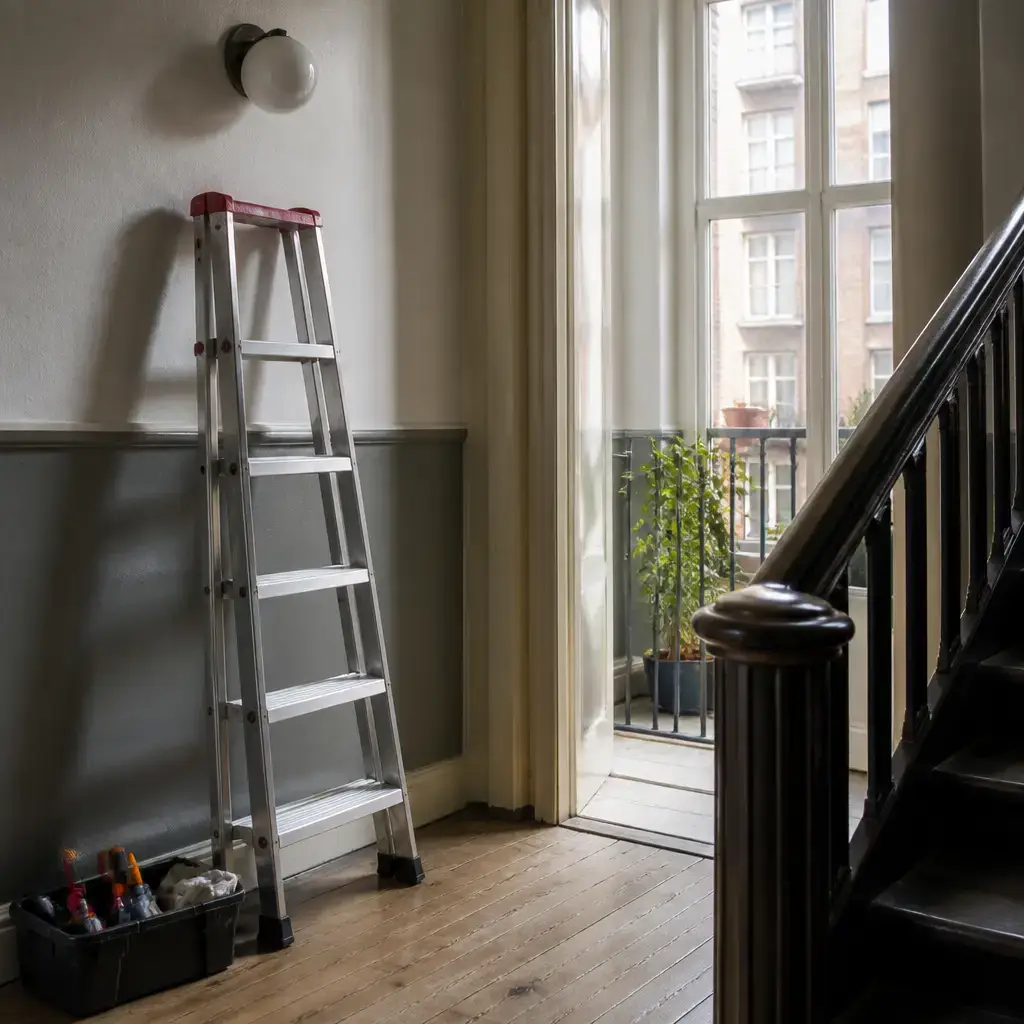
Kann
"Kann" asks whether the speaker is allowed or able to use the ladder. It is the sentence-initial form of "kann" in the question "Kann ich deine Leiter benutzen...?" Use it at the beginning of a question about permission or ability.
ich
"ich" refers to the person speaking: "I". Here it is the person who wants to use the ladder, and it comes directly after the modal verb in "Kann ich...?" Use it when describing your own action, need, or ability.
deine
"deine" means "your" and identifies the ladder as belonging to the person being addressed. It appears before "Leiter" in "deine Leiter". Use this form before a feminine noun in a phrase such as "deine Tür".
Leiter
"Leiter" means "ladder" here, the object being borrowed and used to change the ceiling light. It appears with the possessive "deine" in "deine Leiter". Use it when talking about climbing equipment of this kind.
benutzen
"benutzen" means "use" in "deine Leiter benutzen". It stays in this form after the modal verb "Kann". Use it with an object when saying that you will use a tool, device, or other item.
um
"um" introduces the purpose in "um eine Deckenlampe zu wechseln": the speaker wants to use the ladder in order to change the ceiling light. The complete purpose construction includes "um" and the later "zu" with the infinitive. Use it to explain why an action is being done.
eine
"eine" means "a" before "Deckenlampe" in "eine Deckenlampe". It introduces one unspecified ceiling light as the object of the planned change. Use it before a feminine noun when introducing one such item.
Deckenlampe
"Deckenlampe" means "ceiling light", the light that the speaker wants to change. It is a compound noun used in "eine Deckenlampe". Use it when referring to a light attached to a ceiling.
zu
"zu" marks the infinitive in the purpose construction "um eine Deckenlampe zu wechseln". Together with "um", it connects the purpose to the main action "benutzen". Use this pattern when stating the purpose of an action.
wechseln
"wechseln" means "change" or "replace" in "eine Deckenlampe zu wechseln". Here it refers to replacing the ceiling light, not simply moving it. Use it with an object when changing one item for another or installing a replacement.
Du
"Du" means "you" and refers to the person who wants to use the ladder. It is capitalized here because it begins the sentence "Du kannst sie benutzen". Use it when addressing one person informally.
kannst
"kannst" means "can" or "are allowed to" in "Du kannst sie benutzen". Here it gives permission to use the ladder. Use it with "du" to express one person’s ability or permission.
sie
"sie" refers to the ladder in "sie benutzen" and means "it" in this context. It is used because "Leiter" is referred to again instead of repeating the noun. Use it to refer back to a previously mentioned feminine item.
aber
"aber" means "but" and introduces a condition or warning that limits the permission just given. In "aber lass währenddessen...", it connects permission with the safety instruction. Use it to contrast an earlier statement with an additional point.
lass
"lass" gives the instruction "have someone stay" in "lass ... jemanden ... bleiben". The speaker is asking the other person to arrange for someone to remain nearby. Use it when telling someone to let or have another person do something.
währenddessen
"währenddessen" means "during that time" or "in the meantime". Here it refers to the period while the ladder is being used: "währenddessen jemanden in der Nähe bleiben". Use it to connect an action with another action happening at the same time.
jemanden
"jemanden" means "someone" as the person who should stay nearby. In "jemanden in der Nähe bleiben" it identifies the person involved in the instruction. Use it when the particular person is not specified.
in
"in" helps form the location expression "in der Nähe", meaning nearby. It places someone within the surrounding area rather than at a specific point. Use it in location phrases when describing where a person or thing remains.
der
"der" is the article used in the location expression "in der Nähe". Together, "in der Nähe" means that someone is nearby. Use the complete expression when asking or saying that a person should remain close.
Nähe
"Nähe" means "vicinity" or "nearby area" in "in der Nähe". The phrase says that someone should stay close enough to help with the ladder. Use it with "in der" to describe proximity.
bleiben
"bleiben" means "stay" or "remain" in "jemanden in der Nähe bleiben". It describes remaining in the nearby area while the ladder is in use. Use it when a person or thing continues to be in a place.
Mein
"Mein" means "my" and identifies the brother as belonging to or being related to the speaker. It appears before "Bruder" in "Mein Bruder". Use it before a masculine noun when referring to something or someone connected with you.
Bruder
"Bruder" means "brother". In "Mein Bruder" it is the person who can hold the bottom of the ladder. Use it when referring to a male sibling.
das
"das" means "the" in "das untere Ende". It introduces the specific lower end of the ladder that the brother will hold. Use it before a neuter noun when referring to a particular thing.
untere
"untere" means "lower" or "bottom" in "das untere Ende". It specifies which end of the ladder is meant. Use it before a noun when identifying the lower part of something.
Ende
"Ende" means "end" in "das untere Ende". Here it refers to the bottom end of the ladder, not to the end of an activity. Use it with a modifier when identifying one end or part of an object.
festhalten
"festhalten" means "hold firmly" in "das untere Ende festhalten". The brother is expected to grip the bottom so that the ladder remains stable. Use it with an object when someone needs to keep holding it securely.
damit
"damit" introduces the intended result in "damit die Leiter stabil bleibt": the brother holds the ladder so that it stays stable. The clause after "damit" explains the purpose or desired result of the previous action. Use it to connect an action with its intended outcome.
stabil
"stabil" means "stable" or "steady" in "die Leiter stabil bleibt". It describes the ladder’s desired condition while the brother holds it. Use it to describe something that does not wobble or easily move.
bleibt
"bleibt" means "stays" or "remains" in "die Leiter stabil bleibt". It says that the ladder continues to be stable. Use it when describing a condition that continues over time.
sollte
"sollte" expresses an expectation in "Das sollte helfen": the speaker thinks the proposed support will probably help. It gives a cautious assessment rather than a definite guarantee. Use it when saying that something is expected or recommended to have a result.
helfen
"helfen" means "help" in "Das sollte helfen". It refers to the brother holding the ladder and the expected safety benefit of that action. Use it when saying that a person or action contributes to solving a problem.
Die
"Die" means "the" in "Die Leiter" and introduces the specific ladder already being discussed. It is capitalized because it begins the sentence. Use it before a feminine noun when referring to a particular item.
ist
"ist" means "is" in "Die Leiter ist stabil". It links the ladder with the description "stabil". Use it to state a current condition or description.
musst
"musst" means "must" or "need to" in "du musst ... sein". It expresses the safety requirement that the person needs to be careful. Use it with "du" to state an obligation or necessity.
trotzdem
"trotzdem" means "still" or "nevertheless". Here it emphasizes that care is necessary even though the ladder is stable. Use it when an action or conclusion remains valid despite a previous fact.
vorsichtig
"vorsichtig" means "careful" in "vorsichtig sein". It describes the safe manner required while using the ladder. Use it with "sein" to describe a person’s careful behavior.
sein
"sein" means "be" in "vorsichtig sein". It remains in the infinitive after "musst" and completes the instruction to be careful. Use it with an adjective to describe a required condition or behavior.
brauche
"brauche" means "need" in "Ich brauche sie". The speaker says that the ladder is needed only for a limited period. Use it with an object when explaining that you require something.
nur
"nur" means "only" and limits the need in "nur für kurze Zeit". It shows that the ladder will not be needed for long. Use it to restrict the amount, duration, or extent of something.
für
"für" means "for" in the duration phrase "für kurze Zeit". It introduces the period during which the ladder is needed. Use it before a time expression to state how long something is intended or needed.
kurze
"kurze" means "short" in "für kurze Zeit". It describes the limited duration of the speaker’s need. Use it before a noun when describing a brief period.
Zeit
"Zeit" means "time" in "für kurze Zeit". Here it refers to a short period, not to a particular clock time. Use it with a duration phrase when saying how long something will last.
und
"und" means "and". Here it joins the statement about needing the ladder for a short time with the promise to be careful. Use it to connect two related statements or actions.
werde
"werde" helps form the future statement "ich werde vorsichtig sein": "I will be careful". It is followed by the infinitive phrase "vorsichtig sein". Use this pattern to state a future intention or commitment.
Nimm
"Nimm" means "take" in the instruction "Nimm dir die Zeit, die du brauchst". Here it encourages the listener to allow enough time for the task. Use it when telling one person informally to take or allow something.
dir
"dir" means "for yourself" or "to you" in "Nimm dir die Zeit". It shows that the listener is allowing the time for their own task. Use it in the pattern "sich die Zeit nehmen" when encouraging someone not to hurry.
brauchst
"brauchst" means "need" in the clause "die du brauchst". It describes the amount of time the listener needs. Use it after "du" when saying what one person requires.
Benutze
"Benutze" means "use" in the instruction "Benutze sie draußen nicht". The speaker tells the listener not to use the ladder outside under the stated condition. Use it as an informal instruction to one person about using an object.
draußen
"draußen" means "outside" in "sie draußen benutzen". It specifies the outdoor location where using the ladder should be avoided when the ground is wet. Use it to describe being or doing something outdoors.
nicht
"nicht" makes the instruction negative in "Benutze sie draußen nicht". It tells the listener not to use the ladder outside when the condition applies. Use it to negate an action or statement.
wenn
"wenn" means "if" in "wenn der Boden nass ist". It introduces the condition under which the ladder should not be used outside. Use it to state a condition that affects what happens.
Boden
"Boden" means "ground" in this outdoor safety context: "der Boden". The sentence refers to the surface on which the ladder would stand. Use it for the ground outside or, in another context, a floor inside.
nass
"nass" means "wet" in "der Boden nass ist". It describes the ground as a condition that could make outdoor ladder use unsafe. Use it to describe something containing or covered with water.
drinnen
"drinnen" means "indoors" in "sie drinnen benutzen". The speaker says the ladder will be used inside, where the outdoor wet-ground warning does not apply. Use it to specify that something is inside a building or enclosed space.
zurückbringen
"zurückbringen" means "bring back" or "return" in "sie ... zurückbringen". The speaker promises to return the ladder after finishing the task. Use it with an object when taking it back to its owner or previous place.
fertig
"fertig" means "finished" or "done" in "wenn ich fertig bin". It refers to the speaker being finished with the ladder-related task. Use it with "sein" to say that a person has completed an activity.
bin
"bin" means "am" in "wenn ich fertig bin". Together with "fertig", it says that the speaker is finished. Use it with an adjective or expression to describe your current state.
zu Hause
"zu Hause" means "at home" as a fixed expression in "Wenn ich nicht zu Hause bin". The components "zu" and "Hause" work together to express being at home, while "nicht" says that the person is absent. Use it when describing whether someone is at home.
stell
"stell" means "put" or "place" in the instruction "stell sie neben meine Tür". It tells the listener to place the ladder beside the speaker’s door. Use it for an informal instruction about placing something somewhere.
neben
"neben" means "beside" or "next to" in "neben meine Tür". It specifies the place where the ladder should be put. Use it before a location or object when describing a position next to it.
meine
"meine" means "my" in "meine Tür". It identifies the door as belonging to the person speaking. Use it before a feminine noun when referring to something connected with you.
Tür
"Tür" means "door" in "neben meine Tür". It identifies the precise place where the ladder may be left. Use it when referring to a door or doorway.
Okay
"Okay" expresses agreement or acceptance. Here the speaker accepts the instruction about leaving the ladder beside the door. Use it to acknowledge an arrangement or show that you understand and agree.
stelle
"stelle" means "put" or "place" in "ich stelle sie neben deine Tür". The speaker promises to place the ladder beside the other person’s door if they are away. Use it with an object and a location when describing where you will place something.
da
"da" means "there" or "present" in "wenn du nicht da bist". Here it means that the other person is not present at the relevant place. Use it in expressions about whether someone is present or available.
bist
"bist" means "are" in "wenn du nicht da bist". Together with "da", it describes whether the person being addressed is present. Use it with "du" to describe that person’s current state or location.
Achte
"Achte" means "pay attention" or "focus" in the instruction "Achte auf Sicherheit". The speaker tells the listener to make safety the priority. Use it in the pattern "auf etwas achten" when directing attention to something.
auf
"auf" completes the expression "auf Sicherheit achten", meaning to pay attention to safety. It connects the verb "achten" with the thing receiving attention. Use the pattern "auf etwas achten" for focusing on or being mindful of something.
Sicherheit
"Sicherheit" means "safety" in "Achte auf Sicherheit". It is the priority the listener should keep in mind while using the ladder. Use it when discussing avoiding danger or keeping an activity safe.
auch
"auch" means "even" in the expression "auch wenn es länger dauert". It emphasizes that safety remains important under the possible condition that the task takes longer. Use it in "auch wenn" to express that something remains true despite a condition.
es
"es" is the subject in "es länger dauert" and refers to the task or situation taking longer. It does not name a specific object here. Use it in expressions describing how long an activity or situation lasts.
länger
"länger" means "longer" in "es länger dauert". It says that the task may take more time than expected. Use it to compare a duration with an earlier or expected duration.
dauert
"dauert" means "takes" or "lasts" in "es länger dauert". It describes the duration of the task. Use it when saying how long an activity or situation continues.