Wir
Here, 'Wir' means “we” and is the subject of 'Wir haben den Gemeinschaftsraum eine Weile benutzt.' It includes the speaker and at least one other person; a common reuse pattern is 'Wir können ...' when suggesting a shared action. You use it when speaking for yourself and others.
haben
Here, 'haben' is the auxiliary in 'Wir haben den Gemeinschaftsraum eine Weile benutzt.' Together with 'benutzt', it reports a completed use of the room. A common reuse pattern is 'Wir haben' followed by a past participle when describing something the group has done.
den
Here, 'den' means “the” in 'den Gemeinschaftsraum', the room being used. It marks this masculine noun as the direct object of 'benutzt'. A common reuse pattern is 'den' before a masculine noun that receives an action.
Gemeinschaftsraum
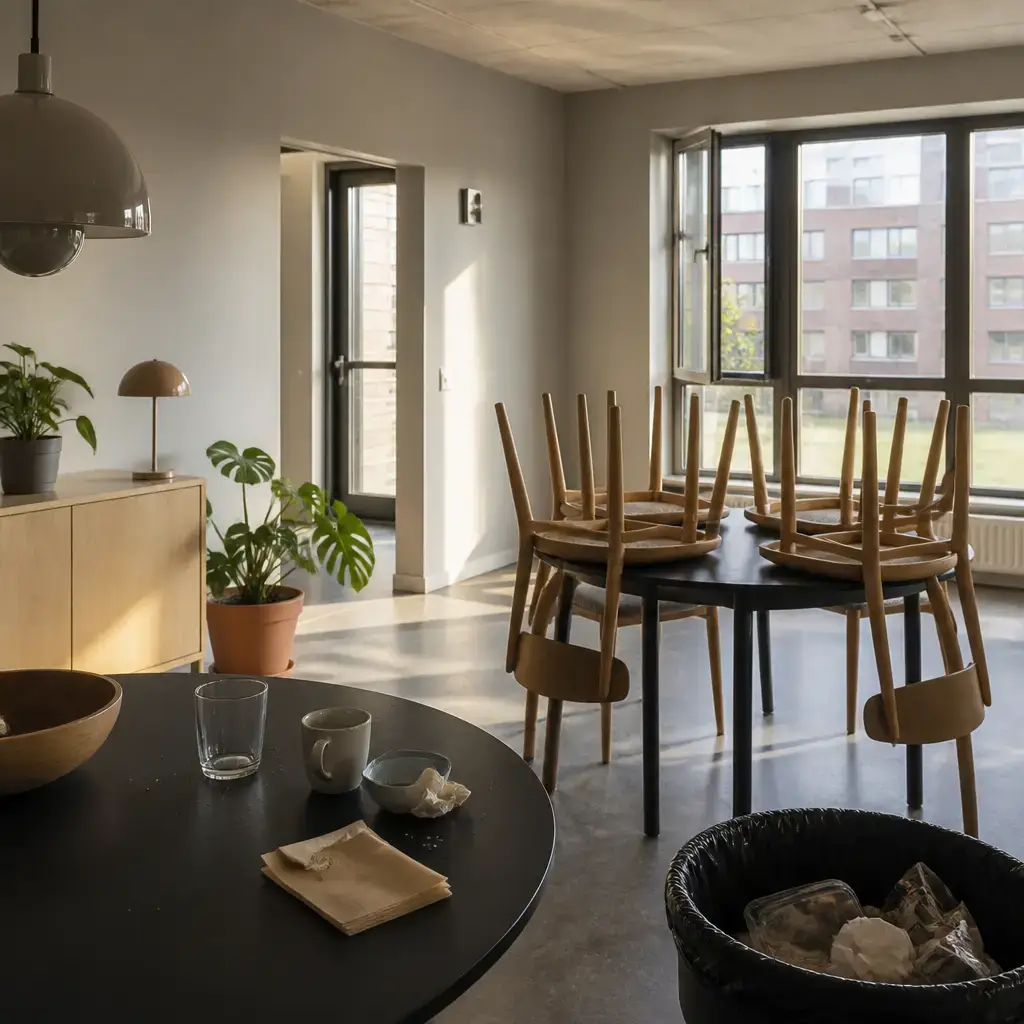
Here, 'Gemeinschaftsraum' means “common room”, the shared room that the speakers used and cleaned. It is the object in 'den Gemeinschaftsraum ... benutzt' and is later referred to by 'ihn'. You use it when talking about a room shared by several people.
eine
Here, 'eine' means “a” in the time expression 'eine Weile'. Together with 'Weile', it describes an unspecified period rather than a precise length of time. A common reuse pattern is 'eine' before a feminine noun.
Weile
Here, 'Weile' means “while” or “period of time” in 'eine Weile'. The expression 'eine Weile' tells us that the speakers used the room for some time. You can reuse this expression when describing an activity that lasted for an unspecified period.
benutzt
Here, 'benutzt' means “used” in 'Wir haben den Gemeinschaftsraum eine Weile benutzt.' It is the form used with 'haben' to report the completed action. A common reuse pattern is 'etwas benutzen' for using an object, place, or service.
Lass
Here, 'Lass' begins the suggestion 'Lass uns ihn aufräumen'. It invites the other person to do the following action together with the speaker. The reusable pattern is 'Lass uns' followed by an infinitive when proposing a joint activity.
uns
Here, 'uns' means “us” in 'Lass uns ihn aufräumen', referring to the speaker and the other person together. It completes the suggestion pattern 'Lass uns ...'. You use this form when inviting a group that includes yourself to do something.
ihn
Here, 'ihn' means “it” in 'Lass uns ihn aufräumen' and refers back to the masculine noun 'Gemeinschaftsraum'. It is the object of 'aufräumen'. A common reuse pattern is a masculine object pronoun before the verb, as in 'Ich sehe ihn'.
aufräumen
Here, 'aufräumen' means “to clean up” or “to tidy” the common room in 'Lass uns ihn aufräumen'. It appears as an infinitive after 'Lass uns'. A common reuse pattern is 'etwas aufräumen' when restoring order to a place or collection of things.
bevor
Here, 'bevor' means “before” and introduces the time clause 'bevor wir gehen'. It shows that cleaning up should happen before the speakers leave. A common pattern is 'bevor' followed by a clause whose verb comes at the end.
gehen
Here, 'gehen' means “to go” or, in this context, “to leave” in 'bevor wir gehen'. It is the infinitive used after 'wir' in the time clause. You use it when referring to leaving a place, especially in a phrase about what happens before departure.
Ich
Here, 'Ich' means “I” and is the subject of 'Ich stelle die Stühle wieder an ihren Platz.' It identifies the speaker as the person taking responsibility for the chairs. A common reuse pattern is 'Ich' followed by a verb to state what the speaker will do.
stelle
Here, 'stelle' means “put” or “place” in 'Ich stelle die Stühle wieder an ihren Platz.' It is the form used with 'Ich' to describe placing the chairs in their intended location. A common pattern is 'Ich stelle' followed by an object and its destination.
die
Here, 'die' means “the” in 'die Stühle' and refers to the chairs as a plural group. It introduces the object that the speaker will place back. A common reuse pattern is 'die' before a plural noun.
Stühle
Here, 'Stühle' means “chairs” in 'Ich stelle die Stühle wieder an ihren Platz.' The chairs are the objects being returned to their place. You use this word when talking about several chairs in a room or other shared space.
wieder
Here, 'wieder' means “back” in 'die Stühle wieder an ihren Platz' and shows that the chairs are being returned to where they belong. It emphasizes restoration of the earlier arrangement. A common reuse pattern is 'wieder' with a verb when something happens again or returns to a previous state.
an
Here, 'an' helps express the destination in 'an ihren Platz', meaning that the chairs are placed at their place. It forms the reusable pattern 'etwas an seinen Platz stellen' for putting something where it belongs. You use it when describing placement at a particular location.
ihren
Here, 'ihren' means “their” in 'ihren Platz' and links the place to the chairs being returned. Together, 'an ihren Platz' means the chairs’ designated place in this dialogue. You use a possessive determiner before a noun when showing who or what a place belongs to.
Platz
Here, 'Platz' means “place” or “spot” in 'an ihren Platz', referring to the chairs’ usual location. The expression describes returning something to its designated position. A common reuse pattern is 'an ... Platz' when putting an item where it belongs.
nehme
Here, 'nehme' means “take” in 'Ich nehme den Müll von den Tischen', with the contextual sense “remove”. It describes the speaker taking the trash away from the tables. A common reuse pattern is 'Ich nehme ... von ...' when removing something from a surface or location.
Müll
Here, 'Müll' means “trash” or “rubbish” in 'den Müll von den Tischen'. It is the material being removed from the tables. You use it when talking about unwanted waste that needs to be cleared away.
von
Here, 'von' means “from” in 'von den Tischen' and identifies the tables as the place the trash is removed from. The reusable pattern is 'etwas von ... nehmen' for taking something away from a surface or location. You use it to mark the source or starting place.
Tischen
Here, 'Tischen' means “tables” in 'von den Tischen', the surfaces from which the trash is removed. Its form appears after 'von' in this expression. You use it when talking about several tables, especially in a room being cleared.
Sollen
Here, 'Sollen' expresses “should we” in the question 'Sollen wir auch die Lichter ausmachen?' It asks whether turning off the lights should be added to the cleanup tasks. A common reuse pattern is 'Sollen wir' followed by an infinitive when asking about a possible shared action.
auch
Here, 'auch' means “also” or “too” in 'Sollen wir auch die Lichter ausmachen?' It adds the lights to the actions already being considered. You use it to include one more item or action in an existing plan.
Lichter
Here, 'Lichter' means “lights” in 'die Lichter ausmachen'. The lights are the objects that should be turned off. A common reuse pattern is 'die Lichter ausmachen' when leaving a room or making it dark.
ausmachen
Here, 'ausmachen' means “to turn off” in 'die Lichter ausmachen'. It is the infinitive used after 'Sollen wir'. The dialogue also shows the command form as 'Mach die Lichter aus'; a common reuse pattern is 'etwas ausmachen' for switching off a device or light.
Mach
Here, 'Mach' starts the command 'Mach die Lichter aus.' It tells the other person to carry out the action, while 'aus' completes the meaning of turning the lights off. A common command pattern is 'Mach' plus an object and the separated particle 'aus'.
aus
Here, 'aus' is the separated part of 'ausmachen' in 'Mach die Lichter aus' and gives the command the meaning “off”. It appears after the object 'die Lichter' in this command. You use the same word order when telling someone to switch off another item with this verb.
Schließ
Here, 'Schließ' means “close” in the command 'Schließ die Fenster'. It tells the other person to shut the windows before the room is locked. A common command pattern is 'Schließ' followed by the thing that should be closed.
Fenster
Here, 'Fenster' means “windows” in 'Schließ die Fenster'. The windows are the objects that must be closed before locking up. You use this word when talking about windows in a room, building, or vehicle.
abschließen
Here, 'abschließen' means “to lock” or “to lock up” in 'bevor wir abschließen' and 'die Tür abschließen'. It can describe securing the room generally or locking the door specifically. A common reuse pattern is 'die Tür abschließen' when leaving a place.
Der
Here, 'Der' means “the” in 'Der Raum ist bereit für die nächste Gruppe' and introduces the masculine subject 'Raum'. It marks the room as the thing being described. A common reuse pattern is 'Der Raum ist ...' when reporting the condition of a room.
Raum
Here, 'Raum' means “room” in 'Der Raum ist bereit für die nächste Gruppe'. It refers to the common room after the chairs, trash, lights, and windows have been dealt with. You use it when describing the condition or use of an indoor space.
ist
Here, 'ist' means “is” in 'Der Raum ist bereit'. It links the room to the description 'bereit'. A common reuse pattern is 'ist' followed by an adjective when describing the current state of a singular subject.
bereit
Here, 'bereit' means “ready” in 'bereit für die nächste Gruppe'. It says that the room is prepared for the people who will use it next. A common reuse pattern is 'bereit für' followed by the person, group, or activity that something is prepared for.
für
Here, 'für' means “for” in 'für die nächste Gruppe'. It identifies the group the room is prepared for. A common reuse pattern is 'bereit für' followed by a noun or group that will receive or use something.
nächste
Here, 'nächste' means “next” in 'die nächste Gruppe'. It identifies the group that will use the room after the current speakers leave. A common reuse pattern is 'die nächste' before a singular feminine noun when referring to the following person, event, or group.
Gruppe
Here, 'Gruppe' means “group” in 'die nächste Gruppe'. It refers to the people who will use the room after the speakers. You use it when several people are considered together for a shared activity or purpose.
Dann
Here, 'Dann' means “then” in 'Dann können wir die Tür abschließen und gehen.' It connects the room being ready with the next step of locking the door and leaving. A common reuse pattern is 'Dann' at the start of a sentence to introduce the consequence or following action.
können
Here, 'können' means “can” or “are able to” in 'Dann können wir die Tür abschließen und gehen.' It shows that, once the cleanup is complete, the speakers are able to perform the two final actions. A common reuse pattern is 'Wir können' followed by one or more infinitives.
Tür
Here, 'Tür' means “door” in 'die Tür abschließen'. It is the object that the speakers will lock before leaving. A common reuse pattern is 'die Tür abschließen' when securing a room or building.
und
Here, 'und' means “and” in 'die Tür abschließen und gehen'. It joins the two actions that can happen next: locking the door and leaving. You use it to connect equivalent words, phrases, or actions in one sentence.