Der
“Der” means “the” here and introduces “Der gemeinsame Waschraum.” It is the form of the definite article used with this noun phrase. A reusable pattern is “Der + noun + ist ...” for describing something.
gemeinsame
“gemeinsame” means “shared” here and describes the Waschraum used by several people. It is the form of “gemeinsam” placed before “Waschraum” in “Der gemeinsame Waschraum.” Use the same adjective-before-noun pattern in a new example such as “ein gemeinsamer Raum.”
Waschraum
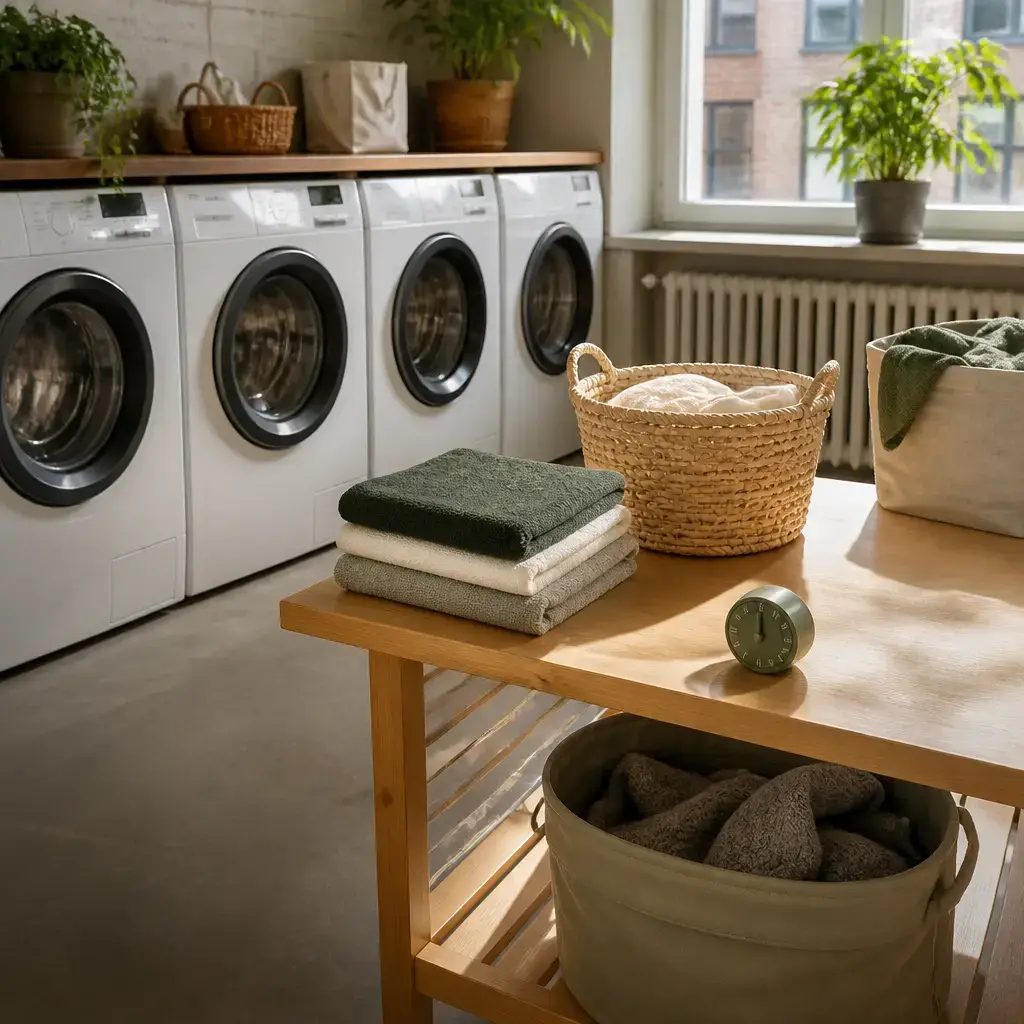
“Waschraum” means “laundry room” here. The compound combines washing with a room and names the shared place being discussed. You can reuse it with a location or description, such as “Der Waschraum ist unten” in a new example.
ist
“ist” means “is” here and states the condition of the laundry room. It is a form of “sein” used with “Der gemeinsame Waschraum.” A reusable pattern is “Der Raum ist ...” for describing a place.
heute
“heute” means “today” and places the situation on the current day. It can appear with a statement such as “Der gemeinsame Waschraum ist heute voll.” Use “heute” when describing what is happening on this day.
voll
“voll” means “full” here, describing the laundry room as busy because it has little available space or capacity. In “ist heute voll,” it follows “ist” to describe the room’s current condition. Use “Der Raum ist voll” in a new example when a place is crowded or full.
Trag
“Trag” tells one person to put or enter something, here in “Trag deinen Namen in den Zeitplan ein.” It is the command form of “eintragen,” with the particle “ein” placed later in the sentence. A reusable pattern is “Trag ... in ... ein” when recording information in a list or schedule.
deinen
“deinen” means “your” here and identifies the name as belonging to the person being addressed. It appears before “Namen” in “deinen Namen.” Use “deinen” before a masculine object in a new example such as “Trag deinen Termin ein.”
Namen
“Namen” means “name” here, specifically the name that should be entered on the schedule. The exact form appears in “deinen Namen”; its citation form is “Name.” A reusable pattern is “seinen Namen eintragen” when someone records a name.
in
“in” means “into” here and marks the schedule as the place where the name is entered. It is used in “in den Zeitplan eintragen.” Reuse the pattern “etwas in den Zeitplan eintragen” for recording something on a schedule.
den
“den” means “the” here in “in den Zeitplan.” Together with “in” and the direction of entering, it introduces the schedule as the destination. A reusable pattern is “in den Kalender eintragen” in a new example.
Zeitplan
“Zeitplan” means “schedule” here, the shared plan that shows when people can use the laundry room. It is the object of “in ... eintragen” in “in den Zeitplan ein.” Use it for a schedule by combining it with “eintragen” or “prüfen” in new examples.
ein
“ein” is the verb particle in “Trag ... ein” and completes the meaning “enter” or “record.” It belongs with “Trag” in the separable expression “eintragen,” so it is placed at the end of the main clause. Keep the pattern “Trag deinen Namen ... ein” when reusing this command.
bevor
“bevor” means “before” and introduces the action that must happen first: “bevor du eine Waschmaschine startest.” It connects the schedule action with the later machine-starting action. Use “bevor” to introduce a full clause describing an earlier action.
du
“du” means “you” here and identifies the person who starts the washing machine. It is the subject of “du eine Waschmaschine startest.” A reusable pattern is “bevor du ...” when giving a time condition to one person.
eine
“eine” means “a” or “one” here and introduces “eine Waschmaschine.” It identifies one washing machine without specifying which one. Use “eine” before a feminine noun in a new example such as “eine Maschine.”
Waschmaschine
“Waschmaschine” means “washing machine” here, the machine that is started for a load. It is the object in “eine Waschmaschine startest.” You can reuse it with “starten,” “benutzen,” or “frei sein” in new examples.
startest
“startest” means “start” here, as in starting a washing machine. It is a form of “starten” used with “du” in “du eine Waschmaschine startest.” A reusable pattern is “du startest eine Waschmaschine” when telling someone what they do.
Nachmittag
“Nachmittag” means “afternoon” here and identifies the part of the day when a machine becomes available. It appears in “Heute Nachmittag.” Use this time expression when referring to an afternoon appointment or activity.
später
“später” means “later” here and says that the machine is available at a later point in the afternoon. In “Heute Nachmittag ist später noch ...,” it narrows the time within that afternoon. Reuse “später” when postponing or locating an event at a later time.
noch
“noch” means “still” or “yet” here and indicates that a washing machine will remain available at that later time. It appears before “eine Waschmaschine” in “ist später noch eine Waschmaschine frei.” A reusable pattern is “noch frei” for something that is still available.
frei
“frei” means “available” here, not occupied by another person. In “eine Waschmaschine frei,” it describes the machine’s availability. Use “Ist die Maschine frei?” in a new example when asking whether it can be used.
Stell
“Stell” tells one person to set a timer in “Stell einen Timer.” It is the command form of “stellen” used for placing or setting something. A reusable pattern is “Stell einen Timer” when reminding someone to set an alert.
einen
“einen” means “a” or “one” here and introduces “einen Timer.” It identifies one timer as the object of “Stell.” Use “einen” before a masculine object in a new example such as “einen Termin.”
Timer
“Timer” means “timer” here, a device or setting used to remind the person when the washing cycle is done. It is the object in “Stell einen Timer.” A reusable pattern is “einen Timer stellen” for setting a timer.
Damit
“Damit” means “so that” here and introduces the purpose of setting a timer: “Damit die nächste Person nicht warten muss.” It links an action with the result or purpose intended by the speaker. Use “damit” before a full clause explaining why an action is useful.
die
“die” means “the” here and introduces “die nächste Person.” It identifies the next person who wants to use the machine. A reusable pattern is “die nächste Person” when referring to the person who follows in a sequence.
nächste
“nächste” means “next” here and identifies the person who will use the laundry room after the current user. It appears before “Person” in “die nächste Person.” Use the pattern “die nächste Person” for the following person in a queue or sequence.
Person
“Person” means “person” here, specifically the next user waiting for the machine. It is the subject of “nicht warten muss” in “Damit die nächste Person nicht warten muss.” You can reuse it with a description such as “eine andere Person” in a new example.
nicht
“nicht” means “not” here and negates the need to wait in “nicht warten muss.” It appears directly before the verb phrase it negates. Use “nicht” to state that an action or condition does not apply.
warten
“warten” means “wait” here and describes what the next person should not have to do. It follows “muss” in “nicht warten muss.” A reusable pattern is “auf jemanden warten” when specifying whom a person is waiting for.
muss
“muss” means “has to” or “must” here, but with “nicht” the phrase means that the next person does not have to wait. It is a form of “müssen” used with “die nächste Person.” Reuse the pattern “jemand muss warten” when saying that someone has to wait.
Soll
“Soll” asks whether the speaker should take the clothes out in “Soll ich meine Wäsche herausnehmen?” It is a form of “sollen” used to ask about an expected or advisable action. A reusable pattern is “Soll ich ...?” when asking what action to take.
ich
“ich” means “I” here and identifies the person asking whether to remove the laundry. It is the subject of “Soll” and the understood subject of “herausnehmen.” Use “Soll ich ...?” to ask whether you should do something.
meine
“meine” means “my” here and identifies the laundry as belonging to the speaker. It appears before “Wäsche” in “meine Wäsche.” Use “meine” before a feminine noun when referring to something belonging to yourself.
Wäsche
“Wäsche” means “laundry” or “clothes” here, specifically the clothes being washed. It is the object of “herausnehmen” in “meine Wäsche herausnehmen.” A reusable pattern is “die Wäsche herausnehmen” when taking laundry out of a machine.
herausnehmen
“herausnehmen” means “take out” here and refers to removing the laundry from the machine. It is the full verb used after “Soll ich” in “Soll ich meine Wäsche herausnehmen?” Reuse the pattern “etwas herausnehmen” when removing an item from inside something.
sobald
“sobald” means “as soon as” here and introduces the point when the laundry should be removed: “sobald der Waschgang endet.” It connects the action of taking out the clothes with the end of the cycle. Use “sobald” before a full clause for an action that follows immediately after an event.
Waschgang
“Waschgang” means “wash cycle” here, the complete washing process in the machine. It is the subject of “endet” in “sobald der Waschgang endet.” Use it with a verb such as “enden” or “fertig sein” when discussing a machine cycle.
endet
“endet” means “ends” here and describes the point at which the wash cycle is over. It is a form of “enden” used with “der Waschgang.” A reusable pattern is “Der Waschgang endet ...” when saying when a cycle finishes.
Bitte
“Bitte” means “please” here and makes the following reply polite. In “Bitte mach das,” it introduces a request to carry out the suggested action. Use “Bitte” before a request or command in everyday conversation.
mach
“mach” means “do” here in “Bitte mach das,” referring back to taking the laundry out. It is the command form of “machen” used with “das.” A reusable pattern is “Bitte mach das” when agreeing that someone should carry out an action already mentioned.
das
“das” means “that” or “it” here and refers back to the action of taking the clothes out. In “Bitte mach das,” it stands for the previously mentioned action rather than a physical object. Use “Mach das” when referring to an action already clear from the conversation.
Nasse
“Nasse” means “wet” here and describes the laundry in “Nasse Wäsche.” The adjective appears before “Wäsche” and explains why leaving it in the machine is a problem. Use the pattern “nasse Wäsche” when referring to wet laundry.
Maschine
“Maschine” means “machine” here, referring to the washing machine where the wet clothes remain. It appears in “die in der Maschine bleibt.” You can reuse it with “in der Maschine” when saying that something is inside the machine.
bleibt
“bleibt” means “stays” or “remains” here and says that the wet laundry remains in the machine. It is a form of “bleiben” used with “Nasse Wäsche, die ...” in the relative clause. A reusable pattern is “etwas bleibt in der Maschine” when something is left inside it.
hält
“hält” contributes to the meaning “holds up” in “hält alle auf,” saying that the laundry delays everyone. It is a form of “halten” used together with the particle “auf.” Keep the complete pattern “etwas hält alle auf” when describing something that delays everyone.
alle
“alle” means “everyone” here and refers to all the people sharing the laundry room. It is the object of the expression “hält ... auf.” Use “alle” when a statement applies to every person in the relevant group.
auf
“auf” is the verb particle in “hält alle auf” and completes the meaning “hold everyone up” or “delay everyone.” It belongs with “hält,” so the full expression is needed to understand the meaning. A reusable pattern is “Das hält mich auf” in a new example.
bringe
“bringe” means “bring” here and says that the speaker will bring the basket downstairs. It is a form of “bringen” used with “Ich” in “Ich bringe meinen Wäschekorb nach unten.” A reusable pattern is “Ich bringe ... nach unten” when carrying something downstairs.
meinen
“meinen” means “my” here and identifies the basket as belonging to the speaker. It appears before “Wäschekorb” in “meinen Wäschekorb.” Use “meinen” before a masculine object when referring to something belonging to yourself.
Wäschekorb
“Wäschekorb” means “laundry basket” here, the basket used to carry the clothes. It is the object of “bringe” in “Ich bringe meinen Wäschekorb nach unten.” Use it with “bringen” or “nehmen” when discussing carrying laundry.
nach
“nach” means “to” or “toward” here in “nach unten,” indicating downward direction. Together with “unten,” it forms the direction expression “nach unten.” Use “nach” with a direction word when describing movement toward that direction.
unten
“unten” means “downstairs” or “down below” here in “nach unten.” It specifies where the basket will be brought. A reusable pattern is “etwas nach unten bringen” for taking something downstairs.
fertig
“fertig” means “finished” or “done” here in “bevor der Waschgang fertig ist.” It describes the wash cycle as completed. Use the pattern “fertig sein” when saying that a task or process is done.
Dann
“Dann” means “then” here and refers to the result of bringing the basket down before the cycle finishes. It links that action to the following conclusion, “Dann sollte alles gut laufen.” Use “Dann” to introduce a consequence or next step.
sollte
“sollte” means “should” here and expresses an expected positive result: everything should run well. It is a form of “sollen” used with “alles.” A reusable pattern is “Das sollte ...” when making a reasonable expectation about a result.
alles
“alles” means “everything” here and refers to the shared laundry-room process as a whole. It is the subject of “sollte ... laufen” in “alles gut laufen.” Use “alles” when referring collectively to all relevant things or activities.
gut
“gut” means “well” here and describes the way things are expected to run. In “alles gut laufen,” it contributes to the meaning “everything should go smoothly.” Use “gut laufen” for a process, plan, or situation that works well.
laufen
“laufen” means “run” here in the figurative expression “alles gut laufen,” meaning that everything works or proceeds smoothly. It follows “sollte” in the sentence. A reusable pattern is “Der Plan läuft gut” in a new example when a plan is progressing successfully.