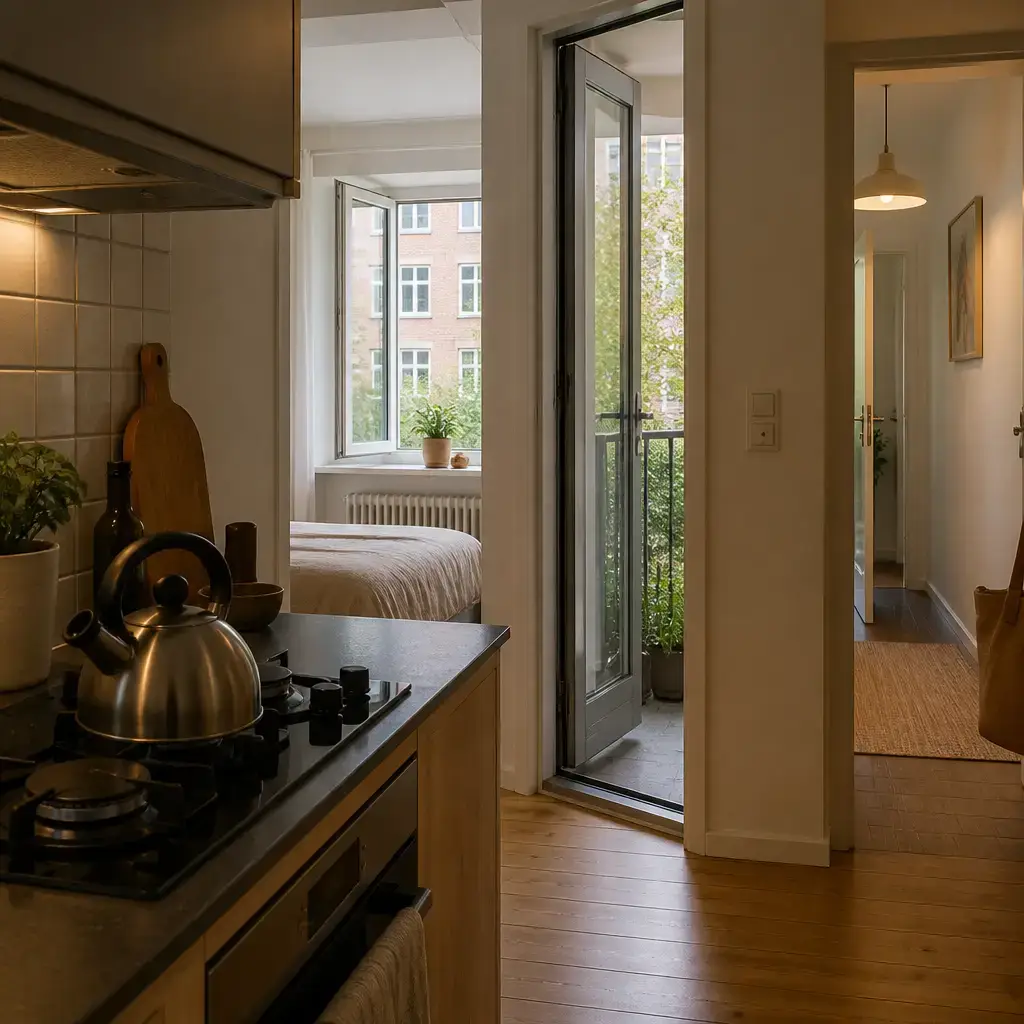
Bevor
“Bevor” means before and introduces the action that must happen later in time, as in “Bevor wir gehen”. It also appears in “bevor es zu spät wird”; use it before a clause to connect an earlier action with a later one.
wir
“wir” means we and includes the speaker and at least one other person. In “Bevor wir gehen”, it is the subject of the leaving action; use it when describing something a group will do together.
gehen
“gehen” means go or leave here. In “Bevor wir gehen”, it refers to the two adults leaving the apartment, while “Gehen wir” is a suggestion to leave; this is useful when making a joint plan.
sollten
“sollten” expresses should as a recommendation: “sollten wir die Wohnung überprüfen” means that checking the apartment is advisable. It is followed by the subject “wir” and the action “überprüfen”; use it when suggesting a sensible action before leaving.
die
“die” is the definite article in “die Wohnung”, referring to the known apartment. In “Die Lichter”, it introduces the known lights as a group; use it before a noun that is already identified in the situation.
Wohnung
“Wohnung” means apartment. In “die Wohnung überprüfen”, it is the place being checked before the speakers leave; use it when talking about checking or leaving a home.
überprüfen
“überprüfen” means check or examine carefully. In “die Wohnung überprüfen”, the speakers check the apartment to make sure everything is ready before leaving; use it with the thing being checked.
Ich
“Ich” means I and marks the speaker as the person carrying out the action. It is used in “Ich habe den Herd schon ausgeschaltet” and “Ich mache es zu”; use it to state what you have done or will do.
habe
“habe” means have as the helping verb in “Ich habe den Herd schon ausgeschaltet”. Together with “ausgeschaltet”, it reports an action that has already been completed; use this construction when telling someone that a task is done.
den
“den” is the definite article before the known object “Herd” in “den Herd”. It marks the stove as the object affected by the action; use this form before a masculine noun used as a direct object.
Herd
“Herd” means stove. In “den Herd schon ausgeschaltet”, it is the appliance that has already been turned off; use it when checking cooking equipment before leaving.
schon
“schon” means already and shows that the action was completed before this point. In “Ich habe den Herd schon ausgeschaltet”, it reassures the other person that the stove has been dealt with; use it with a completed action.
ausgeschaltet
“ausgeschaltet” means turned off or switched off. In “habe den Herd schon ausgeschaltet”, it describes the completed result of turning off the stove; use it to report that an appliance or other device is no longer on.
Sind
“Sind” means are in the question “Sind alle Fenster geschlossen?”. It comes first to ask whether the windows are in a certain state; use it in a question about the condition of several things.
alle
“alle” means all and applies to the complete group in “alle Fenster”. It comes before the plural noun; use it when checking whether every item in a group meets a condition.
Fenster
“Fenster” means windows in “alle Fenster”. It names the group being checked for being closed; use it when discussing windows in an apartment or building.
geschlossen
“geschlossen” means closed and describes the state of the windows in “Sind alle Fenster geschlossen?”. It follows “sind” to describe their condition; use it when asking or stating whether something is closed.
Das
“Das” means that or that situation in “Das sollte alles sein”. It refers to the checklist and actions just discussed; use it to point back to a situation or result that has already been mentioned.
Schlafzimmerfenster
“Schlafzimmerfenster” means bedroom window. In “Das Schlafzimmerfenster ist noch offen”, it identifies the particular window that has not been closed; the compound names a window by the room it belongs to.
ist
“ist” means is and links “Das Schlafzimmerfenster” with its condition in “Das Schlafzimmerfenster ist noch offen”. Use it to describe the current state of one thing.
noch
“noch” means still and shows that the window remains open at this point. In “ist noch offen”, it highlights a condition that has not changed yet; use it with an ongoing state.
offen
“offen” means open and describes the current state of the bedroom window in “ist noch offen”. Use it with a window, door, or similar object when it is not closed.
mache
In “Ich mache es zu”, “mache” contributes the meaning close as part of the full construction “mache es zu”, not simply make. The object comes before “zu”; use this construction when closing something such as a window.
es
“es” means it in “Ich mache es zu” and refers back to the bedroom window. It lets the speaker avoid repeating the noun; use it for a previously mentioned object.
zu
In “mache es zu”, “zu” completes the meaning close, so the whole phrase means close it. It is placed after the object in this construction; use “mache” with the object and “zu” to describe closing something.
und
“und” means and and links the two actions in “Ich mache es zu und schließe die Balkontür ab”. It joins actions that belong to the same plan; use it when listing connected tasks.
schließe
In “schließe die Balkontür ab”, “schließe” contributes the meaning lock as part of the full construction “schließe ... ab”. The object comes between “schließe” and “ab”; use this word order when saying that a door is being locked.
Balkontür
“Balkontür” means balcony door. In “schließe die Balkontür ab”, it is the door being locked before departure; the compound identifies the door by its location.
ab
“ab” completes the locking meaning in “schließe die Balkontür ab”. It appears at the end because it belongs to the split construction “schließe ... ab”; keep it after the object when using this expression.
Lichter
“Lichter” means lights in “Die Lichter im Flur sind noch an”. It is the subject whose state is being checked; use it when referring to several lights in a room or area.
im
“im” means in the in “im Flur” and gives the location of the lights. Use it before a place when saying where something is located.
Flur
“Flur” means hallway. In “Die Lichter im Flur”, it identifies where the lights are; use it after “im” to locate something inside a home.
an
In “sind noch an”, “an” means on or switched on and describes the operating state of the lights. Use it with lights or appliances when they are still powered on.
Also
“Also” means so or therefore and introduces the consequence in “Also schalte ich sie aus”. The speaker notices that the lights are on and then announces the response; use it at the start of a conclusion or decision.
schalte
In “schalte ich sie aus”, “schalte” means turn off as part of the full construction “schalte ... aus”. The object comes between the verb and “aus”; use this pattern when switching off lights or another device.
sie
“sie” means them in “schalte ich sie aus” and refers to the lights. It is the object of the action; use it when referring back to several things already mentioned.
alles
“alles” means everything in “Das sollte alles sein”. It refers to the complete set of checks and tasks; use it to summarize a whole group of things.
sein
“sein” means be and completes “alles sein” in “Das sollte alles sein”. The phrase says that the situation should amount to everything needed; use it after “sollte” when describing what something should be.
spät
“spät” means late in “zu spät”. Here it refers to a time that is later than acceptable; use “zu spät” when warning that an action must happen before the acceptable time passes.
wird
“wird” means gets or becomes in “bevor es zu spät wird”. It describes time changing into the state of being too late; use it when a situation is becoming a new condition.