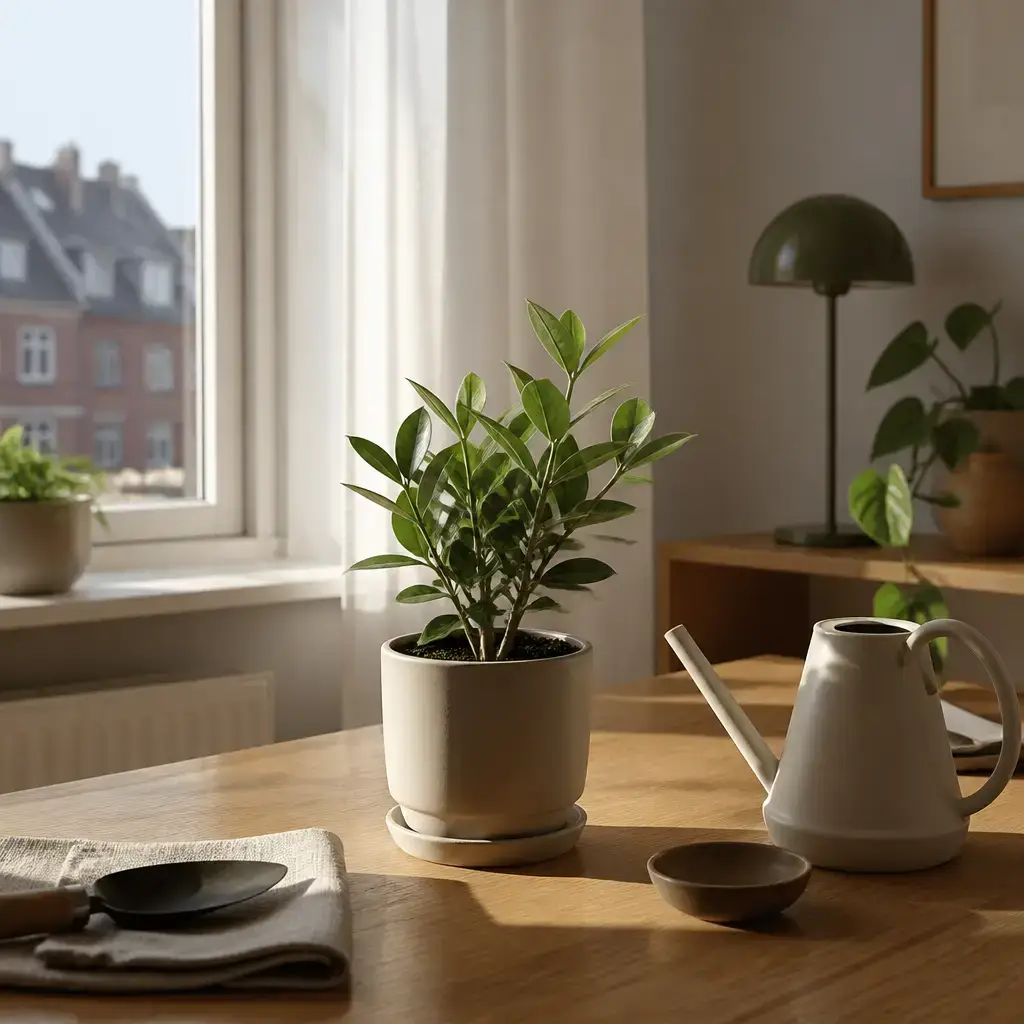
Ich
“Ich” means “I” here: the speaker is talking about their own actions or hopes. It is used at the beginning of statements such as “Ich habe” and “Ich hoffe” when speaking about oneself.
habe
In “Ich habe eine kleine Pflanze für mein Zimmer gekauft”, “habe” is the auxiliary used with “gekauft” to describe a completed purchase. A reusable pattern is “Ich habe [object] gekauft” when saying that you bought something.
eine
“Eine” means “a” in “eine kleine Pflanze”, introducing one plant. It is reused before an adjective and noun when introducing an item, as in the dialogue phrase “eine kleine Pflanze”.
kleine
“Kleine” means “small” and describes the plant in “eine kleine Pflanze”. The reusable phrase is “eine kleine Pflanze” when talking about a small plant.
Pflanze
“Pflanze” means “plant”, specifically the small room plant discussed here. It can be reused in phrases such as “eine Pflanze für mein Zimmer” when talking about a plant intended for a room.
für
“Für” means “for” and marks the intended place or purpose in “für mein Zimmer”. A reliable pattern is “für + noun”, as in “für mein Zimmer” when saying what something is intended for.
mein
“Mein” means “my” and shows that the room belongs to or is associated with the speaker in “mein Zimmer”. It is reused before a noun to express possession, as in “mein Zimmer”.
Zimmer
“Zimmer” means “room” in “mein Zimmer”. The phrase “für mein Zimmer” can be reused when describing something bought or chosen for one’s room.
gekauft
“Gekauft” means “bought” and describes the completed purchase in “Ich habe eine kleine Pflanze für mein Zimmer gekauft”. It is reused with “Ich habe” in the pattern “Ich habe [object] gekauft”.
Braucht
“Braucht” means “needs” in the question “Braucht sie viel Sonnenlicht?”. The pattern “Braucht sie ...?” is useful when asking what a plant or another thing requires.
sie
“Sie” in the dialogue is written as lowercase “sie” and refers to the plant, meaning “it”. It is reused as the subject before a verb when continuing to talk about the plant, as in “sie mag” or “sie wächst”.
viel
“Viel” means “much” or “a lot” in “viel Sonnenlicht”, referring to a large amount of sunlight. It is used before an uncountable noun such as “Sonnenlicht”, and the dialogue also uses “zu viel” for an excessive amount.
Sonnenlicht
“Sonnenlicht” means “sunlight” in “viel Sonnenlicht”. The phrase “viel Sonnenlicht brauchen” is useful when asking how much sunlight a plant needs.
Auf
“Auf” means “on” in “Auf dem Schild”, referring to information written on a label. A reusable pattern is “Auf dem Schild steht, dass ...” when reporting what a label says.
dem
“Dem” is the article used in the phrases “auf dem Schild” and “vor dem Gießen”. These phrases can be reused with “dem” after expressions such as “auf” and “vor” in the same constructions.
Schild
“Schild” means “label” or “sign”; here it is the label that gives information about the plant. The reusable construction is “Auf dem Schild steht, dass ...” when referring to written information.
steht
“Steht” means “says” or “is written” in “Auf dem Schild steht, dass ...”. It is used in the pattern “Auf dem Schild steht, dass ...” to report information displayed on a label.
dass
“Dass” means “that” and introduces the content of what is written: “dass sie indirektes Licht mag”. It is reused after expressions such as “steht” to introduce a complete statement.
indirektes
“Indirektes” means “indirect” and describes the light in “indirektes Licht”. The phrase “indirektes Licht” is useful when describing light that does not shine directly on the plant.
Licht
“Licht” means “light” in “indirektes Licht”. The phrase can be reused with a description before it, as in “indirektes Licht”, when discussing suitable lighting.
mag
“Mag” means “likes” in “sie indirektes Licht mag”, describing the light the plant is suited to. A reusable pattern is “sie mag + noun” when saying what the plant likes.
Dann
“Dann” means “then” and introduces the advice that follows from the information about the plant: “Dann stell sie ans Fenster”. It is useful at the start of a response when giving the next step.
stell
“Stell” means “place” or “put” in the instruction “stell sie ans Fenster”. It is used when telling one person to move or place something, with the object and destination following it.
ans
“Ans” means “to the” or “toward the” in “ans Fenster”; it is the contracted form of “an das”. The reusable pattern “ans + place” describes placing something next to or at a destination such as a window.
Fenster
“Fenster” means “window” in “ans Fenster”. The phrase “stell sie ans Fenster” can be reused when telling someone to place an object by the window.
aber
“Aber” means “but” and contrasts placing the plant near the window with not putting it outside: “ans Fenster, aber nicht nach draußen”. It is useful for adding a restriction or opposing instruction.
nicht
“Nicht” means “not” and negates the destination in “nicht nach draußen”. It can be reused before a destination or action to state that it should not happen.
nach
“Nach” marks direction in “nach draußen”, meaning “to the outside”. The fixed phrase “nach draußen” is useful when describing movement from inside to outside.
draußen
“Draußen” means “outside” in “nach draußen”. Together with “nach”, it forms the direction phrase “nach draußen”, used when saying where something should not be placed.
Wie
“Wie” means “how” in the question “Wie oft sollte ich die Erde gießen?”. The pattern “Wie + question word or adverb” begins questions about manner or frequency.
oft
“Oft” means “often” in “Wie oft”, which asks how frequently the soil should be watered. The reusable pattern is “Wie oft sollte ich ...?” when asking for recommended frequency.
sollte
“Sollte” expresses “should”: in “Wie oft sollte ich ...?” it asks for advice, and in “Sie sollte gut wachsen” it expresses an expected result. It is reused before the main verb when asking what someone should do or stating what is expected.
die
“Die” means “the” in “die Erde”, referring to the specific soil of the plant. The phrase “die Erde gießen” can be reused when talking about watering the soil.
Erde
“Erde” means “soil” in “die Erde gießen” and “Prüfe die Erde”. These phrases are useful when discussing checking or watering the soil of a plant.
gießen
The lowercase form “gießen” means “to water” in “sollte ich die Erde gießen”. The dialogue also has the capitalized form “Gießen” in “vor dem Gießen”; “gießen” is used after “sollte”, while “Gießen” names the watering activity after “dem”.
Prüfe
“Prüfe” means “check” in the instruction “Prüfe die Erde”. It is used when telling one person to inspect something, especially before taking the next step.
vor
“Vor” means “before” in “vor dem Gießen”, showing that checking the soil comes before watering. The reusable pattern “vor dem + activity” describes an action that happens before another activity.
pro
“Pro” means “per” in “zweimal pro Woche”, expressing a rate over a period of time. The pattern “[number] pro Woche” is useful for stating how often something happens each week.
Woche
“Woche” means “week” in “zweimal pro Woche”. The phrase can be reused with a number and “pro”, as in “zweimal pro Woche”, to give a weekly frequency.
hoffe
“Hoffe” means “hope” in “Ich hoffe, dass sie hier gut wächst”. The reusable construction is “Ich hoffe, dass ...” when expressing a personal hope about a result.
hier
“Hier” means “here”, referring to the current place where the plant is kept. In “hier gut wächst”, it specifies the place in which the plant is expected to grow well.
gut
“Gut” means “well” in “gut wächst”, describing successful growth. The reusable phrase “gut wachsen” is useful when talking about whether a plant is developing successfully.
wächst
“Wächst” means “grows” in “sie hier gut wächst”, describing the plant’s growth. It is reused with the subject “sie” and an adverb such as “gut” when describing how the plant is developing.
wachsen
“Wachsen” is the citation form related to the dialogue form “wächst”, meaning “to grow”. The dialogue uses it in “Sie sollte gut wachsen” after “sollte”, a reusable pattern for describing an expected result.
solange
“Solange” means “as long as” and introduces the condition “solange du sie nicht zu viel gießt”. It is useful for stating a condition that must continue for the expected result to hold.
du
“Du” means “you” when addressing one person informally in “solange du sie nicht zu viel gießt”. It is reused as the subject before a verb when giving familiar, direct advice to one person.
zu
“Zu” means “too” or “excessively” in “zu viel”, so “sie nicht zu viel gießt” means that she should not water it excessively. The pattern “zu viel + verb” is useful when describing an excessive amount of an action.