Der
In 'Der Akku meines Handys', 'Der' means 'the' and marks 'Akku' as the subject. It is the masculine singular form of the definite article used here. A reusable pattern places a definite article before the subject.
Akku
In 'Der Akku meines Handys', 'Akku' means the phone's battery or charge. It is the thing described as 'fast leer' and is the reason charging is needed. Reuse it when talking about a device's battery.
meines
In 'meines Handys', 'meines' means 'my' and shows whose phone is meant. Its citation form is mein; 'meines' is the possessive form used here before 'Handys'. This pattern expresses ownership or association.
Handys
In 'meines Handys', 'Handys' means 'phone' and identifies the item belonging to the speaker. Its citation form is Handy; 'Handys' is the form used here in the possessive phrase after 'meines'. This pattern expresses whose item something is.
ist
In 'Der Akku meines Handys ist fast leer', 'ist' means 'is' and connects the battery with its condition 'fast leer'. Its citation form is sein; 'ist' is the third-person singular present form used with 'Der Akku'. A reusable pattern describes a subject by placing a condition after 'ist'.
fast
In 'fast leer', 'fast' means 'almost': the battery is not completely empty yet. It modifies 'leer' to show that the condition is nearly reached. Reuse it before a state or amount that is nearly reached.
leer
In 'fast leer', 'leer' describes the battery as empty or with almost no charge. It is the condition linked to the battery by 'ist'. Reuse it for something that has no contents; here it refers specifically to battery charge.
Hast
At the start of 'Hast du ein Ladegerät oder eine Powerbank dabei?', 'Hast' asks whether the listener has something available. Its citation form is haben; 'Hast' is the second-person singular present form used with 'du'. A reusable question pattern asks whether someone has an item.
du
In 'Hast du ein Ladegerät oder eine Powerbank dabei?', 'du' means 'you' and refers to the person being asked. It is the subject of 'Hast'. Reuse it when addressing one familiar person directly.
ein
In 'ein Ladegerät', 'ein' introduces one unspecified charger. It is the article used before 'Ladegerät' in this question. Reuse it before a singular unspecified item.
Ladegerät
In 'ein Ladegerät', 'Ladegerät' means 'charger'. It names one possible item that could provide power for the phone. Reuse it when talking about charging equipment.
oder
In 'ein Ladegerät oder eine Powerbank', 'oder' presents two alternatives. It joins the two item expressions in the question. Reuse it when asking about one possibility or another.
eine
In 'eine Powerbank', 'eine' introduces one unspecified power bank. It is the article used before 'Powerbank' in this question. Reuse it before a singular unspecified item.
Powerbank
In 'eine Powerbank', 'Powerbank' means 'power bank'. It names the second possible source of power for the phone. Reuse it when discussing a portable battery.
dabei
In 'eine Powerbank dabei?', 'dabei' means 'with you' or 'on hand'. It asks whether the item is currently available with the listener. A reusable pattern places 'dabei' after the item when asking whether someone has it with them.
Ich
In 'Ich habe beides zu Hause gelassen', 'Ich' means 'I' and identifies the speaker as the subject. It introduces the speaker's own action or situation. Reuse it at the start of a statement about yourself.
habe
In 'Ich habe beides zu Hause gelassen', 'habe' helps form the past statement that the speaker left both items at home. Its citation form is haben; 'habe' is the first-person singular present form used with 'Ich'. It comes before the other parts of this past construction.
beides
In 'Ich habe beides zu Hause gelassen', 'beides' refers to both previously mentioned items, the charger and the power bank. It lets the speaker refer to the two items together without repeating them. Reuse it when two known things are being treated as one group.
zu Hause
The whole expression 'zu Hause' means 'at home'. Within this fixed expression, 'zu' and 'Hause' work together to express a home location; here they show where the items were left. Reuse 'zu Hause' when describing being at or leaving something at home.
gelassen
In 'zu Hause gelassen', 'gelassen' means 'left behind'. Its citation form is lassen; 'gelassen' is the form used with 'habe' in the past construction. Here it says that the speaker did not bring the charger and power bank.
muss
In 'Ich muss dringend telefonieren', 'muss' expresses necessity: the speaker needs to make a phone call. Its citation form is müssen; 'muss' is the first-person singular present form used with 'Ich'. A reusable pattern places an infinitive after this modal to state what is necessary.
dringend
In 'Ich muss dringend telefonieren', 'dringend' means 'urgently' and shows that the phone call cannot wait. It modifies 'telefonieren' and gives the action a strong time pressure. Reuse it to mark an urgent action or matter.
telefonieren
In 'dringend telefonieren', 'telefonieren' means 'make a phone call' or 'talk by phone'; here it is the action that is needed. Its citation form is telefonieren, and the dialogue uses the infinitive after 'muss'. A reusable pattern places it after a modal when saying that someone needs to use the phone.
Neben
At the start of 'Neben dem Fenster ist eine Steckdose', 'Neben' means 'beside' or 'next to'. It sets the outlet's location in relation to the window and is followed here by 'dem Fenster'. Reuse it before a reference point to give a nearby location.
dem
In 'dem Fenster', 'dem' means 'the' and belongs to the location phrase after 'Neben'. It is the definite article used before 'Fenster' here. A reusable pattern places an article before a named location reference.
Fenster
In 'Neben dem Fenster', 'Fenster' means 'window' and serves as the reference point for the outlet's location. The article 'dem' comes before it in this phrase. Reuse it when describing something beside a window.
Steckdose
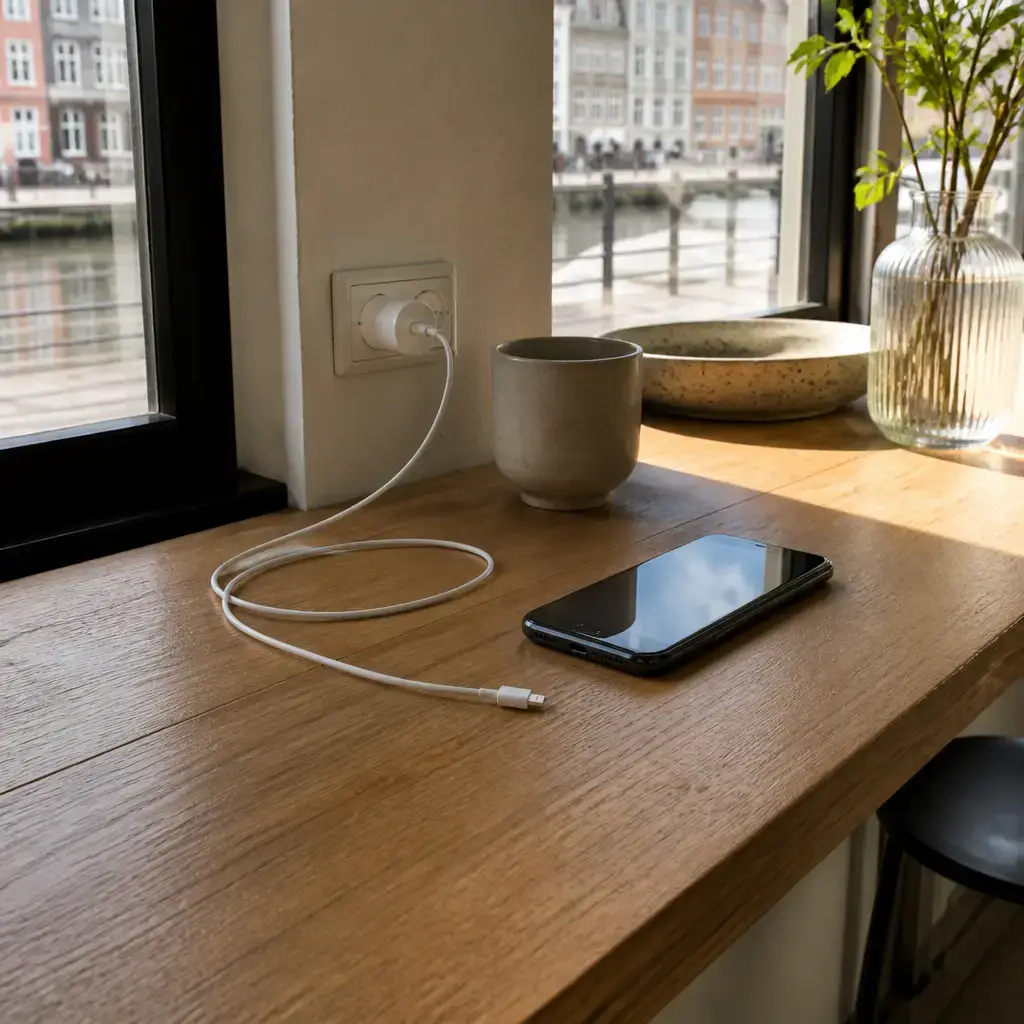
In 'eine Steckdose', 'Steckdose' means 'electrical outlet' or 'socket'. It is the thing located beside the window and relevant to charging. Reuse it when pointing out a place to plug in a device.
Kann
In 'Kann ich dein Kabel ein paar Minuten benutzen?', 'Kann' asks politely whether the speaker can or may use the cable. Its citation form is können; 'Kann' is the first-person singular present form used with 'ich'. A reusable request pattern begins with 'Kann ich' and asks about an action.
dein
In 'dein Kabel', 'dein' means 'your' and identifies the cable as belonging to or being associated with the listener. It is the possessive form used before 'Kabel'. Reuse a possessive form before an item someone owns or controls.
Kabel
In 'dein Kabel', 'Kabel' means 'cable'. It is the item the speaker is asking to use for charging. Reuse it when talking about a cable used to connect or charge a device.
paar
In 'ein paar Minuten', 'paar' means 'a few' and indicates a small amount of time. Together with 'ein' and 'Minuten', it gives a short duration rather than an exact number. Reuse this expression before a plural time unit when asking for a short period.
Minuten
In 'ein paar Minuten', 'Minuten' means 'minutes' and measures how long the speaker wants to use the cable. It follows 'ein paar' in the duration expression. Reuse it to state a duration in minutes.
benutzen
In 'dein Kabel ein paar Minuten benutzen', 'benutzen' means 'use'. Its citation form is benutzen; it is the infinitive after 'Kann'. A reusable pattern uses a modal followed by an infinitive to ask whether an action is possible or allowed.
kannst
In 'Du kannst es lange genug benutzen', 'kannst' means 'can' and gives permission or indicates possibility here. Its citation form is können; 'kannst' is the second-person singular present form used with 'Du'. It is followed by the infinitive 'benutzen'.
es
In 'Du kannst es lange genug benutzen', 'es' refers back to the cable mentioned in the request. It is the item being used. Reuse this pronoun to refer to a singular neuter item that is already clear from the context.
lange
In 'lange genug', 'lange' means 'long' and describes the duration of using the cable. It combines with 'genug' to show that the duration is sufficient for the call. Reuse it with 'genug' when describing a sufficiently long period.
genug
In 'lange genug', 'genug' means 'enough' and marks the minimum duration required. Here it says that the cable can be used for sufficient time to make the call. Reuse it after a quantity or duration word to express sufficiency.
um
In 'um anzurufen', 'um' introduces the purpose of using the cable. It connects 'benutzen' with the goal of making a call. Reuse it with an infinitive clause to express purpose.
anzurufen
In 'um anzurufen', 'anzurufen' means 'to call'. Its citation form is anrufen; 'anzurufen' is the infinitive form with 'zu' inserted after 'um'. It names the purpose of using the cable, and the same pattern expresses purpose with 'um'.
gebe
In 'Ich gebe es zurück', 'gebe' contributes the action of giving, while the whole expression means 'return it'. Its citation form is geben; 'gebe' is the first-person singular present form used with 'Ich'. Together with 'zurück', it describes returning the cable.
zurück
In 'gebe es zurück', 'zurück' adds the meaning 'back' to the giving action, so the cable is returned to its owner. It appears after the object 'es' in this sentence. Reuse it with a giving action when something is returned.
sobald
In 'sobald mein Handy angeht', 'sobald' means 'as soon as' and introduces the time condition for returning the cable. It connects the return with the phone turning on. Reuse it when one action follows immediately after another event.
mein
In 'mein Handy', 'mein' means 'my' and identifies the phone as the speaker's. It is the possessive form used before 'Handy'. Reuse it before an item that belongs to or is associated with you.
Handy
In 'mein Handy', 'Handy' means 'phone'. It is the device that turns on in the time clause and whose battery is being charged. Reuse it when referring to a mobile phone.
angeht
In 'mein Handy angeht', 'angeht' means 'turns on'. Its citation form is angehen; 'angeht' is the third-person singular present form used with 'mein Handy'. It describes the event that triggers the return.
Lass
In 'Lass es eingesteckt', 'Lass' tells the listener to leave or keep the item in its plugged-in state. Its citation form is lassen; 'Lass' is the imperative form addressed to du. A reusable pattern places an object after 'Lass' and then states the condition to maintain.
eingesteckt
In 'Lass es eingesteckt', 'eingesteckt' means 'plugged in' and describes the state in which the item should remain. Its citation form is einstecken; 'eingesteckt' is the form used for the resulting plugged-in state. Together with 'Lass es', it expresses keeping something plugged in.
bis
In 'bis dein Handy genug Akku hat', 'bis' means 'until' and sets the endpoint for keeping the item plugged in. It introduces the clause that says when enough battery has been reached. Reuse it before an event or condition that ends an action.
hat
At the end of 'genug Akku hat', 'hat' means 'has', describing the phone as having enough battery charge. Its citation form is haben; 'hat' is the third-person singular present form used with 'dein Handy'. It completes the endpoint clause introduced by 'bis'.