Welchen
"Welchen" means "which" in the question "Welchen Film sollen wir ansehen?" It identifies the film to be selected and appears directly before the masculine object "Film". A reusable question pattern is to place this form before the masculine thing being chosen.
Film
"Film" means film or movie in "Welchen Film sollen wir ansehen?" It is the movie the speakers are deciding whether to watch. The word can be used when discussing a specific movie as an object of viewing or choosing.
sollen
"sollen" expresses "should" in "Welchen Film sollen wir ansehen?" Here it asks what the group ought to watch, and it is followed by the subject "wir" and the verb "ansehen". This modal pattern is useful for asking for a recommendation or shared decision.
wir
"wir" means "we" in "Welchen Film sollen wir ansehen?" It refers to the two friends acting together as the subject of the question. It commonly appears before a verb when the speaker includes the group in an action or decision.
ansehen
"ansehen" means "watch" in "Welchen Film sollen wir ansehen?" It is the action being considered and appears as the verb after "sollen". The form is useful for talking about watching a film or another thing that someone looks at.
Ich
"Ich" means "I" in "Ich möchte etwas Leichtes, vielleicht eine Komödie." It marks the speaker as the person expressing a preference. It is used as the subject when stating what the speaker wants or would like.
möchte
"möchte" expresses a polite "would like" or "want" in "Ich möchte etwas Leichtes, vielleicht eine Komödie." It introduces the speaker's desired choice and is followed here by "etwas Leichtes". This form is useful for stating a preference politely.
etwas
"etwas" means "something" in "Ich möchte etwas Leichtes, vielleicht eine Komödie." It keeps the desired choice unspecified before the speaker narrows it to a possible type of film. It commonly introduces an unspecified thing, often followed by a description.
Leichtes
"Leichtes" means "something light" in "Ich möchte etwas Leichtes, vielleicht eine Komödie." It describes the kind of film or entertainment the speaker wants, not something with little physical weight. Its capitalized form is used as a noun-like description after "etwas".
vielleicht
"vielleicht" means "maybe" in "Ich möchte etwas Leichtes, vielleicht eine Komödie." It presents "eine Komödie" as a possible suggestion rather than a fixed choice. It is useful when offering an option without stating certainty.
eine
"eine" means "a" or "one" in "vielleicht eine Komödie." It introduces one possible comedy as the example of the light thing being considered. It commonly comes directly before a singular noun when presenting an option.
Komödie
"Komödie" means "comedy" in "vielleicht eine Komödie." It names the possible film type suggested by the speaker. The word is useful when identifying a movie by its comedic genre.
Dieser
"Dieser" means "this" in "Dieser Film hat sehr gute Kritiken und klare Untertitel." It points to the particular film currently under discussion. It appears directly before "Film" to identify that specific choice.
hat
"hat" means "has" in "Dieser Film hat sehr gute Kritiken und klare Untertitel." It says that the film possesses or receives the stated reviews and subtitles as relevant features. The form is useful with a subject followed by the things or qualities it has.
sehr
"sehr" means "very" in "sehr gute Kritiken." It strengthens the positive evaluation of the reviews. It commonly comes before an adjective to increase its intensity.
gute
"gute" means "good" in "sehr gute Kritiken," where it describes the film reviews positively. The form appears directly before "Kritiken" and agrees with that noun in the dialogue. This is a reusable pattern for placing an adjective before a noun.
Kritiken
"Kritiken" means "reviews" in "Dieser Film hat sehr gute Kritiken." It refers to the positive evaluations the film has received. The word is useful when discussing reviews of a film, book, or other work.
und
"und" means "and" in "sehr gute Kritiken und klare Untertitel." It joins the film's positive reviews with its clear subtitles. It is used to connect two related items or descriptions.
klare
"klare" means "clear" in "klare Untertitel." It describes subtitles that are easy to follow or understand while watching the film. It appears before the noun it describes, as in this film feature description.
Untertitel
"Untertitel" means "subtitles" in "klare Untertitel." It names the written text shown with the film, which the speakers value because it is clear. The word is useful when discussing subtitles while watching a movie.
Können
"Können" expresses "can" in the question "Können wir den Trailer ansehen, bevor wir uns entscheiden?" It asks whether watching the trailer is possible or permitted before choosing. This question pattern is useful for making a polite request about a shared action.
den
"den" means "the" in "den Trailer." It identifies the specific trailer the friends want to watch and marks it as the object of "ansehen." It is used before this masculine object in the dialogue.
Trailer
"Trailer" means "trailer" in "den Trailer ansehen." It refers to the short preview the friends want to watch before choosing a film. The word is useful when discussing a movie preview.
bevor
"bevor" means "before" in "bevor wir uns entscheiden." It introduces the action that must happen earlier: the friends decide after watching the trailer. It is useful for connecting one action with a later action in time.
uns
"uns" refers to "ourselves" in "bevor wir uns entscheiden." It is the form used with the group when the friends make the decision themselves. The complete reflexive expression here is "uns entscheiden," used for deciding.
entscheiden
"entscheiden" means "decide" in "bevor wir uns entscheiden." It names the choice the friends will make after viewing the trailer and appears at the end of the clause introduced by "bevor." The reusable pattern is "uns entscheiden" when a group decides for itself.
Der
"Der" means "the" in "Der Trailer sollte uns bei der Entscheidung helfen." It identifies the trailer as the subject of the statement. The same article appears as "der" in "bevor der Film beginnt"; it is capitalized here because it starts the sentence.
sollte
"sollte" expresses "should" in "Der Trailer sollte uns bei der Entscheidung helfen." It presents the trailer as something expected or intended to help the friends choose. The form is useful with an action that is expected to have a helpful result.
bei
"bei" means "with" or "in the context of" in "bei der Entscheidung." It places the help in the context of making the film choice. The preposition is useful when describing help or support connected with an activity or situation.
Entscheidung
"Entscheidung" means "decision" in "bei der Entscheidung." It names the choice the friends are making about which film to watch. The word is useful for talking about the decision connected with a particular matter.
helfen
"helfen" means "help" in "Der Trailer sollte uns bei der Entscheidung helfen." It describes the trailer's intended contribution to the friends' decision and follows "sollte." This form is useful for saying that something helps someone with a task or decision.
Die
"Die" means "the" in "Die Geschichte sieht lustig aus, aber nicht zu schwierig." It identifies the particular story belonging to the film being considered. It appears before "Geschichte" to introduce that specific part of the film.
Geschichte
"Geschichte" means "story" in "Die Geschichte sieht lustig aus." It refers to the plot of the film that the friends are evaluating. The word is useful when discussing what a film or book is about.
sieht
"sieht" means "looks" or "seems" in "sieht lustig aus." Together with "aus," it describes how the story appears to the speaker from the trailer. This pattern is useful for giving an impression based on what something appears to be like.
lustig
"lustig" means "funny" or "fun" in "sieht lustig aus." It describes the story as entertaining based on the trailer. The form can be reused in an appearance pattern when evaluating whether something seems amusing.
aus
"aus" completes the expression "sieht lustig aus," giving the meaning "looks funny" or "seems fun." It is not carrying this meaning alone; it works with "sieht" as part of the verb expression. This pattern is useful for describing an impression of something.
aber
"aber" means "but" in "lustig aus, aber nicht zu schwierig." It contrasts the story being fun with the condition that it is not too difficult. It is useful for joining two statements where the second limits or qualifies the first.
nicht
"nicht" means "not" in "nicht zu schwierig." It negates the description of the story's difficulty. It is useful when rejecting or limiting a quality in a description.
zu
"zu" means "too" in "nicht zu schwierig." It indicates that the story is not excessively difficult, rather than simply saying that it is easy. This form comes directly before the adjective whose degree is being limited.
schwierig
"schwierig" means "difficult" in "nicht zu schwierig." It describes the level of difficulty the story does not exceed. The form is useful after an appearance expression when evaluating how challenging something seems.
Dann
"Dann" means "then" in "Dann nehmen wir diesen Film." It signals the decision that follows the positive evaluation of the trailer. It is useful for introducing a next step or conclusion based on what was just discussed.
nehmen
"nehmen" means "choose" in "Dann nehmen wir diesen Film." Although it can also mean "take," it means selecting this film in the movie-choice context. The form is useful with the object that a person or group selects.
diesen
"diesen" means "this" in "diesen Film." It points to the particular film the friends have decided to select. It appears directly before the object "Film" in the choice statement.
Holen
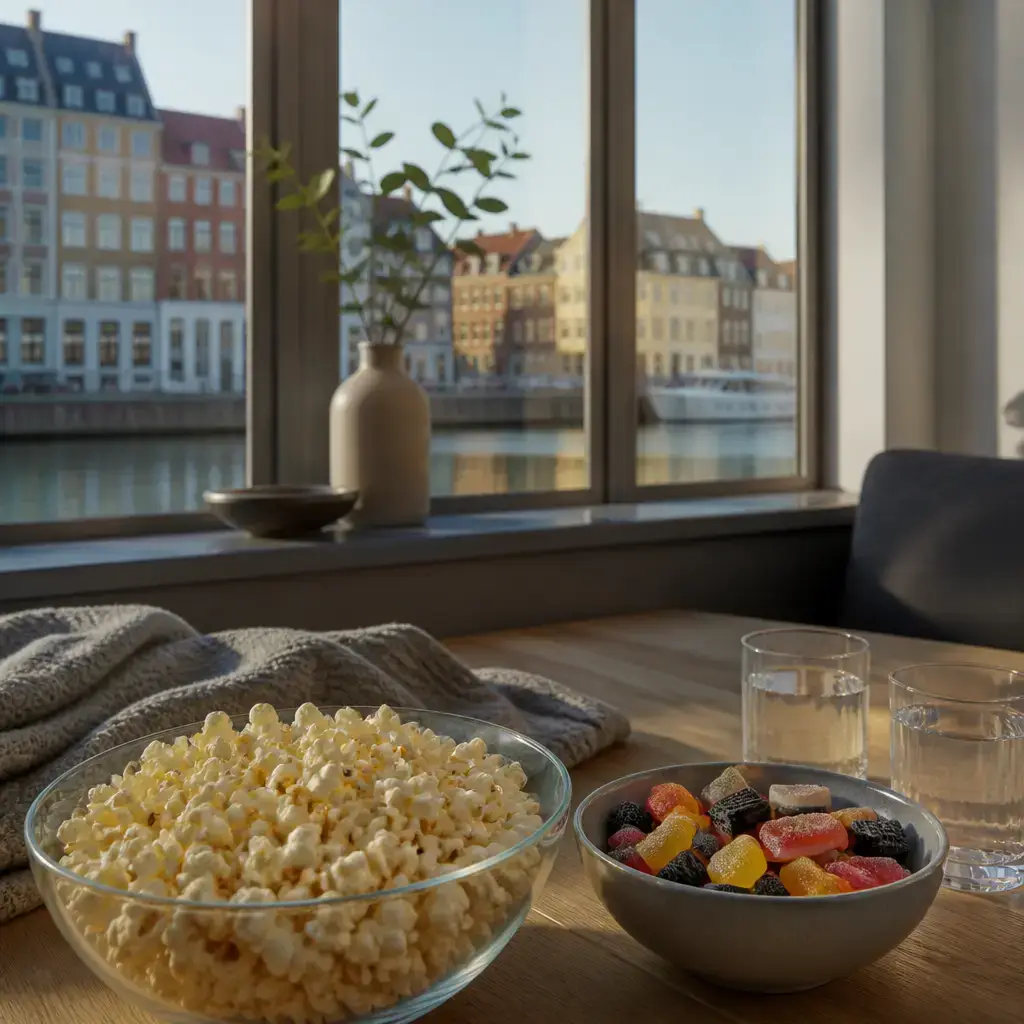
"Holen" means "get" in "Holen wir uns einen Snack, bevor der Film beginnt." It makes a suggestion for the group to get a snack before the film starts. The verb-first form with "wir" is useful for proposing a joint action.
einen
"einen" means "a" or "one" in "einen Snack." It introduces one snack as the thing the friends plan to get. It appears directly before the singular object of the action.
Snack
"Snack" means "snack" in "einen Snack." It refers to the food the friends plan to get before the movie begins. The word is useful when naming a small item of food bought or eaten between activities.
beginnt
"beginnt" means "starts" in "bevor der Film beginnt." It says that the film starts after the friends get a snack. The form appears at the end of the clause introduced by "bevor" and is used with "der Film" as its subject.